You’re thinking about buying a Bouncie GPS tracker. Smart move to research first. This post breaks down exactly how it works, what real users say, and whether it’s worth your money — no fluff, just the facts you need.
What Is the Bouncie GPS Tracker?
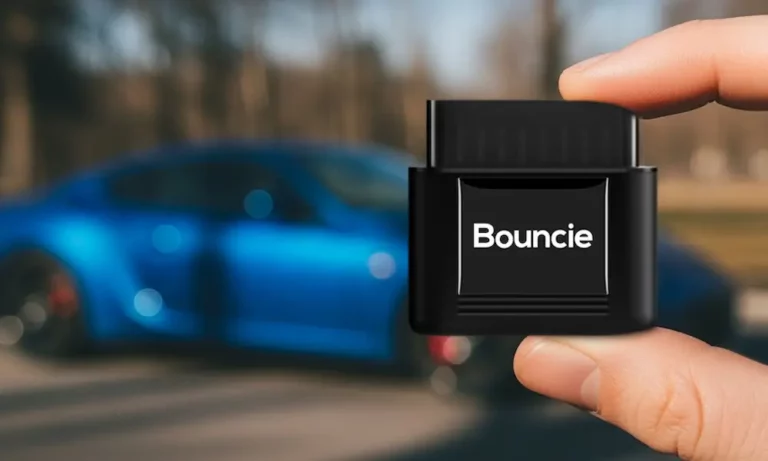
Bouncie is a plug-in GPS tracker that connects to your car’s OBD-II port — that diagnostic socket under your steering column. Every car sold in the US since 1996 has one.
Once plugged in, it tracks your vehicle’s location, driving behavior, and engine health in near real-time. The data streams straight to the Bouncie app on your phone.
No wiring. No tools. No electrician.
The hardware costs $89.99, and the monthly plan runs $9.00 per month — no contracts, no cancellation fees.
How Does Bouncie Actually Work?
The device pulls power directly from your car. It uses a 4G LTE cellular module to ping your vehicle’s location every 5 seconds while it’s moving.
Here’s the basic flow:
- Car starts → device wakes up
- GPS locks onto your position (56-channel receiver + GLONASS backup)
- Data transmits to Bouncie’s cloud servers every 15 seconds
- You see live updates in the app
If you drive through a dead zone, the device caches the data locally and uploads the full route once you’re back in coverage.
The device measures just 1.75″ x 1.875″ x 1.0″ and weighs 1.13 ounces. It sits nearly flush in the port and won’t interfere with your pedals.
Bouncie GPS Tracker Reviews: What Real Users Say
Bouncie’s reviews tell two very different stories depending on where you look.
The positive side:
On the Apple App Store, Google Play, and Amazon, Bouncie consistently scores between 4.6 and 4.8 out of 5 stars across thousands of reviews. Users love the simple setup, clean app interface, and low cost.
Some parents credit the crash detection feature with getting help to their teenager faster after a serious accident.
The critical side:
On Trustpilot, Bouncie averages just 2.1–2.2 out of 5 stars. The complaints cluster around a few specific issues:
- App sometimes lags or fails to update in real time during server outages
- Customer support leans heavily on chatbots and email — no phone support
- False crash alerts and occasional incorrect diagnostic codes
- Rural coverage gaps that turn the “live tracker” into a passive data logger
This split isn’t unusual for SaaS products. Happy users don’t typically write reviews — frustrated ones do. But the Trustpilot complaints reveal real edge cases you should know about before buying.
Key Features Worth Knowing About
Real-Time Location Updates
Bouncie’s 15-second refresh rate is one of the fastest in the consumer GPS market. Most competitors update every 60 seconds to 3 minutes. That difference matters when you’re tracking a teenage driver or dispatching a field crew.
Crash Detection and Emergency Alerts
The built-in accelerometer detects sudden deceleration consistent with a collision. When it triggers, Bouncie automatically sends an SMS with the exact GPS coordinates to your emergency contacts.
The app also prompts you to call 911 immediately.
This feature is included in the standard $9/month plan — not locked behind a premium tier.
You can set alert sensitivity to high (triggers at 8 mph/sec deceleration) or low (triggers at 14 mph/sec). That flexibility reduces false alarms on rough roads.
Geo-Zones (Geofencing)
Draw a digital boundary around any location — your home, a school, a job site. When the vehicle enters or exits, you get an instant push notification.
You don’t have to watch the app constantly. The system monitors in the background and only pings you when something changes.
Engine Diagnostics
Bouncie reads Diagnostic Trouble Codes (DTCs) directly from your car’s computer. Instead of a cryptic alphanumeric code, the app translates the issue into plain language so you understand what’s wrong and how urgent it is.
It also monitors your battery voltage and alternator output — so you get a warning before you’re stranded with a dead battery.
Teen Driver Monitoring
Parents can set custom speed limits and driving curfews. The app flags:
- Speeding beyond your set threshold
- Hard braking
- Rapid acceleration
- Movement outside approved hours
The trip history shows every route on Google Maps with the exact timestamp, distance, and any flagged driving events.
Smart Home Integration
Bouncie connects with Amazon Alexa, Google Assistant, and IFTTT. You can ask Alexa “Where’s my car?” or build automation workflows — like turning down your thermostat when the tracker confirms you’ve left home.
Bouncie vs. The Competition
Here’s a clear breakdown of how Bouncie stacks up against the main alternatives:
| Feature | Bouncie | Vyncs | Spytec GL300 | Apple AirTag | Enterprise (Samsara) |
|---|---|---|---|---|---|
| Power Source | OBD-II Port | OBD-II Port | Internal Battery | CR2032 Battery | Hardwired/OBD-II |
| Network | 4G LTE | 4G LTE | 4G LTE | Bluetooth Only | 4G/5G |
| Location Update | 15 seconds | 60 sec–3 min | 30 sec–3 min | Passive only | 1–5 seconds |
| Diagnostic Codes | ✅ | ✅ | ❌ | ❌ | ✅ |
| Crash Detection | ✅ | ❌ | ❌ | ❌ | ✅ (with dashcam) |
| Contract Required | None | 1-Year | None | None | Multi-Year |
| Monthly Cost | $9.00 | ~$7–8/mo (billed annually) | $15–30/mo | $0 | $25–45/mo |
Bouncie vs. Vyncs
Vyncs is Bouncie’s closest competitor. Both plug into the OBD-II port. Vyncs charges annually ($80–$100/year), which looks cheaper upfront. But the standard Vyncs tier only updates every 60–180 seconds. If you’re actively monitoring a driver or dispatching a crew, that’s a significant gap.
Bouncie’s app also gets consistently better usability reviews. Vyncs users frequently complain about a cluttered, confusing dashboard.
Bouncie vs. Battery-Powered Trackers (Spytec GL300)
Battery trackers offer one big advantage: you can hide them anywhere — under a bumper, inside cargo, on equipment. But the battery dies in 1–3 weeks depending on update frequency, and they can’t read engine data. Monthly costs run $15–30. Over three years, that’s significantly more than Bouncie.
Bouncie vs. Apple AirTag
AirTags cost $29 with no monthly fee. Sounds great until you understand how they actually work: they have no GPS and no cellular radio. They only update location when a random stranger’s iPhone passes within 30–50 feet of the tag. In a rural area or remote parking lot? Completely invisible.
AirTags are fine for finding lost luggage. They’re not a substitute for real-time vehicle tracking.
What It Costs Over Time
Three-year total cost of ownership comparison for a single vehicle:
Bouncie: $89.99 hardware + ($9.00 × 36 months) = $413.99
Average battery-powered tracker: $25 hardware + ($25 × 36 months) = $925.00
That’s over $500 in savings with Bouncie over three years — despite the higher upfront hardware cost.
For fleets with three or more vehicles, the monthly rate drops to $8.35 per vehicle. No activation fees. No cancellation fees. Cancel anytime.
Who Should Use Bouncie?
Parents of teen drivers — You get speed alerts, curfew monitoring, hard braking flags, and crash detection. All for $9/month.
Small business owners — Track field crews, verify job site arrival times, and audit fuel waste from excessive idling. The trip history data can resolve client billing disputes with timestamped GPS evidence.
Turo hosts — Bouncie is popular with peer-to-peer car sharing hosts who use it to document renter abuse and support damage reimbursement claims. The tamper alert fires immediately if a renter unplugs the device.
Former Hum by Verizon users — Verizon is shutting down all Hum services on December 31, 2025. Bouncie is the recommended replacement. Note: Bouncie doesn’t include Wi-Fi hotspots or physical towing dispatch — those Hum features don’t carry over.
Honest Limitations You Should Know
No off-engine tracking. If your car gets towed without starting the engine, Bouncie won’t track it moving. The device sleeps to protect your battery. You’ll see the last known parked location until the engine starts.
Easy to unplug. Anyone in the driver’s seat can pull the device out in two seconds. You’ll get a tamper notification, but the tracking stops immediately.
Rural coverage gaps. Bouncie runs on AT&T and T-Mobile networks. If your routes go through dead zones regularly, expect gaps in real-time tracking. The device caches data and catches up when coverage returns — but active monitoring breaks.
EV compatibility issues. Bouncie works with many EVs, but some platforms have problems. Volvo Recharge owners report false dashboard warnings after plugging in Bouncie. Tesla models that removed the OBD-II port entirely aren’t compatible. Check compatibility before buying.
Roadside assistance is gone. As of January 1, 2024, Bouncie discontinued its emergency roadside assistance program for new accounts. If you need towing and fuel delivery included, you’ll need a separate roadside plan.
The Bottom Line on Bouncie GPS Tracker Reviews
Bouncie is one of the most cost-effective real-time vehicle trackers on the market right now. The 15-second update rate, crash detection, engine diagnostics, and geofencing at $9/month genuinely deliver more than most competitors charge $20–30/month for.
It’s not perfect. Customer support frustrates users when things go wrong. Rural coverage limits real-time monitoring in dead zones. The exposed OBD-II location makes it easy to unplug. And EV owners need to double-check compatibility.
But for most families, small businesses, and independent fleet operators driving standard gas or hybrid vehicles? Bouncie delivers serious functionality at a price that’s hard to argue with.
The $89.99 hardware pays for itself fast — especially if one crash alert, one billing dispute, or one speeding notification avoids a bigger problem down the road.