Thinking about protecting your car with a Chemical Guys ceramic coating? Before you grab your wallet, you need to read this. Some products genuinely impress. Others? They’ll frustrate you more than a traffic jam on a Friday afternoon. This review breaks down every major product, benchmarks them against competitors, and tells you exactly what to buy — and what to skip.
What Is Chemical Guys, Really?
Chemical Guys started in Southern California in the late 1960s as a supplier for local car enthusiasts and detailing shops. Today, their products fill shelves at Walmart, Target, and AutoZone, backed by slick YouTube videos and vibrant, eye-catching packaging.
They’re brilliant at marketing. But marketing and chemistry aren’t the same thing.
The brand lowers the barrier to entry for car detailing, which is genuinely valuable. But professional detailers often push back hard on the brand’s product redundancy, inflated claims, and pricing structure.
So, what’s actually worth your money? Let’s dig in.
The “Label Engineering” Problem You Should Know About
Here’s something that’ll make you raise an eyebrow.
Chemical Guys sells an unusually large number of products. Detailers who’ve analyzed Material Safety Data Sheets found that many share identical base formulations — just different dyes and fragrances added.
This strategy is sometimes called “label engineering.” It maximizes shelf space and encourages you to buy separate products for overlapping tasks. For example, the brand sells distinct glass cleaners that vary only by manufacturing region, despite being chemically identical.
For professional detailers running high-volume operations, the math breaks down quickly. Chemical Guys products are mostly ready-to-use formulations. Professionals prefer bulk concentrates diluted with distilled water at a 10-to-1 ratio — far cheaper per application.
For casual weekend detailers? It’s less of a problem. But you deserve to know it exists.
Chemical Guys Ceramic Coating Reviews: Product by Product
Carbon Force Professional Ceramic Coating — The Real Deal
Carbon Force is the crown jewel of the lineup. Priced between $129 and $139 for a one-ounce kit, it’s Chemical Guys’ professional-grade liquid coating that actually earns its price tag.
What it promises:
- Up to 5 years of protection
- Extreme water-beading hydrophobicity
- UV resistance, scratch resistance, chemical resistance
What it actually delivers:
Carbon Force has a noticeably thick, almost gel-like consistency. It applies smoothly, flashes within 3–4 minutes, and bonds aggressively to the paint surface. Independent testing confirms it resists degradation through heavy washing and hard water pressure tests.
The catch? Prep work is non-negotiable. Your car needs a thorough wash, clay bar decontamination to pull out embedded iron, and machine polishing before you apply this. Skip those steps, and Carbon Force will permanently lock in every swirl mark and scratch.
Miss the leveling window before it cures? You’re looking at machine compounding to fix stubborn high spots. It also requires gloves and safety goggles — a sign this is serious chemistry.
Practical durability sits between 2 to 4 years — slightly below the 5-year claim, but still impressive. For a DIY liquid ceramic coating, this is the most legitimate product in the entire Chemical Guys catalog.
Verdict: Buy it — if you’re willing to do the prep work properly.
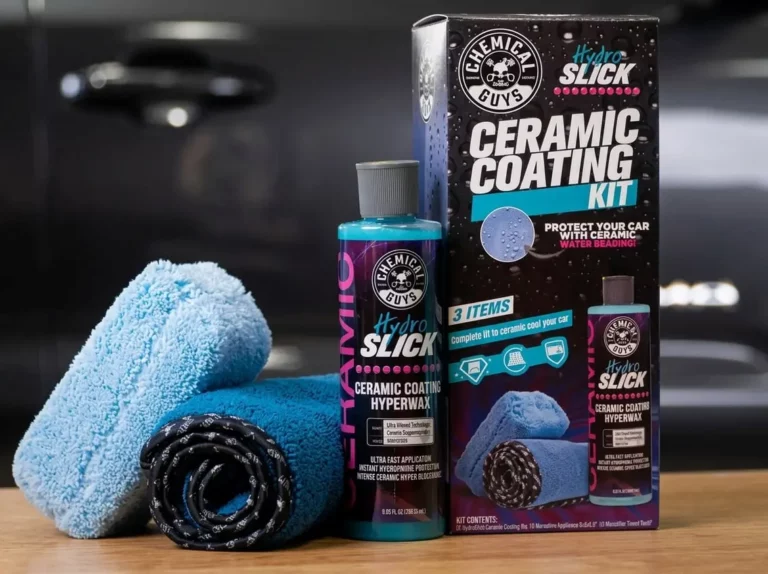
HydroSlick Ceramic HyperWax — Skip It
HydroSlick is one of the most heavily marketed products in detailing. It’s also one of the most disappointing.
Priced around $39 for 16 ounces, it’s sold as a “HyperWax” — a gel that bridges the gap between a nano-coating and a traditional paste wax. Despite the branding, there’s no carnauba wax in it. It’s a silicon dioxide gel suspension.
The application nightmare:
HydroSlick is exceptionally grabby. Users consistently describe dragging resistance across the paint surface — think smeared, cottage-cheese-like blue paste across your hood. If the car is even slightly warm or in indirect sunlight, the gel bakes onto the paint almost immediately, requiring a quick detailer just to remove the residue without scratching anything.
The longevity problem:
Chemical Guys advertises 12 months of protection. Real-world testing shows water beading turns lazy within 3 weeks. After one heavy rainstorm or a few regular washes, the gloss visibly fades. Practical longevity is closer to 3–6 weeks — not months.
Professional detailers overwhelmingly advise against it due to the brutal application process, severe streaking potential, and genuinely poor return on investment.
Verdict: Hard pass. For $39, you’ll find far better options.
HydroCharge Ceramic Spray Coating — Decent, But Overpriced
HydroCharge is Chemical Guys’ answer to the spray sealant market. Priced at $39–$55 for 16 ounces, it’s significantly easier to apply than HydroSlick.
Spray it onto a microfiber towel or directly onto a panel, spread evenly, buff away. Apply too much, and you’ll get patchy results that need re-wiping.
Real-world protection lasts 3–6 months depending on weather exposure and wash frequency. It works well as a maintenance booster over an existing Carbon Force installation.
The problem? At that price point, competitors outperform it convincingly. More on that below.
Verdict: It works. It’s just expensive for what you get.
HydroSpeed Ceramic Quick Detailer — Surprisingly Good for Its Job
HydroSpeed retails around $24 and functions as a ceramic quick detailer — not a base layer of protection. It uses a diluted silicon dioxide blend with synthetic lubricating polymers.
It’s designed to:
- Remove light dust, fingerprints, and fresh water spots between washes
- Enhance existing gloss
- Work as a drying aid to prevent micro-scratching
Consumer satisfaction is genuinely high. It flashes quickly, leaves a reflective wet-look finish, and adds lubrication during drying. Some users note the scent is strong and industrial, but results are consistent.
Professionals acknowledge it performs its intended function reliably. Their criticism? Paying $24 for a 16-ounce bottle of heavily diluted spray is poor value.
Verdict: It’s good at what it does. Just don’t expect miracles.
Complete Product Comparison
| Product | Format | Advertised Longevity | Practical Longevity | Verdict |
|---|---|---|---|---|
| Carbon Force | Liquid Nano-Ceramic | Up to 5 Years | 2–4 Years | Best in lineup. Prep required. |
| HydroSlick | Gel HyperWax | Up to 12 Months | 3–6 Weeks | Avoid entirely. |
| HydroCharge | Spray Sealant | Up to 12 Months | 3–6 Months | Works, but overpriced. |
| HydroSpeed | Quick Detailer | Maintenance Only | 1–2 Weeks | Solid for light touch-ups. |
Specialty Products: Wheels, Interiors, and Trim
HydroSpin Wheel Coating
Wheels endure extreme heat, brake dust, and road grime — the harshest conditions of any exterior surface. HydroSpin addresses this at around $20.
The spray format handles complex wheel spokes well. It does make maintenance washing faster by allowing water to sheet away brake dust. Durability in extreme brake heat is limited, though — expect to reapply every 2–3 washes.
Verdict: Useful but requires frequent reapplication.
Interior Ceramics: HydroInterior, HydroLeather, HydroThread
These products retail between $22 and $40 and bring the “ceramic” label inside your car. They promise dust repulsion, UV protection, and hydrophobic barriers for cloth, leather, and plastic surfaces.
The professional community is deeply skeptical. Traditional interior protectants achieve identical UV protection and anti-static results for a fraction of the cost. The silicon dioxide inclusion is largely viewed as a price-justification marketing mechanism.
More concerning: multiple users report that prolonged use of these interior sprays builds up a stubborn white powdery residue on dark dashboards that’s extremely difficult to remove.
Verdict: Skip. Traditional interior protectants do the same job cheaper.
HydroSuds Ceramic Car Wash Soap
HydroSuds is a pH-neutral ceramic-infused car wash soap priced at $20–$27 for 16 ounces. It produces thick foam and feels luxurious in a foam cannon setup.
The issue? Many professionals report that HydroSuds leaves a streaky film on paint and glass if not rinsed immediately — especially in warm weather. The active protective agents bond unevenly when they dry on the surface.
Most detailers prefer additive-free soaps like CarPro Reset or Optimum No Rinse for coated vehicles, arguing that washing and protecting should be separate steps.
Verdict: Nice foam, but the streaking issue is a real problem.
How Chemical Guys Compares to Competitors
This is where the picture gets uncomfortable for Chemical Guys fans.
Budget Retail Competitors
Turtle Wax Hybrid Solutions Ceramic Spray costs $15–$20 and consistently outperforms HydroCharge and HydroSlick in durability torture tests. It delivers genuine 6–12 months of water-beading, resists multiple heavy detergent washes, and applies effortlessly. Users actively switch from Chemical Guys after comparing results side by side.
Meguiar’s Hybrid Ceramic Wax does something clever — you apply it to a wet vehicle after washing, then rinse off immediately. The entire process takes minutes. Compared to HydroSlick, Meguiar’s provides longer protection (4–6 months) with essentially zero effort.
Premium and Professional Competitors
Nexgen Ceramic Spray contains a 13% silicon dioxide concentration. Most mass-market retail sprays, including HydroCharge, run at 1–2%. That concentration difference translates to 6–7 months of genuine protection from a $35 bottle that coats a mid-size vehicle 4–6 times.
Undrdog Pro takes a different approach entirely, using polytetrafluoroethylene (PTFE), silicon, and paraffin instead of traditional silicon dioxide. It lasts 1–8 years depending on maintenance. Uniquely, it’s safe to apply in direct sunlight — something Carbon Force and HydroSlick absolutely cannot handle.
Gtechniq Crystal Serum Light is the professional industry benchmark. It measures 9H on the pencil hardness scale and outlasts Carbon Force in harsh climates with road salt, acidic bird droppings, and industrial fallout.
Adam’s Polishes Advanced Graphene Coating adds an ultraviolet tracer to the liquid. Shine a UV flashlight during application and the coating glows, ensuring you don’t miss spots or leave uneven high spots. That’s a genuinely clever engineering solution that Carbon Force simply doesn’t offer.
Competitor Benchmark Summary
| Brand | Product | Price Range | Key Advantage Over Chemical Guys |
|---|---|---|---|
| Turtle Wax | Hybrid Solutions Spray | $15–$20 | Better durability, much lower cost |
| Meguiar’s | Hybrid Ceramic Wax | $20–$25 | Wet-application method, zero-effort use |
| Nexgen | Ceramic Spray | ~$35 | 13% SiO2 concentration vs. 1–2% |
| Undrdog | Undrdog Pro | $40–$60 | PTFE formula, safe in direct sunlight, up to 8 years |
| Gtechniq | Crystal Serum Light | $60–$80 | Industry benchmark, 9H hardness |
| Adam’s Polishes | Graphene Coating | $150+ | UV tracer for foolproof application |
The “Ceramic” Word Problem
Here’s a broader issue worth understanding.
Chemical Guys — alongside other retail brands — has diluted the word “ceramic” significantly. They’ve attached it to spray sealants, quick detailers, leather conditioners, and interior cleaners with trace amounts of silicon dioxide.
True ceramic coatings once referred strictly to professional-grade liquid polymers with high silicon dioxide concentrations, requiring days to cure into a rigid, semi-permanent glass-like shell.
Now consumers struggle to tell the difference between a $30 spray that washes off in 3 months and a $1,000 professional installation lasting 5 years. Both get called “ceramic.”
This creates a dangerous secondary problem. Buyers who trust the 12-month longevity claim on HydroSlick or HydroCharge stop maintaining their vehicle, believing it’s protected. When the coating degrades in 3–6 weeks, environmental contaminants sit on exposed paint — etching into the clear coat and causing permanent, costly damage.
The false sense of security is arguably worse than no protection at all.
Who Should Actually Buy Chemical Guys Ceramic Products?
Chemical Guys genuinely serves a purpose. For someone who’s never detailed a car before, products like HydroSpeed and HydroCharge offer a satisfying, low-stakes introduction to paint protection.
The problem is the gap between expectation and reality. Beginners often mistake the initial gloss and slickness for long-term durability. When water stops beading after a month, they assume it’s time for more product — not that the product failed its own claims.
Here’s the honest breakdown:
- You’re a complete beginner → Start here, but don’t expect Carbon Force longevity from HydroSlick.
- You detail your car monthly and want easy maintenance → HydroSpeed is fine.
- You want the best spray sealant for the money → Buy Turtle Wax Hybrid Solutions or Nexgen instead.
- You want serious long-term paint protection → Carbon Force is legitimate, but only with proper prep. Alternatively, look at Undrdog Pro or Gtechniq.
- You run a detailing business → Chemical Guys ready-to-use formulas will eat your profit margins. Move to bulk concentrates.
The brand’s real value is as a gateway. Once beginners experience the satisfaction of hand washing and ceramic coating, they eventually discover the longevity shortcomings and graduate to better products. Professional detailers indirectly benefit from this funnel every time a Chemical Guys fan walks into their shop wanting “the real stuff.”
Just make sure you don’t overpay for flashy packaging when better chemistry sits right next to it on the shelf — often for less money.