
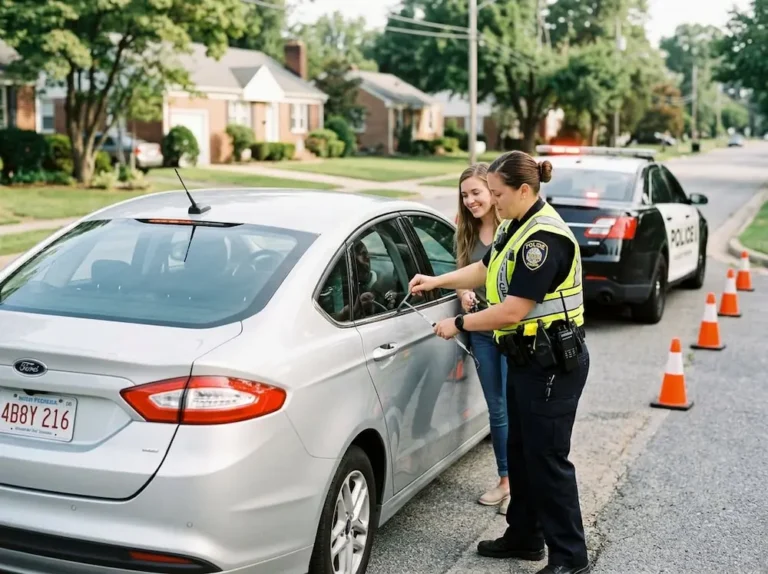
Locked your keys in the car? Your first thought might be to call the police. That used to work great. Not anymore.
Most police departments today won’t unlock your car for free unless someone’s life is at risk. This guide breaks down why, when cops will still help, and what you should actually do when you’re standing outside your car staring at your keys through the window.
Why Police Stopped Unlocking Cars for Free
Cops used to carry a thin metal tool called a “slim jim” to pop open car doors in seconds. It worked because old car doors were basically hollow metal boxes with simple rods inside.
That’s not how cars work anymore.
Modern doors are packed with wiring, sensors, and airbag mechanisms. Jam a metal tool in there blindly, and you risk triggering a side airbag deployment. That’s not a minor oops. It can injure the officer, blow out thousands of dollars in interior parts, and open the department up to a lawsuit.
So departments made a simple choice: stop carrying the tools, stop taking the risk.
What Changed Inside Your Car Door
Here’s a quick side-by-side of how much car doors have changed:
| Vehicle Era | Door Design | Police Tool Used | Damage Risk | Typical Policy |
|---|---|---|---|---|
| Pre-1990s | Hollow, simple metal rods | Slim jim | Very low | Free, routine service |
| 1990s-2000s | Anti-theft barriers, plastic trim | Various tools, less effective | Moderate | Departments start pulling back |
| Today | Airbags, sensors, wiring harnesses | None carried by police | Extremely high | Emergencies only |
Car makers added these features to stop thieves and protect you in crashes. Good news for safety. Bad news for anyone hoping an officer will pop their door for free.
Cities Have Officially Ended the Service
Big city departments have made this policy crystal clear. The Philadelphia Police Department flat-out states officers won’t respond to routine lockout calls. Staffing is tight. Call volumes are high. Sending an officer to a locked, empty car for 20-30 minutes means someone else waits longer for a real emergency.
The Saint Paul Police Department in Minnesota goes even further. Their official policy bans all personnel from carrying door-opening tools, period. No sworn officers, no supervisors, nobody. If there’s no danger to a person, they’re required to decline and walk away.
This isn’t a random city being difficult. It’s the new normal almost everywhere.
Small Towns Might Still Help (Sometimes)
Rural and small-town police departments are a different story. With fewer emergency calls competing for attention, some officers still help out as a favor to the community.
But don’t count on it. Even in small towns:
- The officer decides on the spot whether to try
- Newer cars with airbags and electronics usually get a hard pass
- You’ll likely need to sign a liability waiver first
It’s a courtesy, not a guarantee.
When Police Will Actually Show Up
Here’s where the policy flips completely. If there’s a real danger to life, police respond fast and skip the fancy tools altogether.
Situations that trigger emergency response:
- A child locked inside, any weather
- An elderly or disabled person who can’t unlock the door themselves
- A pet showing signs of heat distress
- A running car in a closed garage (carbon monoxide risk)
In these cases, officers don’t try to pick the lock. They break the window. Fast.
Why? Because car interiors heat up terrifyingly quickly. Temps inside a parked car can climb 20 degrees in just 10 minutes. Even on a mild 70-degree day, the inside can hit over 100 degrees within an hour. Kids and pets can’t regulate their body heat like adults, so minutes matter.
When it’s truly urgent, glass is cheap compared to a life.
How 911 Dispatchers Decide What Counts as an Emergency
Before an officer ever shows up, a 911 dispatcher screens your call using strict protocols set by groups like APCO and NENA. They ask specific questions to figure out if this is a true emergency or just an inconvenience.
Here’s roughly how that plays out:
| Situation | Priority Level | What Happens |
|---|---|---|
| Empty car, legally parked | Routine (non-emergency) | Dispatcher declines, suggests a locksmith |
| Car blocking traffic | Low-medium priority | Officer sent for traffic control only |
| Pet in hot car, signs of distress | High priority | Police and/or animal control dispatched fast |
| Child locked inside | Critical priority | Police, fire, and EMS all sent immediately |
Dispatchers legally can’t recommend a specific locksmith or towing company either. That’s to avoid favoritism claims. So don’t expect a referral, just a “call a locksmith” and a dial tone.
If Police Do Help, Expect a Waiver
In the rare cases where a small-town department agrees to try unlocking your car, you’ll almost always need to sign a liability waiver first.
This document usually states that:
- The officer is not a trained locksmith
- There’s no guarantee they’ll succeed
- You accept responsibility for any damage to locks, airbags, paint, or trim
Legal experts note these waivers aren’t bulletproof protection for the department. If something goes seriously wrong, lawsuits can still happen. That’s actually one more reason departments would rather skip the whole thing entirely.
What About Rescuing a Pet or Child Yourself?
If you spot a child or animal in serious danger and can’t wait for police, many states now protect you legally if you break in to help.
More than 26 states have passed Good Samaritan laws specifically for hot car rescues. States like Arizona, California, Colorado, and Florida extend this protection to pets and vulnerable adults too.
But you can’t just smash a window on a whim. To stay protected, you generally need to:
- Confirm the person or animal is genuinely in danger
- Check that the doors are actually locked (no easier way in)
- Call 911 before breaking in
- Use only the force needed, like breaking one window, not five
- Stay with them until help arrives
Skip any of these steps, and you could lose your legal protection and face damage claims.
Your Real Options When You’re Locked Out
Since police assistance is mostly off the table now, here’s what actually works:
Call a professional locksmith. They carry tools like inflatable air wedges and non-marring rods designed specifically to avoid triggering airbags or damaging wiring. Costs money, but it’s fast and safe.
Use your roadside assistance plan. Many auto insurance and membership programs cover lockout service as part of your monthly fee.
Check your car’s app. This is the real game-changer. Apps like Ford’s FordPass, Hyundai’s Bluelink, and GM’s OnStar let you unlock your car remotely from your phone. No tools, no waiting, no cost beyond what you already pay for the service.
Try a spare key. Simple but often overlooked. Keep a spare with a trusted family member or in a lockbox at home.
Final Thoughts
So, do the police unlock your car for free? In almost every case today, the answer is no. Modern car doors are too complex, too full of sensitive electronics, and too risky for officers to mess with over a routine lockout.
Police still show up fast when a life is actually at risk, like a child or pet trapped in a hot car. But for the everyday “I locked my keys inside” moment, you’re on your own.
The good news? You’ve got better options now anyway. A locksmith, roadside assistance, or your car’s own app can solve the problem faster than waiting for a squad car ever could. Keep a spare key handy, download your car’s app, and you’ll probably never need to worry about this again.


