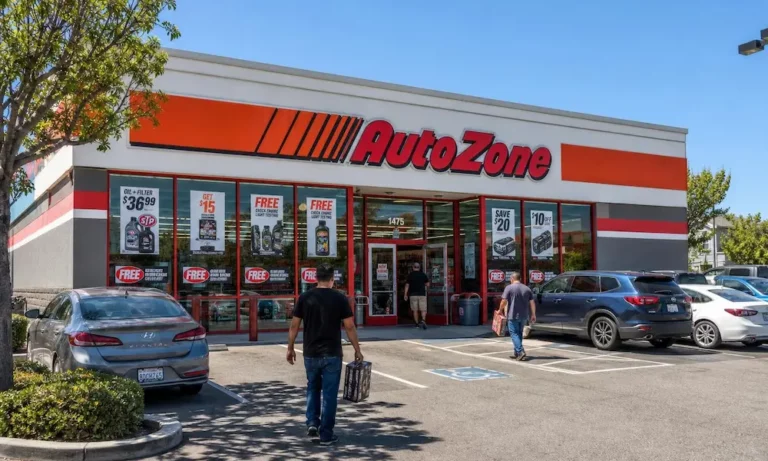
Your check engine light just came on. Your stomach drops. Before you panic about a massive repair bill, you’re probably wondering if AutoZone can tell you what’s wrong — for free. Good news: they can help, but there are real limits you need to know. Read to the end so you don’t waste a trip or make an expensive mistake.
Yes, AutoZone Does Free Diagnostics — Here’s How It Works
AutoZone offers a free diagnostic service called Fix Finder. An associate plugs a handheld scanner into your car’s OBD2 port — that’s the universal diagnostic socket under your dashboard. The scanner reads your check engine light codes, ABS codes, and maintenance system data in about four to five seconds.
You get a printed report listing the trouble codes and the most likely fixes for your specific vehicle. AutoZone pulls this data from millions of real-world repairs verified by certified technicians.
It’s not a full mechanical diagnosis. It’s a strong starting point that costs you nothing.
What the Scanner’s Indicator Lights Mean
When the associate plugs in the reader, three colored lights give you an instant snapshot:
- Green (checkmark): All systems are running clean. No fault codes present.
- Yellow (question mark): Monitors haven’t finished self-testing yet, or a pending code exists. Usually happens after a battery disconnect.
- Red (X): A hard fault is confirmed. Your check engine light is on for a real reason.
If the screen stays completely blank, you likely have a blown interior fuse killing power to your diagnostic port.
What the Free Diagnostic Report Actually Tells You
The raw code AutoZone pulls is just a five-character string like P0420 or P0171. That alone doesn’t tell you much. What makes the Fix Finder service useful is what happens next.
You give the associate your vehicle’s year, make, model, engine size, and mileage. They upload the code into AutoZone’s system. The database cross-references your exact vehicle against repair records from millions of similar cars and spits out the most statistically likely fix.
You walk out with a printed report and a digital copy. That’s your roadmap — whether you fix it yourself or take it to a shop.
Common Codes AutoZone Catches
Here’s a breakdown of the trouble codes that show up most often during a free scan:
| Code | What It Means | Likely Cause |
|---|---|---|
| P0300 | Random misfire detected | Worn spark plugs, bad ignition coil, vacuum leak |
| P0420 | Catalytic converter efficiency low | Failed cat, unresolved misfires |
| P0171 | System running too lean | Faulty O2 sensor, clogged injector, vacuum leak |
| P0128 | Coolant below operating temp | Thermostat stuck open |
| P0442/P0456 | Evap system leak detected | Loose or bad gas cap |
| P06DD | Oil pressure control stuck off | Low oil pressure — serious, stop driving |
For a full breakdown of what OBD2 codes mean, AutoZone has a detailed guide worth bookmarking.
Steady vs. Flashing Check Engine Light — Know the Difference
This part matters. A lot.
A steady check engine light means something’s wrong, but you can usually drive a short distance without destroying anything. Get it scanned soon.
A flashing check engine light is a crisis. It almost always means a severe active misfire. Raw unburned fuel is hitting your catalytic converter and igniting inside it. You can destroy your catalytic converter in minutes this way — and that’s a $1,000+ repair on top of whatever caused the misfire.
If your check engine light is blinking, pull over. Don’t keep driving to the AutoZone.
Free Electrical Testing — Not Just Code Reading
AutoZone’s free diagnostics go beyond your check engine light. They also test the three core components of your starting and charging system at no cost.
Battery Load Testing
A battery showing 12 volts at rest might completely collapse the moment you try to start the engine. AutoZone’s free battery testing applies an artificial electrical load that mimics the current draw of your starter motor. If the voltage drops and doesn’t recover, the battery’s chemically dead.
If it’s just depleted, they’ll charge it for free — usually 30 minutes to a few hours depending on battery type. If it fails the test, you need a new one.
Alternator Testing
A bad alternator drains your battery while you drive, eventually leaving you stranded. AutoZone tests your alternator while it’s still in the vehicle. They connect a diagnostic tool to your battery terminals with the engine running and check output voltage.
A healthy charging system reads between 14 and 14.5 volts. They’ll also crank up your AC, headlights, and rear defroster to simulate heavy load and see if the alternator keeps up. If voltage sags below your battery’s resting level, the alternator is failing.
Starter Motor Testing
If your starter clicks once and nothing happens, or your engine won’t crank despite a good battery, the starter may be dead. AutoZone tests starters on a bench inside the store — but you need to remove it from the vehicle first and bring it in.
One important note: If you’re in California, starter and alternator testing isn’t available at retail locations. Battery testing and charging is limited to inside the store only. State regulations on what counts as “automotive repair” make certain services unavailable there.
Can AutoZone Clear Your Check Engine Light?
Technically, their scanners can. In practice, they won’t.
AutoZone employees are prohibited from erasing trouble codes by both corporate policy and federal environmental law. Here’s why this actually protects you.
Clearing an OBD2 code resets all your vehicle’s internal readiness monitors. If you drive to an emissions inspection right after, the testing equipment detects the incomplete monitors and you automatically fail — even if your car runs perfectly.
Worse, federal environmental agencies have run sting operations on retail parts stores for clearing codes without verified repairs. Penalties can hit $10,000 per violation. AutoZone isn’t going to risk that for you.
There’s also a practical reason not to want your code cleared without a real fix: when your car sets a fault, it captures “freeze frame” data — every sensor reading at the exact moment the fault occurred. Clear the code without fixing anything, and that data is gone forever. Your mechanic loses the best clue they had.
How to Reset Your Check Engine Light Yourself
If you’ve actually fixed the problem and want the light off, here are your options:
- Use an OBD2 scanner: Buy a basic reader or borrow one. Ignition on, engine off. Select erase. Done.
- Disconnect the battery: Remove the negative cable, wait 15 minutes. Works, but you’ll lose radio presets and the engine’s learned idle settings.
- Pull the ECM fuse: Same result as the battery disconnect, with a risk of pulling the wrong fuse.
- Complete a drive cycle: The best option. Drive a mix of city and highway. If the fix was real, the computer clears the light itself.
Borrowing Tools You Can’t Afford to Buy
Here’s one AutoZone service most people don’t know about: the Loan-A-Tool program.
Need a strut spring compressor, a ball joint separator, or a brake caliper wind-back tool? These specialty tools cost hundreds of dollars for a job you might do once. AutoZone stocks nearly 100 specialty tools you can borrow for free.
The process is simple. You pay a deposit equal to the tool’s full retail price. You use it. You return it within 90 days in good condition. You get every dollar back.
No daily rental fees. No rush. If a complex repair takes a week, that’s fine. And if you decide the tool is worth keeping permanently, just don’t return it — you already paid for it.
What AutoZone Won’t Do
Free diagnostics have clear boundaries, and knowing them saves you frustration.
Code erasure: As covered above, they won’t clear your codes. State laws in California and Hawaii are especially strict — code reading itself may be limited or unavailable at some locations.
Fuse box troubleshooting: Associates won’t lean into your car to pull and test individual fuses. Automotive electrical systems are complex, and if an employee accidentally kills your anti-theft system or disables a module, that’s a lawsuit. They’ll sell you a test light and the fuses — you do the pulling.
Complex battery installations: AutoZone offers free battery installation as a courtesy, but it’s not guaranteed. If your battery sits inside a wheel well, under trunk panels, or buried beneath intake ducting, an hourly retail employee isn’t removing engine components to get to it. Modern vehicles with battery management systems also need a computerized recalibration after installation — something retail tools can’t do.
AutoZone Battery Warranties at a Glance
If you do end up buying a battery after your free test, here’s how the warranties stack up:
| Battery Tier | Type | Free Replacement Period |
|---|---|---|
| Duralast ProPower Elite | AGM | 5 Years |
| Duralast ProPower AGM | AGM | 4 Years |
| Duralast Gold/Ultra | Premium Flooded | 3 Years |
| Duralast Plus/Standard | Standard Flooded | 1–2 Years |
| Optima Red/Yellow Top | Spiral Cell AGM | 2 Years |
| Odyssey | Advanced AGM | 3–4 Years |
| Econocraft | Economy | 30–90 Days |
AutoZone registers your warranty to your phone number automatically. You don’t need the receipt to make a claim at any location nationwide. Warranties don’t transfer if you sell the vehicle.
The Bottom Line on AutoZone’s Free Diagnostics
AutoZone’s free diagnostic service gives you real, useful information — fast and at zero cost. The Fix Finder scan identifies your trouble codes, suggests the most likely fixes based on real repair data, and helps you walk into any shop conversation with knowledge instead of anxiety.
Pair that with free battery, alternator, and starter testing, and AutoZone functions as a solid first stop before any repair decision. Just remember: a code is a starting point, not a verdict. A P0420 code doesn’t automatically mean you need a catalytic converter — it means your system flagged an efficiency issue that needs investigation.
Use the free scan. Read the report. Then decide whether this is a DIY fix with a borrowed specialty tool or a job for a certified mechanic.