
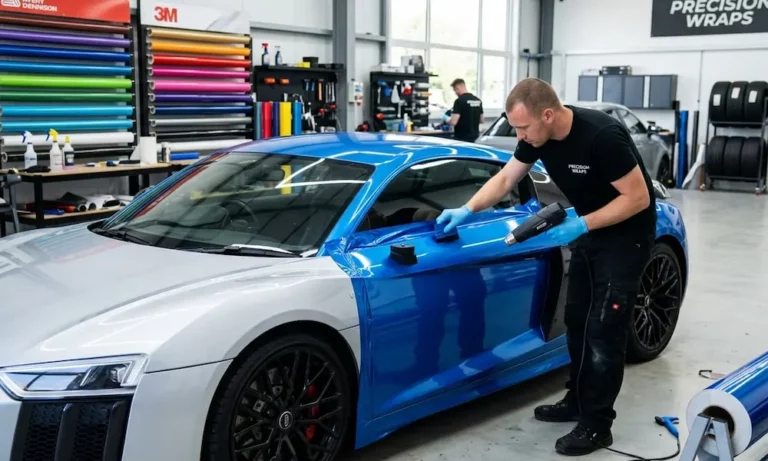
Worried a vinyl wrap will ruin your car’s finish? It’s a fair concern — and the answer isn’t just a flat “no.” The real answer depends on a handful of factors that most wrap shops won’t tell you upfront. Read to the end, and you’ll know exactly what protects your paint and what destroys it.
The Short Answer: No — But Only Under the Right Conditions
A premium cast vinyl wrap doesn’t damage car paint. In fact, it does the opposite — it shields your factory clear coat from UV rays, chemical damage, and minor road debris.
But here’s the catch: that’s only true when:
- You’re using quality cast film (not cheap calendered vinyl)
- The paint underneath is healthy and fully cured
- A certified professional does the install
- You remove it before it expires (within 5–7 years)
Miss any of these, and yes — you can absolutely damage your paint. Let’s break down exactly why.
Your Paint Type Matters More Than You Think
Factory Paint: The Gold Standard for Wrapping
Factory paint goes through a multi-layer process — electro-coat primer, color coat, and clear coat — all baked at extreme industrial temperatures. That curing process creates an incredibly strong bond between each layer.
When a wrap’s adhesive bonds to your clear coat, it grips the surface — not the structure. Because the factory paint’s internal bond is far stronger than the wrap’s adhesive, the film peels away cleanly when it’s time to remove it. No delamination. No drama.
Repainted or Damaged Paint: High Risk Territory
Aftermarket repaints can’t be cured at the same temperatures as factory jobs — the car’s plastics and electronics would melt. That means weaker interlaminar bonds between the layers.
If a wrap goes over a poor repaint, removal can pull up the clear coat or color coat — still attached to the discarded vinyl. That’s not the wrap’s fault. It’s the weak paint underneath giving way.
Flaking or oxidized paint is even worse. The adhesive bonds to the loose particles, not the stable panel. When the wrap comes off, it takes those flakes with it — and more.
| Paint Condition | Delamination Risk |
|---|---|
| Healthy factory paint | Extremely low |
| Professional aftermarket repaint | Low to moderate |
| Failing or flaking paint | Near certain |
| Fresh, uncured paint | Critical — avoid wrapping |
The Outgassing Trap With Fresh Paint
Fresh paint releases solvents as it cures — a process called outgassing. This takes 3–4 weeks after a repaint. Wrap a car too early, and those trapped solvents create bubbles under the film and chemically fuse the adhesive to the soft clear coat.
Before wrapping a recently repainted car, professionals test for outgassing by pressing a thumbnail into the paint (soft = not ready) and applying a small film patch for 24 hours. Bubbles mean wait longer.
Cast vs. Calendered Film: This Choice Can Make or Break Your Paint
Cast Film: Built for Cars
Cast film starts as a liquid mixture — PVC, plasticizers, pigments — poured onto a carrier sheet and oven-cured. No mechanical pressure. No internal stress. The result? A film with zero molecular memory, meaning it holds whatever shape you stretch it into after post-heating.
That’s critical for modern car shapes with deep recesses, compound curves, and tight body lines. Cast film stays put. Edges don’t lift. Moisture doesn’t sneak under. Paint stays protected.
Quality cast films from major manufacturers last 5–7 years and use removable adhesives specifically engineered to release cleanly from factory clear coat.
Calendered Film: Fine for Flat Surfaces, Dangerous for Cars
Calendered film is made by forcing a solid dough-like PVC mass through heavy steel rollers. That process creates significant internal stress. The film “wants” to shrink back to its original flat shape — especially in heat.
On a vehicle with curves? That shrinkage will eventually overpower the adhesive. Edges lift. Water and road salt get trapped against exposed paint. Rust forms. And when the adhesive on cheaper films ages, it can leave aggressive residue or pull weak clear coat right off.
| Feature | Cast Film | Calendered Film |
|---|---|---|
| Internal stress | None | High — film tries to shrink |
| Conformability on curves | Excellent | Poor |
| Paint damage risk | Very low | High on complex vehicles |
| Lifespan | 5–7 years | 1–3 years on vehicles |
| Best for | Full car wraps | Flat signage, box trucks |
Actually, Vinyl Wraps Protect Your Paint
A quality wrap isn’t just “not harmful” — it actively protects your factory finish.
UV protection: Cast films block 95–98% of UV radiation from reaching your clear coat. Cars unwrapped after years often reveal paint that’s dramatically more vibrant than identical unprotected vehicles.
Rock chip and abrasion defense: The pliable PVC absorbs and disperses light impacts. It also eliminates swirl marks during washing — because the film takes the micro-scratching, not your paint.
Chemical and biological barriers: Bird droppings, tree sap, and insect proteins can etch factory clear coat in hours on a hot day. The wrap absorbs the damage instead. You replace the film, not the paint.
Installation Mistakes That Actually Damage Paint
The film itself is safe. Human error is not. These two installation mistakes cause the most paint damage.
Direct Blade Cutting
An untrained installer using a razor blade with too much extension — or too much pressure — cuts straight through the vinyl and into your clear coat. You won’t see it while the wrap is on. But moisture seeps into those cuts over time. When the wrap comes off, you find deep linear paint damage that can rust right through to bare metal.
The professional solution? Knifeless tape. A high-strength filament embedded in adhesive tape is laid on the paint before wrapping. The installer pulls the filament to cut the film from below — a metal blade never touches the paint.
Overusing Adhesion Promoters
Adhesion promoters (like 3M Primer 94) are designed for low-energy surfaces like unpainted plastic bumpers. When inexperienced installers use them carelessly on painted surfaces, the chemical bond they create can exceed the paint’s own interlaminar strength.
Result? When removal time comes, the clear coat comes up with the wrap. A properly trained installer using quality cast film on healthy factory paint almost never needs adhesion promoter.
How Long Your Wrap Lasts — And Why Timing Matters
Lifespan by Finish Type
| Wrap Finish | Expected Lifespan |
|---|---|
| Standard gloss | 5–7 years |
| Matte or satin | 3–5 years |
| Carbon fiber (textured) | 5–7 years |
| Chrome / reflective | 1–3 years |
| Fluorescent / neon | 6–12 months |
Hot climates cut these timelines significantly. In sun-heavy states like Arizona, Texas, or Florida, UV exposure can reduce lifespan by up to 50% for cars parked outdoors daily.
What Happens When You Leave It Too Long
This is where most DIY wrap horror stories come from. Sun-baked vinyl loses its plasticizers and becomes brittle. The adhesive hardens and chemically fuses to the clear coat.
When you try to remove it? The film shatters into fragments. The hardened adhesive pulls up the paint with it. Damage that could have been avoided with timely removal now requires panel repainting.
The rule: Remove at the first sign of cracking edges, severe fading, or brittleness. Don’t wait until structural failure.
Wrap Maintenance: What You Must Never Do
Skip the Automatic Car Wash
Brush-style automatic washes are a hard no. Spinning nylon bristles scratch gloss finishes and permanently alter matte textures. The spinning force also catches tucked edges and lifts panels.
Hand wash every two weeks with a pH-neutral automotive shampoo and soft microfiber mitts. Wash top-down. Dry immediately with a microfiber towel to prevent water spotting.
If you pressure wash: stay under 2,000 psi, under 140°F, use a 40-degree wide nozzle, and keep the tip at least 12 inches away from the surface. Never aim directly at a seam.
Deal With Contaminants Fast
Bird droppings and tree sap can permanently stain vinyl within 48 hours. Soak the contaminant with warm soapy water for 3–5 minutes to break it down, then gently wipe with a microfiber cloth. For stubborn residue, a diluted isopropyl alcohol solution (2:1 water to 70% IPA) works — but rinse it off immediately.
Skip traditional carnauba wax, especially on matte finishes. It leaves white residue in the film’s pores. Use a film-specific silica ceramic coating instead for UV protection and hydrophobic properties.
How to Remove a Wrap Without Wrecking Your Paint
Safe removal comes down to heat and angle — not force.
Use heat first. A heat gun or steamer brings the film to 120–150°F, shifting the adhesive from a rigid bond to a pliable gel. Cold removal is one of the leading causes of clear coat delamination.
Pull at 15–45 degrees. Don’t pull straight up. A shallow, lateral peel shears the adhesive from the surface without vertical stress on the paint. Slow and steady — jerking causes residue and tears.
For leftover adhesive: Use a citrus-based automotive adhesive remover with proper dwell time (5–15 minutes). Never use acetone, lacquer thinner, or metal scrapers. After cleanup, wash the car thoroughly, then do a light machine polish to restore the clear coat.
What You Might See After Removal (And What It Means)
Ghosting: Your Wrap Protected Too Well
If you had a partial wrap or vinyl lettering, you might see an outline where it was. The covered paint stayed pristine while surrounding paint faded. That’s not damage from the wrap — that’s differential UV aging. A professional paint correction with a cutting compound and dual-action polisher levels it out.
Yellowing Under the Wrap
On white vehicles exposed to prolonged heat, adhesive compounds can migrate into the clear coat’s pores, leaving a faint yellow-brown shadow. Polishing won’t fix it — it’s below the surface.
The fix? Leave the car in direct sunlight for several weeks after removal. The UV exposure bleaches the trapped compounds naturally as they finish outgassing. It works surprisingly well.
Vinyl Wrap vs. Paint Protection Film: Know the Difference
Vinyl wraps and Paint Protection Film (PPF) both go over your paint, but they serve different purposes.
Vinyl wrap (PVC): ~2–3 mil thick. Built for color change and aesthetics. Great UV and chemical protection. Won’t stop highway rock chips.
PPF (thermoplastic polyurethane): 6–8 mil thick. Built to absorb rock chips and deep scratches. Features self-healing properties. Traditionally clear — designed to protect, not color-change.
The industry is now merging both. At SEMA 2025, manufacturers like TeckWrap launched colored PPF — thick, self-healing polyurethane film with full opaque color options. You get the aesthetic of a color-change wrap and the impact protection of PPF in one product.
The Bottom Line on Does Vinyl Wrap Damage Car Paint
Does vinyl wrap damage car paint? Not if you do it right.
Use a premium cast film. Wrap healthy, fully cured factory paint. Hire a certified installer who uses knifeless tape. Wash it by hand with pH-neutral soap. And take it off before it cracks and hardens.
Follow those steps, and your factory paint comes off looking better than it went in — protected from years of UV damage, chips, and chemical fallout that the rest of the car absorbed. The wrap takes the beating. Your paint stays clean.


