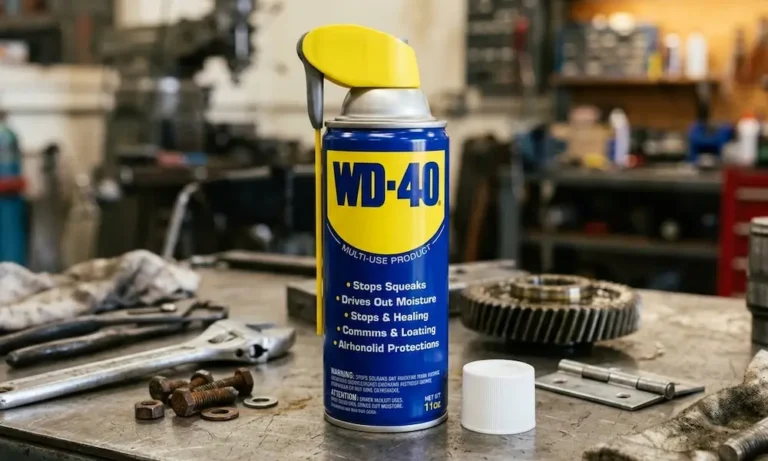
You’ve got rust, you’ve got a can of WD-40, and you’re wondering if one solves the other. The answer isn’t a simple yes or no — it depends entirely on which WD-40 product you’re using and how bad the rust actually is. Read this to the end before you grab that blue-and-yellow can.
The Big Misconception About WD-40 and Rust
Most people think WD-40 dissolves rust. It doesn’t — at least not the original formula.
The classic WD-40 spray is a blend of petroleum distillates and aliphatic hydrocarbons. It displaces moisture, leaves a thin lubricating film, and stops rust from forming. But it carries zero acidic or chelating compounds that break down iron oxide chemically.
So if you spray the original formula on a rusted bolt and walk away, you’ll come back to the same rusted bolt.
That said, WD-40 does play a useful role in rust removal — just not in the way most people expect.
What WD-40 Actually Does to Rust
Here’s where things get interesting.
The original formula works brilliantly as a cutting lubricant during mechanical rust removal. Think of it as the helper, not the hero.
When you’re restoring a cast iron table saw top or any porous iron surface, dry sanding is a nightmare. The sandpaper clogs within seconds. Water makes things worse — it creates more rust. But spray WD-40 on the surface, let it soak for about 10 minutes, and it penetrates the porous metal and gets under the oxidation layer.
Then you sand. The petroleum formula suspends the dislodged rust particles in a dark slurry, preventing your abrasive pad from clogging and keeping the cutting action smooth and consistent.
That’s the original formula’s sweet spot: mechanical rust removal, not chemical dissolution.
Why You Can’t Leave WD-40 as a Final Coating
After you’ve mechanically removed rust with WD-40, you can’t just leave it on the metal. The oily residue never fully dries. In a workshop, it attracts sawdust, dirt, and debris — which then traps corrosive minerals against the metal and starts the rust cycle all over again.
The right process looks like this:
- Spray WD-40 and let it soak for 10 minutes
- Sand with 400–600 grit wet/dry sandpaper or fine steel wool
- Wipe off the slurry with clean paper towels
- Degrease completely with acetone or mineral spirits
- Apply a non-silicone paste wax like Johnson’s Paste Wax or Boeshield T-9 immediately
Acetone is the preferred degreaser here because it flashes off almost instantly, leaving zero residue in the metal’s pores.
When You Need the Real Rust Remover: WD-40 Specialist Rust Remover Soak
If the rust is heavy, deep, or on a part with complex geometry — threads, gears, antique tools — mechanical abrasion isn’t realistic. That’s where the WD-40 Specialist Rust Remover Soak comes in.
This isn’t the same product as the blue can. It’s a dedicated liquid rust dissolver that works through selective chelation — it bonds to oxygen molecules inside the iron oxide structure and separates the rust from the steel without touching the healthy base metal underneath.
No scrubbing. No scraping. Just submerge and wait.
How Long Do You Soak?
| Rust Severity | Soak Time | Typical Use Case |
|---|---|---|
| Light surface rust | 30 min – 3 hours | Hand tools, recent hardware exposure |
| Medium rust | 8 hours (overnight) | Automotive parts, garden tools, bike chains |
| Heavy or flaking rust | Up to 24 hours | Pitted cast iron, antique restoration, tractor parts |
Keep the solution at room temperature or warmer. Below 60°F, the chelation reaction slows dramatically — so don’t bother using it in an unheated garage in January unless you add a heat source.
The solution is reusable until it turns completely black and stops producing results on new parts. Don’t pour spent solution back into a fresh container.
Why This Formula Is Safer Than Acid-Based Removers
Traditional rust removers use phosphoric, hydrochloric, or citric acid. They work fast, but they carry real risks:
- They etch healthy base metal if you leave parts soaking too long
- They release toxic fumes
- They can cause hydrogen embrittlement in high-carbon steel — a hidden structural failure where hydrogen atoms penetrate the steel’s grain boundaries, reducing ductility without any visible warning signs
The Specialist Soak is non-acidic, non-caustic, fume-free, and VOC-free. You can submerge parts with rubber gaskets or plastic trim attached without worrying about chemical damage.
Does WD-40 Remove Rust from Guns? Tread Carefully.
This one needs its own section because getting it wrong causes real damage.
The original WD-40 spray is safe for blued firearms — it won’t strip the finish. A quick spray after rain or field exposure works well for displacing moisture. However, long-term use as a gun lubricant is a bad idea. The petroleum residue polymerizes over time into a sticky varnish that can gum up firing pin channels and trigger mechanisms — especially in cold weather.
More importantly: never use the Rust Remover Soak on blued or browned firearms. The chelation process can’t distinguish between destructive red rust and the protective black iron oxide (magnetite) that forms the bluing. It strips both indiscriminately, destroying the protective finish entirely.
For isolated rust spots on a blued gun, the right approach is ultra-fine bronze wool or 0000-grade steel wool with a drop of light penetrating oil — gentle mechanical removal that lifts the red rust without scratching the black oxide underneath.
Seized Bolts and Penetrating Oils: The WD-40 Specialist Penetrant
Rust doesn’t just look bad — it locks things together. When bolt threads oxidize, the rust expands and binds the fastener through extreme friction. That’s where penetrating oils come in.
The key quality in a penetrant is low surface tension — the ability to wick upward into microscopic thread gaps through capillary action. The original WD-40 formula wasn’t designed for this. Independent torque tests consistently show it requires significantly higher breakout torque compared to dedicated penetrants.
The WD-40 Specialist Penetrant addresses this directly — engineered with low surface tension, fast capillary action, and a low-odor profile that makes it practical for indoor shop use. It’s also fully VOC-compliant across all 50 states.
How Do Other Penetrants Compare?
| Penetrant | Key Advantage | Main Drawback | Best For |
|---|---|---|---|
| Original WD-40 | Widely available, multi-use | Poor deep penetration | Lightly stuck hinges, household hardware |
| Kano Kroil | Micro-penetration, extreme rust | Expensive, low residual lubrication | Aerospace, critical engine components |
| PB Blaster | Fast-acting, automotive strength | Strong, lingering chemical odor | Exhaust bolts, suspension, undercarriages |
| Liquid Wrench | Budget-friendly, strong test performance | Medium-duty applications only | General repair, farm equipment |
| WD-40 Specialist Penetrant | Low odor, fast capillary action, 50-state compliant | Pricier than basic grades | Indoor shops, precision threading |
| Acetone/ATF mix (50/50) | Cheap, effective torque reduction | No safety documentation, high flammability | Budget-conscious independent shops |
For truly seized fasteners, combine the penetrant with heat from a propane torch. The heat expands the metal and micro-fractures the rust layer, letting the penetrant seep deeper as the metal cools and contracts.
Long-Term Rust Prevention After Removal
Removing rust is only half the job. The bare metal you’ve just exposed is now highly vulnerable to flash rusting.
The WD-40 Specialist Corrosion Inhibitor goes beyond simple water displacement. It uses Vapor Phase Corrosion Inhibitors — molecules that actively migrate across the metal surface and bond electrochemically, creating a self-healing barrier. If the film gets scratched, the surrounding vapor-phase molecules reseal the gap.
It dries into a tacky, waxy film that clings to vertical surfaces without dripping and resists corrosion for up to two years indoors and one year outdoors. This formula undergoes standardized salt spray chamber testing — 5% sodium chloride mist at 95°F — to validate real-world performance before it reaches shelves.
One Place WD-40 Should Never Go: Cast Iron Cookware
This is a hard stop.
Never use WD-40 — any formulation — on cast iron cookware. The petroleum distillates are toxic if ingested. They’ll contaminate food with chemical residues and severe off-flavors.
If you accidentally contaminate a skillet, scrub it repeatedly with heavy-duty dish detergent and hot water — minimum five cycles — then bake it at high heat to vaporize any residue trapped in the pores. Don’t burn it off in an open campfire; excessive heat creates irreversible “heat scale” that destroys the iron’s ability to hold seasoning.
For rusty cookware, use food-safe methods: coarse salt scrubbing, a thin layer of flaxseed or vegetable oil, and oven seasoning.
FAQs
Can I spray WD-40 near electrical fires or arcing circuits?
Absolutely not. The aerosol propellant — typically propane or butane — ignites explosively near sparks or open flames. The pressurized can can also rupture violently near extreme heat, causing severe shrapnel injuries.
Will WD-40 damage rubber O-rings or asphalt materials?
Yes. Petroleum distillates act as aggressive solvents against rubber and petroleum-based materials. They cause swelling, surface crazing, and structural breakdown. Use silicone-based lubricants for rubber components. Always test on an inconspicuous area if you’re unsure about the material.
Is WD-40 a good long-term lubricant for bicycle chains?
No. It’s too thin for high-friction drivetrain use and evaporates quickly. The tacky residue left behind attracts road grit and sand, forming a grinding paste that accelerates wear on the chain and cassette. Use a dedicated dry lubricant, wax emulsion, or PTFE chain lube instead.
How long does WD-40 stay good in the can?
Indefinitely — the sealed, pressurized container prevents chemical degradation. The real risk is the can itself. If stored in damp or corrosive conditions, the valve mechanism can rust, allowing propellant to leak out and leaving the liquid inaccessible. Store it in a cool, dry spot away from direct sunlight.
Does WD-40 conduct electricity?
Standard petroleum-based formulas are highly dielectric — they resist electrical current. That’s why mechanics use them to displace water from flooded distributors and spark plug boots. However, the aerosol propellant is flammable. Always de-energize equipment completely before spraying and let fumes dissipate fully before restoring power.