Your G37 shifts weird, throws a P0720 code, or just dropped into limp mode. Something’s wrong with the transmission, and the valve body is likely the culprit. This guide breaks down exactly what fails, why it fails, and what your replacement options actually cost — so you don’t overpay or buy the wrong part.
What Is the G37 Valve Body (and Why Does It Fail)?
The Infiniti G37 uses the RE7R01A seven-speed automatic transmission, built by Jatco and introduced in the 2009 model year. It’s a genuinely impressive piece of engineering — four planetary gear sets, three clutch packs, and a sophisticated hydraulic control system.
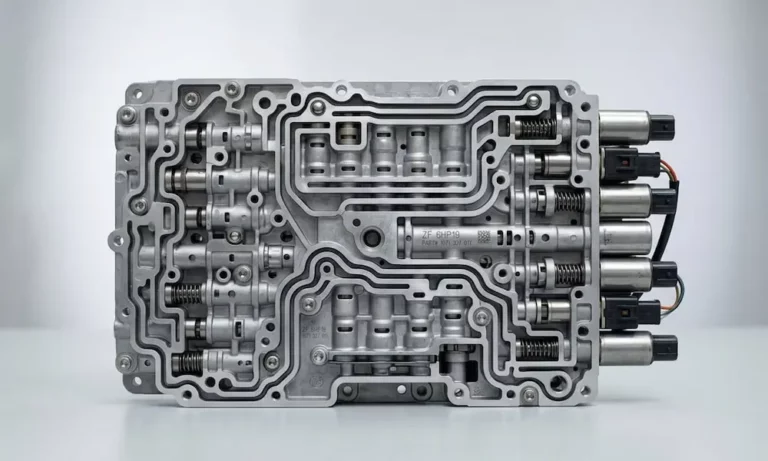
The valve body sits at the heart of all that complexity. It’s a precision-machined aluminum block that routes pressurized transmission fluid to the right clutch at exactly the right millisecond. That’s how your transmission knows when and how hard to shift.
Here’s the catch: Nissan bolted the Transmission Control Module (TCM) directly onto the valve body. The electronics live inside the transmission, constantly submerged in hot fluid. It’s a clever design — until it isn’t.
The RE7R01A mechatronic unit combines the hydraulic valve body with the electronic control module into one unified assembly. When either half fails, you typically replace the whole thing.
The Three Root Causes of G37 Valve Body Failure
1. Thermal Cycling Destroys the Circuit Board
This is the most common failure mode, and it’s entirely predictable. Every time you start your G37 on a cold morning, the transmission heats up from ambient temperature to full operating temperature. Then it cools back down when you park.
That expansion and contraction cycle stresses the solder joints on the TCM’s printed circuit board. The plastic housing, the fiberglass board, the silicon chips, and the metallic solder joints all expand at different rates. Over tens of thousands of miles, those microscopic solder joints develop hairline fractures.
Once the cracks form, electrical resistance spikes. Sensors lose connectivity. The transmission starts behaving erratically — and you get codes pointing to sensors that aren’t actually broken.
An external fluid cooler lowers peak operating temperature, but it doesn’t eliminate the cold-to-hot thermal cycle. The circuit board fatigue still happens. It just happens more slowly.
2. Torque Converter Debris Scores the Valve Body Bores
The G37 uses a continuous partial lockup strategy Nissan calls Smooth Lockup Control. The torque converter clutch never fully releases between shifts — it modulates constantly. That friction wears the clutch lining down over time, shedding metallic flakes directly into your transmission fluid.
Those flakes get pumped straight into the valve body circuits. The aluminum spool valves inside are machined to incredibly tight tolerances. Hard metallic debris wedges between the spool and the bore, scores the aluminum walls, and eventually seizes the valve entirely.
If the torque converter regulator valve seizes in the closed position, the converter stays mechanically locked to the engine. The result? Your G37 stalls violently every time you stop in Drive or Reverse. That’s a classic sign of a stuck torque converter control circuit.
3. Degraded Fluid Kills the Solenoids
Transmission fluid breaks down over time. It oxidizes, darkens, and thickens into a gel-like paste. That paste coats the electromagnetic solenoid plungers inside the valve body, making them sluggish or completely inoperable.
Contaminated fluid can also seep past the TCM housing seals, causing electrical arcing on the logic board. Game over for the control module.
There’s another contamination risk worth knowing about: radiator internal cooler failure. On some older Nissan and Infiniti platforms, pressurized engine coolant breaches an internal barrier and mixes with the transmission fluid. That emulsified mixture aggressively attacks the TCM seals and rusts the steel spool valves. If you see milky or pink-tinted fluid in your transmission pan, assume the worst.
G37 Transmission Fault Codes: What They Actually Mean
| Trouble Code | Description |
|---|---|
| P0720 | Output Speed Sensor Circuit — usually TCM circuit board failure |
| P0740 | Torque Converter Clutch Circuit Malfunction |
| P0745 | Pressure Control Solenoid A |
| P0731–P0735 | Gear 1–5 Incorrect Ratio — hydraulic slipping under load |
| P0780 | Shift Malfunction |
| U1000 | CAN Communication Failure — TCM dropped off network |
| U0402 | Invalid Data from TCM |
| P0705 | Transmission Range Sensor Circuit Malfunction |
| P0750 | Shift Solenoid A |
| P2713 | Pressure Control Solenoid D |
The P0720 code is the big one. It’s the most notorious fault code associated with G37 and 370Z transmission failures. The description says “output speed sensor circuit.” Most people replace the sensor. The problem doesn’t go away.
That’s because the sensor itself is almost never the actual fault. The failure is inside the TCM’s printed circuit board — the pathway that reads the sensor’s data has cracked. Replacing the sensor wastes your money. You need a valve body replacement.
U1000 and U0402 are even more serious. When the internal solder joints fracture completely, the TCM drops off the vehicle’s CAN network entirely. The transmission immediately locks into limp mode.
The gear ratio codes (P0731–P0735) tell a different story. These codes fire when the TCM commands a gear but the input and output speed sensors detect the wrong ratio. That means the clutches are slipping under load — a hydraulic failure, not an electronic one. Usually a seized pressure control solenoid or a scored valve body bore leaking pressure back into the pan.
G37 Valve Body Symptoms You Shouldn’t Ignore
Limp mode — transmission locks into third gear, dashboard MIL illuminates, gear indicator goes blank. The TCM can’t see its sensors and defaults to maximum line pressure in one gear to prevent further damage.
Transmission slipping or flaring — you hit the gas, the engine revs climb, but the car barely accelerates. The clutch pack isn’t holding because hydraulic pressure is too low.
Slam shifts or violent jolts — a delayed shift suddenly engages at maximum pressure when a sticky regulator valve breaks free. Those jolts accelerate debris generation and can crack valve guides.
Stalling at stops — the torque converter stays locked to the engine when you brake. The drivetrain can’t decouple. The engine stalls.
Constant highway judder — a back-and-forth jerking sensation at steady cruising speed means the torque converter clutch is rapidly cycling between locked and unlocked. Classic torque converter control circuit issue.
No-code drivability problems — sluggish acceleration with an RPM ceiling around 65–70 mph, terrible fuel economy, and a feeling like the transmission never fully engages. This often means a seized torque converter stator — and it won’t trigger a check engine light.
G37 Valve Body Replacement Cost: OEM vs. Remanufactured
Here’s the honest breakdown of what you’re looking at.
OEM Parts Direct from Nissan/Infiniti
| Part Number | Application | MSRP | Discounted Price |
|---|---|---|---|
| 31705-X629D | G37 Control Valve Assembly | $2,669 | $2,186 |
| 31705-X977A | G37 Control Valve Assembly | $2,580 | $2,113 |
| 31705-61X2C | 08–09 G37 Blank (No Programming) | $2,242 | $1,836 |
| 31705-17X6E | Blank Valve Assembly | $2,219 | $1,817 |
OEM units from Infiniti ship completely blank. No firmware. No calibration data. You can’t just bolt one in and drive away. The dealership has to program it to your VIN using proprietary CONSULT-III diagnostic software. Add dealer labor, programming fees, and potentially a tow — and you’re looking at $2,500 to $3,500 total.
Remanufactured Aftermarket Units
Remanufactured valve bodies from specialized transmission shops run $470 to $700. That’s a massive price difference.
Good remanufacturers fully disassemble the core unit, ultrasonically clean the aluminum castings, sleeve worn hydraulic passages, and replace all failure-prone solenoids with updated heavy-duty versions. The TCM gets inspected and repaired with higher-grade solder alloys designed for better thermal cycling resistance.
The real advantage? Many aftermarket suppliers offer pre-programming services. You send them your VIN before the unit ships. They flash the correct firmware on their bench. You get a plug-and-play unit. No dealer programming required, no tow fees, no $300 labor charge just to write software.
Why You Should Skip Used/Salvage Units
A used valve body from a junkyard carries all the same thermal cycling damage as your failed unit. The design flaw exists in every original unit. You’re essentially buying someone else’s ticking time bomb. If the donor vehicle suffered coolant cross-contamination, the TCM and solenoids are already compromised — you just can’t see it yet.
Installation Basics: What to Know Before You Wrench
Check the Pan First
Before you commit to a valve body replacement, drain the fluid and pull the pan. Look carefully at what’s sitting at the bottom.
- A little fine metallic glitter is normal
- Thick metallic sludge, large metal chunks, or shredded friction material means the internals are toast
If you see the latter, a valve body swap won’t fix the car. The transmission needs a full rebuild or replacement. Bolting in a new valve body on top of damaged clutch packs just destroys the new part.
Handle the Electrical Connectors Carefully
The control module uses specific green sub-harness connectors. These plastic connectors have spring tension that maintains a secure electrical connection. If you force them or pry carelessly, you permanently deform that tension. A loose connector will gradually vibrate itself apart under normal driving conditions — and you’ll be back in limp mode within weeks.
Torque Specs Matter
Every valve body mounting bolt torques to exactly 10 Newton-meters (90 inch-pounds). That’s it. Over-torque warps the aluminum casting and the spool valves bind. Under-torque causes internal hydraulic leaks and clutch slipping. Use a proper torque wrench.
Use a new oil pan gasket and appropriate chemical sealant. Refill with fluid that meets or exceeds the Dexron VI specification — synthetic only. The fluid level check requires an overflow plug procedure with the transmission running at a specific temperature window. There’s no dipstick.
The ITB12-027 Software Update You Might Not Know About
If your G37 shifts sluggishly, hesitates on downshifts, or just feels unresponsive — but doesn’t have major fault codes — check whether your car has received the ITB12-027 Technical Service Bulletin update.
Nissan issued this TSB to address widespread drivability complaints on 2009–2012 G37 models. The original factory firmware prioritized fuel economy, which meant early upshifts and slow downshift responses. The updated firmware rewrites the hydraulic pressure mapping and shift logic parameters. It reduces downshift lag, smooths low-speed coasting, and sharpens throttle response.
Many transmission complaints that mechanics misdiagnosed as valve body failures were actually just outdated firmware. Check this before spending money on parts.
Reprogramming a Blank OEM Unit: The Rules
If you do go the OEM route, the CONSULT-III reprogramming procedure has strict requirements:
- Battery voltage must stay between 12.0 and 13.5 volts throughout the entire flash. Connect a smart charger.
- Turn off all electrical loads — climate control, audio, seat heaters, exterior lighting.
- Turn the hazard lights ON. This keeps the Body Control Module awake during the flash. Skip this step and the BCM enters sleep mode mid-programming, corrupting the module.
- Turn off all Bluetooth devices near the diagnostic computer. Bluetooth interference can corrupt the data transfer invisibly.
- Warm the transmission up first — a 10-minute drive to bring coolant temperature to 70–100°C.
If the flash gets interrupted mid-sequence, the module can be permanently bricked. A $2,000 paperweight.
Frequently Asked Questions
Why don’t aftermarket shift kits exist for the G37’s seven-speed like they do for the older five-speed?
The older RE5R05A five-speed used fixed hydraulic spring pressures that you could mechanically modify with a TransGo-style kit. The RE7R01A’s valve body is controlled almost entirely by pulse-width modulated electrical signals. If you mechanically alter the valve body without also rewriting the TCM’s software, the computer actively fights the changes and immediately triggers gear ratio error codes.
Do I need an adaptive learning reset after installing a new valve body?
Absolutely. The old TCM gradually raised line pressure over time to compensate for worn clutches and degrading solenoids. If you install a fresh valve body without resetting those learned adaptations, the system applies old high-pressure settings to new components. You’ll get violent shifting and potentially rupture clutch pack seals.
Will an external transmission cooler prevent TCM failure entirely?
It helps significantly, but it’s not a complete fix. The cooler lowers peak fluid temperatures and extends clutch life. But the TCM’s circuit board fatigue comes from the temperature differential between a cold start and full operating temperature — not just the peak temperature itself. That thermal cycling still happens every time you drive.
How much more fluid does a valve body swap need versus a regular fluid change?
Quite a bit more. A standard drain-and-fill only removes fluid from the lower pan. A valve body removal evacuates fluid from the upper hydraulic passages and solenoid circuits too. After installation, you need to start the engine, slowly cycle through all gear positions to purge trapped air, then perform the overflow plug fluid level check at the correct operating temperature.
Will a pre-programmed aftermarket valve body mess with the anti-theft system?
No. The immobilizer and security key logic lives in the Body Control Module and the Engine Control Module — not the TCM. The VIN programming on an aftermarket valve body simply identifies the TCM as a valid node on the CAN network. It has no access to the encrypted security keys that allow the engine to start.