Got sticky residue on your car, floor, or wall? Picking the wrong remover can trash the surface. This guide breaks down Goo Gone vs Goof Off — what they do, what they destroy, and which one fits your job.
They’re Not the Same Product
People grab whichever bottle looks right on the shelf. Big mistake.
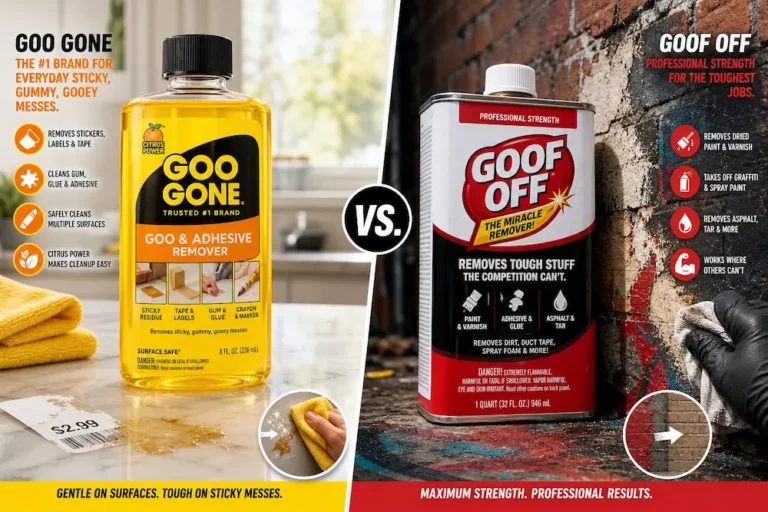
Goo Gone and Goof Off are two completely different animals. One works slowly and gently. The other attacks fast and hard. Use the wrong one, and you’ll melt your vinyl siding or wait forever while a mild oil barely touches dried concrete paint.
Here’s the short version:
- Goo Gone = citrus-based, slow, oil-heavy, surface-safe for most materials
- Goof Off Professional Strength = acetone-powered, fast, aggressive, melts plastics and paints
- Goof Off Heavy Duty = the middle ground — tougher than Goo Gone, safer than Pro Strength
What’s Actually Inside Each Bottle
Goo Gone Original
Goo Gone’s formula is mostly petroleum distillates — between 60% and 100% of the mixture. These refined oils slide into sticky residue slowly, softening it without destroying the surface underneath.
It also contains:
- d-Limonene (1–5%): A natural citrus extract that breaks down sap, gum, and organic stickiness
- Orange sweet extract: Helps cut grease and covers the petroleum smell
- Glycol ethers: Help lift stains from hard, non-porous surfaces
- Colorants: That recognizable orange tint
No acetone. No xylene. No harsh stuff. That’s the point.
Goof Off Professional Strength
Goof Off Pro is a different beast entirely. It uses a cocktail of aggressive solvents:
- Acetone (15–100% depending on format): Dissolves latex paint, glue, and nail polish fast
- Xylene (7–30%): Strips cured enamels, putties, and heavy adhesives
- Methyl acetate (30–60%): Fast-drying organic dissolver
- Methanol (1–5%): Lowers surface tension so other chemicals penetrate deeper
- Ethylbenzene: Targets heavy grime and oxidation
This formula works in seconds. It also evaporates in seconds. That’s both its superpower and its trap.
Goof Off Heavy Duty
Goof Off Heavy Duty skips acetone and xylene completely. Instead, it uses:
- Benzyl alcohol (5–10%): Strong penetrant that won’t melt plastics
- Glycol ethers (2–10%): Target water-based paints and markers
- Oleic acid potassium salt: Corrosion inhibitor + surfactant in one
This one bridges the gap between too gentle and too destructive.
| Chemical | Goo Gone | Goof Off Pro | Goof Off Heavy Duty | What It Does |
|---|---|---|---|---|
| Petroleum Distillates | 60–100% | None | None | Dissolves grease, wax, adhesive |
| d-Limonene | 1–5% | None | None | Natural degumming agent |
| Acetone | None | 15–100% | None | Melts paint, glue, nail polish |
| Xylene | None | 7–30% | None | Strips cured polymers |
| Benzyl Alcohol | None | None | 5–10% | Safe penetrant for plastics |
| Methanol | None | 1–5% | None | Increases chemical penetration |
How Each One Actually Works
Goo Gone: The Slow Soak
Goo Gone doesn’t destroy adhesives. It swells them. The oil molecules push into the sticky polymer, expanding it from the inside until it turns soft and gooey. Then you physically wipe or scrape it away.
That process takes time — usually 3 to 10 minutes of dwell time. Rush it and it won’t work. The oils don’t evaporate, so they stay wet and active on the surface until you wipe them off.
One catch: those same oils leave a slick residue behind. You must follow up with hot soapy water or isopropyl alcohol to clean the surface completely.
Goof Off: The Fast Attack
Goof Off Pro doesn’t swell adhesives. It dissolves them — chemically breaking the molecular bonds holding dried paint or glue together. The material liquefies, and you wipe it away instantly.
But here’s the problem: the solvents flash off fast. You have seconds, not minutes. If you don’t wipe immediately, the dissolved material re-hardens into a wider smear that’s even harder to remove than before.
Apply to a cloth first, not directly to the surface. Work fast. Wipe clean.
What Surfaces Can Each One Handle?
This is where most people go wrong. Picking the right chemical for the wrong surface ruins things.
| Surface | Goo Gone | Goof Off Pro | Notes |
|---|---|---|---|
| Glass | ✅ Safe | ✅ Safe | Both work fine |
| Finished/sealed wood | ✅ Safe | ⚠️ Caution | Goof Off can strip clear coat |
| Unfinished wood | ❌ Unsafe | ✅ Safe | Goo Gone permanently stains raw wood |
| Hard plastics (PP) | ✅ Safe | ❌ Unsafe | Acetone melts many plastics |
| Acrylic/styrene | ✅ Safe | ❌ Unsafe | Goof Off dissolves these on contact |
| Rubber | ❌ Unsafe | ❌ Unsafe | Petroleum oils destroy rubber |
| Automotive paint | ✅ Safe | ⚠️ Caution | Goof Off etches clear coat fast |
| Vinyl siding/flooring | ✅ Safe | ❌ Unsafe | Goof Off warps and discolors PVC |
| Concrete/masonry | ✅ Safe | ✅ Safe | Both work; Goof Off works faster |
| Leather/fine fabric | ❌ Unsafe | ❌ Unsafe | Both cause damage |
What Goo Gone Does Well
- Sticker and price tag residue on glass, plastic, and car paint
- Tree sap and bug splatter on automotive clear coats
- Tape adhesive on finished floors and walls
- Crayon and gum on hard surfaces
- Grease and wax buildup on sealed counters
What Goo Gone Destroys
- Rubber: The petroleum oils cause irreversible swelling and breakdown
- Raw wood and drywall: It soaks in permanently — leaves a dark oil stain you can’t get out
- Suede and leather: Heavy oils damage the fibers and structure
- Faux stainless steel: Strips the plastic film coating right off
What Goof Off Does Well
- Dried latex paint on concrete and masonry
- Cured construction adhesive and mastic
- Graffiti on brick and glass
- Heavy tar and industrial contamination on bare metal
- Cyanoacrylate (super glue) on non-sensitive surfaces
What Goof Off Destroys
- Acrylic, polycarbonate, and styrene plastics: Melts on contact
- Vinyl siding and flooring: Causes warping and permanent discoloration
- Automotive paint: Etches clear coat in seconds if you’re not fast
- Any synthetic fabric: The chemical matrix strips dyes and weakens fibers
Safety — Don’t Skip This Part
Goo Gone Risks
Goo Gone feels harmless. It’s not completely.
The biggest danger: aspiration pneumonia. If someone swallows it, the low-viscosity petroleum oils slip into the lungs. Never induce vomiting if this happens — that makes it worse. Call Poison Control immediately.
Skin contact causes defatting — it strips your skin’s natural oils. Repeated exposure to d-Limonene can trigger allergic reactions. The Environmental Working Group rates Goo Gone an “F” for systemic risks, despite its EPA Safer Choice label. Use nitrile gloves.
Goof Off Risks
Goof Off Professional Strength carries serious hazards.
- Vapors: Acetone, xylene, and methanol vapor cause dizziness, coordination loss, and unconsciousness fast. The Goof Off Pro SDS lists a flash point of -17.8°C. That means it emits explosive vapors even in cold temperatures.
- Vapor travel: The heavy vapors sink and travel along floors. They can reach a furnace pilot light or electric motor 30 feet away and flash back to you.
- Carcinogens: It carries a California Proposition 65 warning for ethylbenzene (possible carcinogen) and methanol (reproductive harm).
- Methanol poisoning: If ingested, methanol converts to formic acid in your body. It attacks the optic nerve, causing blindness, then seizures, then death.
Never use Goof Off Pro in a closed bathroom, closet, or basement. Open windows and doors. Keep ignition sources — candles, pilot lights, space heaters — off and away.
Thick Residue? Start With Mechanical Removal
Neither product works well on thick, unbroken layers of foam tape, vinyl stickers with waterproof backing, or heavy mastic.
You need to remove the bulk first:
- Use a plastic scraper or razor blade (glass only) to peel away the top layer
- Apply heat with a heat gun or hair dryer to soften thick adhesive
- Peel off the softened bulk material
- Then apply your chosen solvent to the thin residue layer underneath
Skipping mechanical prep means Goo Gone sits uselessly on top of foam, and Goof Off evaporates before it ever reaches the adhesive bond.
Cleanup After Application
After Goo Gone
The job isn’t done after removing the sticker. Goo Gone oils don’t evaporate — they stay on the surface and attract dirt.
Wash with hot soapy water right after. Dish soap works great. The surfactants in the soap grab the oil molecules and rinse them away cleanly. Alternatively, wipe with high-concentration isopropyl alcohol — it dissolves the oily film and evaporates dry.
After Goof Off
Goof Off evaporates fast, but it still leaves trace chemical residue. Wash the treated area with soap and water after use. This removes any dissolved adhesive film and stops residual chemicals from slowly off-gassing indoors.
Which One Do You Actually Need?
Choose Goo Gone if you’re:
- Removing stickers, decals, tape, or gum from everyday surfaces
- Working on automotive paint, finished wood, plastics, or ceramics
- Doing the job indoors with limited ventilation
Choose Goof Off Professional Strength if you’re:
- Removing dried paint, construction adhesive, tar, or graffiti
- Working on concrete, masonry, bare metal, or glass
- Working outdoors or in a space with strong airflow
Choose Goof Off Heavy Duty if you’re:
- Tackling paint or tough stains on surfaces that include plastics or fabrics
- Wanting more power than Goo Gone without the plastic-destroying risk of Pro Strength
Always spot-test first. Apply a small amount to a hidden area. Wait two minutes. Check for discoloration, softening, or damage before committing to the full surface.