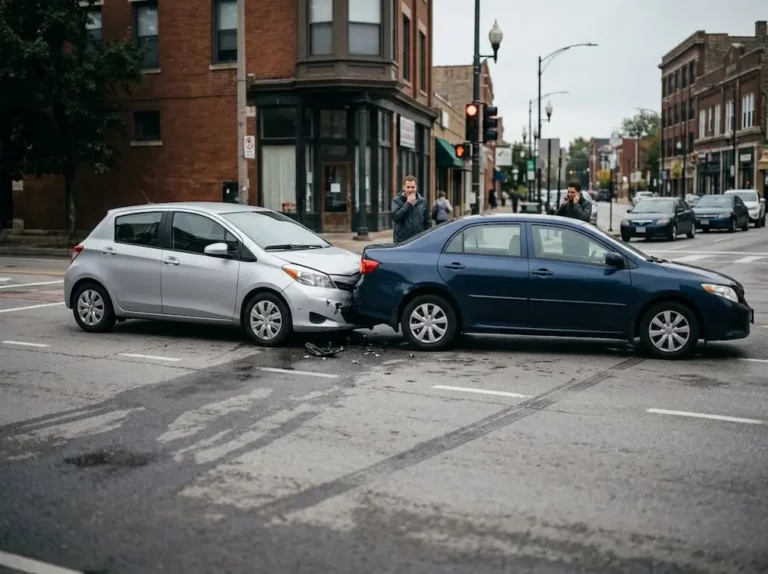
Rear-end crashes make up roughly 29% of all U.S. traffic collisions. That’s a big number — and most of them are completely preventable. Whether you’re stuck in rush-hour traffic or cruising on the highway, this guide gives you the exact tools to protect yourself. Read to the end — the last section could save you from serious injury.
Why Rear-End Crashes Happen So Often
The short answer? Distracted driving and tailgating.
Distracted driving killed 3,308 people in 2022 alone — and safety experts believe that number is actually an undercount. Drivers don’t always admit they were distracted after a crash.
Here’s the thing that makes distraction so dangerous. It doesn’t just mean looking at your phone. It comes in three distinct forms, and each one chips away at your ability to stop in time.
| Distraction Type | What It Means | Why It’s Dangerous |
|---|---|---|
| Visual | Eyes off the road | You can’t see brake lights or stopped cars |
| Manual | Hands off the wheel | You can’t steer away from danger |
| Cognitive | Mind off the task | Your brain can’t process a threat fast enough |
Texting is the worst offender because it hits all three at once. At 55 mph, a five-second glance at your phone means you’ve traveled the full length of a football field completely blind.
And here’s something most drivers don’t know: even after you put your phone down, your driving stays erratic for several seconds. Insurance telematics researchers call this the “cognitive hangover.” During that lag window, you’re still highly vulnerable to rear-ending someone — or triggering a chain reaction behind you.
The Two Driving Frameworks That Actually Work
You don’t need a racing license to drive defensively. You just need a mental system to follow. Two frameworks have stood the test of time.
The OODA Loop: Military Strategy Applied to Traffic
The OODA Loop was originally a decision-making tool for fighter pilots. It stands for Observe, Orient, Decide, Act — and it works brilliantly in traffic.
Here’s how it plays out in real driving:
- Observe — Constantly scan your surroundings. Watch following distances, traffic flow, and what vehicles ahead are doing.
- Orient — Put what you see into context. Is that car ahead braking earlier than expected? Is someone tailgating you?
- Decide — Form a plan. Slow down, change lanes, create more space.
- Act — Execute smoothly. Adjust your speed or position before a problem becomes a crisis.
Run this loop continuously and hazard recognition becomes automatic. You stop getting surprised.
The Smith System: Five Keys to Staying Out of Trouble
Developed in 1952 for commercial fleet drivers, the Smith System builds three things every safe driver needs: space, visibility, and time. When applied consistently, it reduces preventable accidents by up to 60%.
| Key | What to Do | How It Protects You from Rear-End Crashes |
|---|---|---|
| Aim High | Look 15 seconds ahead | Spot slowdowns early and brake gradually — no panic stops |
| Get the Big Picture | Maintain 360° awareness | Catch tailgaters before they become a threat |
| Keep Eyes Moving | Shift focus every 2 seconds | Prevents trance-like staring and boosts hazard detection |
| Leave Yourself an Out | Surround your car with space | Always have an escape route if traffic stops suddenly |
| Make Sure They See You | Signal early, tap brakes to warn | Give trailing drivers time to react |
The hidden bonus of the Smith System? Drivers who use it experience far less road stress. When you have space and visibility, you’re not reacting — you’re anticipating.
How Much Space Should You Actually Leave?
Space is the currency of safe driving. More space = more time to react. It’s that simple.
The Three-to-Four Second Rule
Traffic safety experts universally recommend a minimum three-to-four second gap between you and the car ahead under normal, dry conditions.
Here’s how to measure it:
- Pick a fixed roadside object — a sign, a shadow, a utility pole
- Watch when the car ahead passes it
- Start counting: “one-one-thousand, two-one-thousand, three-one-thousand”
- If your car reaches that marker before you hit three, you’re too close
In rain, snow, fog, or at higher highway speeds? Stretch that gap to at least six seconds. Wet roads dramatically increase stopping distances, and that three-second buffer shrinks fast when traction disappears.
The Rear Tires Rule at a Red Light
Rear-end crashes don’t only happen at speed. Intersections and stop-and-go traffic are hotspots too.
When you stop behind another vehicle, leave enough space to clearly see its rear tires touching the pavement. That gap does three things for you:
- Preserves an escape route if the car ahead stalls or won’t move
- Buffers an impact if someone hits you from behind — reducing the chance you get pushed into the car ahead and turning a two-car crash into a multi-car pileup
- Widens your sightlines so you can see pedestrians, cross-traffic, and changing signals earlier
It costs you nothing. And it could save you from a chain-reaction collision.
Approaching a Stale Green Light
Seeing a green light that’s been green for a while? That’s a stale green — and it’s a classic setup for a rear-end crash.
Before you reach the intersection, mentally draw a “point-of-decision” line on the road ahead. Decide in advance: if the light turns yellow before you cross it, you stop. If it turns yellow after, you go through cleanly.
This pre-commitment eliminates the sudden, indecisive braking that catches trailing drivers completely off guard.
Set Up Your Mirrors the Right Way
You can’t avoid a threat you can’t see. Most drivers set their mirrors wrong — and they don’t even know it.
Traditional Setup vs. the BGE Method
The traditional mirror setup angles both side mirrors inward so you can see a sliver of your own car. Comfortable? Sure. Safe? Not really. It creates massive blind spots on both sides — large enough to hide an entire vehicle.
The better approach is the Blindzone Glare Elimination (BGE) method, developed through Society of Automotive Engineers research. It angles your mirrors further outward to create a seamless panoramic view.
Here’s how to set it up:
- Driver’s side mirror — Lean your head left until it touches the window. Angle the mirror out until you just barely see your car’s edge.
- Passenger’s side mirror — Lean your head right toward the center console. Angle that mirror out the same way.
When you sit back up normally, your car won’t be visible in either side mirror. That’s intentional — and it works.
| Feature | Traditional Setup | BGE Method |
|---|---|---|
| Field of vision | Heavy overlap between mirrors | Seamless, gap-free panoramic view |
| Vehicle tracking | Cars disappear into blind spots | Vehicles transition smoothly from mirror to peripheral vision |
| Nighttime glare | Headlights reflect directly into your eyes | Rear headlight glare redirected away from your eyes |
| Blind spots | Large enough to hide a full vehicle | Effectively eliminated for passenger cars |
One important note: the BGE method doesn’t replace shoulder checks. Always do a quick glance before changing lanes. Mirrors give you a strong picture — a shoulder check confirms it.
How Often Should You Actually Check Your Mirrors?
Your mirrors are only useful if you use them regularly. Check your rearview mirror every five to ten seconds during normal driving. In heavy traffic or before braking, increase that to every five seconds.
Try the “Rainbow Check” technique: sweep from your left mirror, across to the center rearview, then to your right mirror, then back to the road ahead. It only takes a second, and it keeps you fully aware of what’s closing in behind you.
How to Handle a Tailgater (Without Making Things Worse)
Tailgaters are frustrating. But how you respond makes all the difference.
Why Brake Checking Is a Terrible Idea
When someone’s riding your bumper, slamming your brakes to “teach them a lesson” feels satisfying in theory. In reality, brake checking is dangerous, illegal, and legally costly.
It creates a manufactured emergency. The tailgater has zero stopping distance. The result? A high-speed rear-end crash that causes whiplash, soft tissue injuries, and traumatic brain injuries — to both of you.
Legally, it’s messy:
- Virginia — Brake checking falls under reckless driving. You’re looking at up to 12 months in jail, $2,500 in fines, and a six-month license suspension
- Illinois — Intentional sudden stops qualify as reckless driving under state law
- California — CVC 22109 explicitly prohibits sudden stops on highways without proper signaling
And if you trigger a crash through brake checking, dashcam footage or witnesses can shift full liability onto you — even though you were the one being tailgated.
The Smart Response to a Tailgater
Here’s what actually works:
- Ease off the gas — Gradually slow down without touching the brakes. This forces the tailgater to naturally back off.
- Increase your forward gap — More space ahead means if traffic stops, you can brake slowly and smoothly. That gives the tailgater time to react.
- Move right and let them pass — Signal early and change lanes when it’s safe. Isolation is the safest position in traffic. Let them go.
No ego, no escalation. Problem solved in 30 seconds.
Intersection Tactics Most Drivers Overlook
Keep Your Wheels Straight While Waiting to Turn Left
This one’s critical and almost nobody talks about it.
When you’re waiting in an intersection to make an unprotected left turn, don’t pre-turn your steering wheel. Keep your front wheels pointing straight forward.
If a distracted driver hits you from behind while your wheels are turned left, the impact pushes you directly into oncoming traffic. What could have been a manageable rear-end collision becomes a head-on crash.
With straight wheels, you get pushed forward into an empty intersection instead. Only turn the wheel when you’re actually accelerating through the gap.
If a Crash Is Unavoidable: What to Do in the Final Seconds
Sometimes you do everything right and it still happens. A driver behind you isn’t stopping, and you can see it in your mirror.
The Brake Release Technique
If you’re stopped and you can see a collision is about to happen, releasing your brake just before impact can reduce injury significantly.
Here’s the physics: when your brakes are locked, the striking vehicle’s energy slams into your car’s rigid structure and transfers directly through your body — especially your neck and spine. That’s whiplash.
When your wheels are free to roll, your car absorbs the impact by moving forward. It converts crash energy into motion instead of structural deformation. Less force on your body.
Critical caveat: This only works safely if you’ve left that rear-tire gap we talked about earlier. You need room to be pushed forward without hitting the car in front. If you’re boxed in or near a crosswalk, keep the brake on — absorb the rear impact to avoid a far more dangerous secondary crash.
Steer into a Glancing Blow
If you have an open lane or shoulder available, try to steer into a glancing angle rather than taking a direct centered hit. A deflecting impact dissipates energy sideways instead of straight through your vehicle. Keep your grip firm and look where you want to go — not at what’s about to hit you.
Your Car’s Built-In Rear-End Defenses
You’re not fighting alone. Your vehicle has built-in systems designed specifically to prevent rear-end crashes.
Center High Mounted Stop Lamps (CHMSL)
That third brake light mounted high on your rear window isn’t decorative. The NHTSA mandated it on all passenger cars starting in 1986 because early fleet tests showed it reduced rear-end impacts by up to 54%.
Long-term data shows the CHMSL maintains a steady 4.3% reduction in rear-end crashes. Applied across the entire U.S. fleet, that translates to 92,000 to 137,000 fewer crashes every year. It’s one of the most cost-effective safety devices ever mandated — preventing roughly $655 million in annual property damage and injury costs at a consumer equipment cost of just $206 million.
Advanced Emergency Braking (AEB) Systems
AEB systems use radar and cameras to watch the road ahead continuously. If they detect you’re closing on a stopped vehicle too fast, they act — even if you don’t. The intervention sequence works like this:
- Warning phase — Audible or visual alert to the driver
- Haptic brake jerk — Brief braking to physically prompt a response
- Brake assist — Supplements your pedal pressure if it’s not enough
- Autonomous braking — Full emergency stop if you don’t respond at all
For commercial trucks, this matters enormously. A fully loaded semi at 65 mph needs roughly 525 feet to stop. AEB systems help close the gap between human reaction time and the physics of stopping that much mass.
AEB doesn’t replace attentive driving. But it’s a genuinely powerful last line of defense when everything else fails.
Put It All Together
Knowing how to avoid being rear ended comes down to building consistent habits — not reacting to one scary moment and then forgetting about it.
Use the three-to-four second following rule every single drive. Set your mirrors with the BGE method today. Apply the Smith System’s five keys until they’re automatic. Let tailgaters pass instead of escalating. Keep your wheels straight while waiting to turn. And make sure you always have an out.
Distracted driving costs the U.S. an estimated $120.32 billion annually. You can’t control other drivers. But you can control your space, your awareness, and your response — and that’s exactly what keeps you safe.