
Thinking about becoming a pilot car driver? It’s a real career with solid earning potential — but there’s more to it than buying a truck and hitting the road. From state certifications to insurance requirements, the rules vary wildly depending on where you operate. This guide breaks down everything you need to know, so keep reading.
What Does a Pilot Car Driver Actually Do?
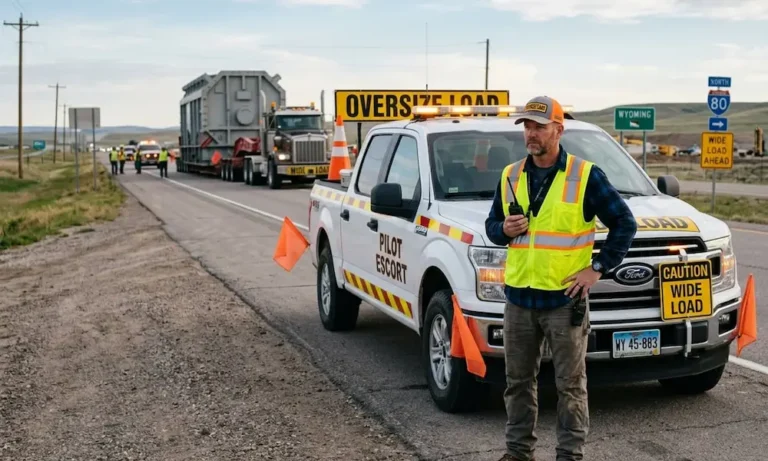
A pilot car driver — officially called a Pilot/Escort Vehicle Operator (P/EVO) — escorts oversized loads safely through public roads. We’re talking wind turbine blades, industrial cranes, prefabricated buildings, and other freight that’s simply too big for standard transport.
These loads create serious hazards for other drivers: massive blind spots, poor braking ability, and tight clearances at bridges and intersections. Your job is to warn other motorists, guide the truck driver through tricky infrastructure, and manage traffic during complex maneuvers.
It’s not just driving. It’s coordinating, communicating, and making fast decisions under pressure — every single trip.
Do You Need a Special License to Drive a Pilot Car?
You don’t need a Commercial Driver’s License (CDL) to drive a pilot car. However, you do need:
- A valid state driver’s license in good standing
- No drug or alcohol convictions on your record (ever)
- No single moving violation worth 6+ points within the last five years
- A current Motor Vehicle Record (MVR), often required within 30 days of applying
Age requirements depend on the state. Most states set the minimum at 18 years old. New York and Pennsylvania bump that up to 21 years old. There’s no DOT physical required, but you need to be physically capable — you’ll be stepping into live traffic, measuring bridge clearances, and managing emergencies in all kinds of weather.
Which States Require Pilot Car Certification?
This is where things get complicated. The U.S. has no single federal certification for pilot car drivers. Instead, 14 states legally mandate formal P/EVO certification:
Arizona, Colorado, Florida, Georgia, Kansas, Minnesota, New York, North Carolina, Oklahoma, Pennsylvania, Texas, Utah, Virginia, and Washington.
Operating in any of these states without valid credentials is a direct violation of state law. The load stops. The permit gets voided. Everyone loses money.
How Does Reciprocity Work Between States?
Good news: you don’t need to get certified in every state separately. Eight states form a reciprocity compact — they recognize each other’s certifications as equivalent.
| State | Min. Age | Key Details |
|---|---|---|
| Colorado | 18 | Accepts AZ, FL, MN, NC, OK, UT, VA, WA. Requires $1M commercial liability insurance and a clean 5-year MVR. |
| Florida | 18 | Accepts 11 states. Requires an 8-hour NSC defensive driving course unless you hold a CDL. |
| Minnesota | 18 | Residents need MN State Patrol cert. Accepts CO, FL, NC, OK, UT, VA, WA for out-of-state operators. |
| North Carolina | 18 | Requires an 8-hour Community College course plus an approved defensive driving course. |
| Oklahoma | 18 | OK residents need state-specific cert. Recognizes reciprocal compact states for out-of-state operators. |
| Utah | 18 | Accepts AZ, CO, FL, MN, NC, OK, VA, WA. Requires vehicle inspection at a Utah Port of Entry before escorting. |
| Virginia | 18 | Accepts FL, GA, MN, NC, OK, UT, WA. Must formally apply to Virginia DMV for recognition. |
| Washington | 18 | Most widely recognized cert nationwide. Valid for 3 years. Accepted in all compact states. |
Pro tip: Many operators get their Washington State certification first. It gives you the widest geographic coverage and the most flexibility for multi-state work.
Keep in mind — reciprocity only covers the certification credential itself. You still must follow each state’s local equipment rules, insurance minimums, and operational laws the moment you cross their border.
Watch Out for These State-Specific Rules
Some states operate completely outside the standard compact. Ignoring these quirks can halt an entire load at the state line.
| State | What Makes It Different |
|---|---|
| New York | Completely isolated. Accepts zero out-of-state certifications. Must be 21+, complete NY-specific application, and pass a written exam. |
| Texas | Accepts WA and CO certs, but requires an active MUTCD flagging certification for any traffic control duties. |
| Georgia | Requires completion of the Certified Escort Vehicle Program plus an official “Amber Light Permit” from Georgia DOT. |
| Nevada | No formal training course required, but strictly enforces an amber light law — no flashing lights without a pre-approved, paid NHP permit. |
| Louisiana | Requires all out-of-state escort vehicles to purchase an annual approved escort vehicle permit. |
What Does Pilot Car Training Actually Cover?
The standard certification course runs 8 hours — either in-person or proctored online — followed by a written exam. Most states require a minimum score of 80% to pass. Certifications typically stay valid for 3 to 5 years before renewal.
The curriculum follows the FHWA Pilot/Escort Vehicle Operators Best Practices Guidelines and covers:
- Reading transport permits — understanding route restrictions, load dimensions, and legal hierarchies between state and local rules
- Route surveying — how to conduct pre-runs, measure bridge clearances, identify low-hanging utility lines, and spot construction hazards
- Vehicle positioning — lead vs. chase car strategies, state-mandated following distances, and blind spot management
- Traffic control — MUTCD flagging standards, manual stop/slow paddle techniques, and keeping yourself out of the path of inattentive drivers
- Emergency protocols — railroad crossing emergencies, load shifts, and bridge strike prevention
For operators over 55, the FHWA recommends supplemental defensive driving courses like AAA Roadwise or AARP Smart Driver. These sharpen reaction times and often earn you discounts on commercial insurance premiums.
What Insurance Do You Actually Need?
This is non-negotiable. Your personal car insurance won’t cover you — not even close. Operating under a personal policy while running commercial escort work is a breach of contract. One accident, and you’re personally liable for everything.
A compliant commercial insurance portfolio has three pillars:
| Coverage Type | What It Covers | Typical Minimum |
|---|---|---|
| Commercial Auto Liability | Property damage and bodily injury caused by operating the pilot car | $1,000,000 CSL per occurrence |
| General Liability | Injuries and damage that happen outside the vehicle — flagging, measuring bridges on foot, etc. | $1M per occurrence / $2M aggregate |
| Errors & Omissions (E&O) | Claims from professional mistakes — like measuring a bridge wrong and the load hits it | $1,000,000 minimum (NPCA standard) |
E&O is the coverage most new operators skip — and it’s the most critical. Standard auto liability won’t touch a damage claim that stems from your professional miscalculation. Get it before you take a single job.
What Kind of Vehicle Do You Need?
Not just any vehicle qualifies. States regulate both the vehicle itself and every piece of equipment mounted on it.
Vehicle basics:
- Must be a passenger car, SUV, or two-axle pickup truck
- Minimum curb weight: 2,000 lbs
- Maximum GVW: 12,000–16,000 lbs depending on the state (New York caps it at 10,000 lbs)
- Minimum wheelbase: 95 inches (New York requires 100 inches)
- 360-degree driver visibility required — cargo vans, panel trucks, and box trucks are universally prohibited
Required exterior equipment:
| Equipment | Standard Specifications |
|---|---|
| Oversize Load Sign | Black on yellow; minimum 5 ft wide × 10 in high; Louisiana requires 7 ft × 18 in |
| Amber Warning Lights | Roof-mounted, 360° visibility from 500 ft minimum; only active during escort operations |
| Warning Flags | Red or orange; standard 18 × 18 in; 2–4 flags at vehicle’s widest points |
| Height Measuring Pole | Non-conductive fiberglass; frame-mounted so it resonates audibly inside the cab on contact |
Required interior equipment:
- CB radio with external antenna (plus a backup handheld two-way radio)
- ANSI Class 2+ high-visibility vest, hard hat, safety glasses, and work boots
- STOP/SLOW paddle (18-inch, high-reflectivity)
- 3–9 reflective traffic cones (36-inch)
- 8–12 road flares (minimum 15-minute burn time)
- First aid kit, fire extinguisher (5 B:C minimum rating), full-size spare tire, jumper cables, and spare bulbs
DOT enforcement officers inspect this at weigh stations. Missing items means immediate delays — and a bad reputation with dispatchers.
How Do Lead and Chase Cars Work Differently?
Once the load is moving, your duties depend entirely on your position in the convoy.
Lead car — You’re out front. You navigate the permit route, warn oncoming traffic, and monitor the height pole constantly. If that pole taps anything overhead, you radio the truck driver to stop immediately.
Chase car — You’re behind the load. You watch accumulated civilian traffic, execute lane protection maneuvers during wide turns, and monitor the load’s securement chains throughout the trip.
Both positions demand continuous radio communication. Silence during a complex maneuver is not an option.
How Do Hours of Service Rules Apply to Pilot Cars?
Pilot cars are generally passenger vehicles and don’t automatically fall under the same HOS rules as commercial trucks. But when operations cross state lines or trigger DOT weight thresholds, operators need to understand these limits.
The FMCSA HOS framework for property-carrying operations covers four key limits:
| Rule | What It Means |
|---|---|
| 14-Hour Driving Window | The clock starts the moment you begin any work-related activity. You can’t drive after that 14th hour — period. |
| 11-Hour Driving Limit | Within that 14-hour window, you can only physically drive for 11 hours maximum. |
| 10-Hour Off-Duty Requirement | Once you hit your daily limits, you need 10 consecutive hours off before driving again. |
| 60/70-Hour Weekly Limit | You can’t drive after 60 hours on-duty in 7 days, or 70 hours in 8 days. A 34-hour restart resets the clock. |
Falsifying logs carries penalties up to $11,000 for the motor carrier and $2,750 per offense for the driver. Fatigue is one of the biggest killers in this industry — don’t treat HOS rules as suggestions.
How Do You Build a Pilot Car Business That Lasts?
Getting certified is the easy part. Building a career that actually pays well takes deliberate effort.
Start with an apprenticeship. Ride with an experienced P/EVO before you go solo. You’ll learn radio etiquette, real-world permit reading, and how to handle situations no training manual fully prepares you for.
Build your network. Most pilot car contract work comes through word-of-mouth referrals from other drivers and dispatchers — not job boards. Reliability and professionalism are your best marketing tools.
Track your expenses obsessively. Fuel, maintenance, hotels, tolls, and equipment add up fast. Separate your business and personal finances immediately. Set aside money for taxes and vehicle downtime from day one.
Frequently Asked Questions
Can pilot cars tow small trailers during an escort operation?
No. Towing a trailer changes braking dynamics, obscures rear visibility, and compromises your ability to execute evasive maneuvers. It also undermines the standardized silhouette that other drivers and law enforcement expect from an escort vehicle. It’s prohibited.
What happens if a road closure blocks the permitted route mid-transport?
You pull over safely and stop. You can’t spontaneously reroute onto an unpermitted road — that risks bridge strikes on unsurveyed infrastructure. Contact the state permitting agency, request an official route amendment, and wait for the updated permit before moving again.
How do pilot cars handle roundabouts with massive loads?
The lead car enters first and uses its warning lights to block all entering traffic at the yield points. The chase car secures the rear. The truck tracks across multiple lanes and mounts the center truck apron. Continuous radio communication between all three vehicles is mandatory throughout.
Do oversized loads move at night?
Most states restrict extra-legal load movement to daylight hours — roughly 30 minutes before sunrise to 30 minutes after sunset. Nighttime moves are generally reserved for “superload” operations requiring complete highway closures, where moving at night minimizes civilian traffic disruption.
What if you’re certified in one state but cross into a non-certification state, then into a certification state again?
Compliance is border-by-border. The moment you cross into a certification-required state, you must hold valid credentials for that state. If you don’t, the permit is voided at the port of entry and the load halts until a certified replacement operator arrives. No exceptions, no grace periods.

