If you own a Ford 6.7 Powerstroke built between 2011 and today, the CP4 fuel pump sitting in your engine valley is a ticking clock. It’s not a matter of if it fails — it’s when. The good news? You have real options. Keep reading, and you’ll know exactly what to do before it costs you a fortune.
What Makes the 6.7 Powerstroke CP4 Such a Problem?
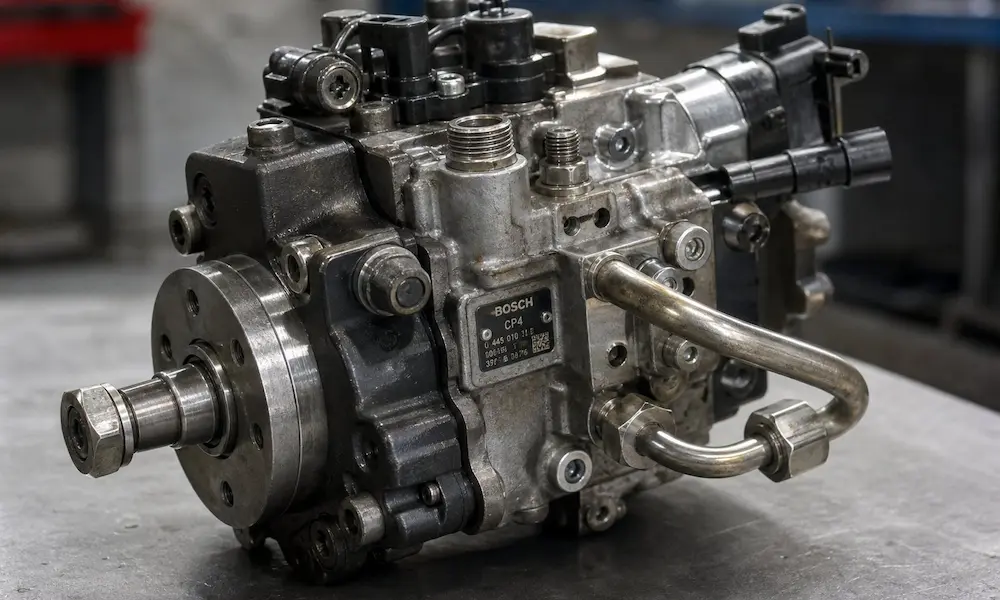
The Bosch CP4.2 pump arrived on the 6.7 Powerstroke in 2011. Ford needed extreme fuel pressure — up to 29,000 PSI — to meet tighter emissions standards. The CP4 delivered that pressure. But it brought a serious design flaw along for the ride.
Here’s the core issue: the CP4 has zero independent oil lubrication. It relies entirely on diesel fuel to lubricate its internal components. That sounds fine until you factor in one critical detail — U.S. ultra-low sulfur diesel (ULSD) is a notoriously poor lubricant.
Why? Federal regulations require refineries to strip sulfur from diesel to cut emissions. That stripping process also removes the natural lubricating agents from the fuel. So the CP4 pump — engineered for Europe’s higher-lubricity diesel — runs perpetually starved for lubrication on American roads.
The CP4 vs. CP3: A Quick Comparison
The older Bosch CP3 pump, found in earlier Powerstroke and Duramax engines, used a radial three-piston design with looser tolerances and a generous fuel bath for cooling. It could shrug off bad fuel and air intrusion without blinking.
The CP4 uses an axial two-piston design with ultra-tight tolerances and a cam-and-roller tappet system. Those tighter clearances demand better lubrication — lubrication that U.S. diesel simply doesn’t provide.
How the CP4 Destroys Itself (and Your Wallet)
When lubrication falls short, friction builds between the roller tappets and the spinning cam lobes. Once that friction causes a tappet to bind, the cam’s rotational force twists the lifter 90 degrees sideways in its bore.
At that point, the roller’s sharp hardened edge drags directly across the main shaft. The inside of your fuel pump turns into a high-speed metal-grinding machine. Worse, the CP4 has no internal safety screen or containment mechanism. The pump blasts metal shavings straight into your fuel rails and injectors — at 29,000 PSI.
What Speeds Up the Failure
Several conditions accelerate CP4 wear beyond the baseline lubricity problem:
- Air intrusion and cavitation — Running a low fuel tank, a bad supply line, or improper filter changes lets air into the pump, causing the lifters to float and skip
- Water contamination — Water lacks viscosity and corrodes internal surfaces; a neglected water separator is a direct path to pump destruction
- Wrong fluid introduction — Accidentally adding gasoline or diesel exhaust fluid (DEF) into the tank will immediately crystallize components and destroy the pump
The Contamination Cascade: Why One Pump Failure Costs $15,000
The metal debris doesn’t stay in the pump. Here’s where the real damage happens:
The high-pressure fuel lines carry shrapnel directly into both fuel rails. From there, it infiltrates all eight piezoelectric injectors — precision components with microscopic internal tolerances. Metal particles score injector pintles and control valves, causing injectors to stick open or fail entirely.
It doesn’t stop there. Diesel engines return excess fuel to the tank via a low-pressure return circuit. That return fuel carries metal debris into the tank, through the lift pump, and into both filter housings. Every component that touches fuel gets contaminated.
What a Full Contamination Repair Includes
| Component Replaced | Estimated Parts Cost |
|---|---|
| High-pressure fuel pump | Included in kit |
| All 8 fuel injectors | Major cost driver |
| Driver & passenger fuel rails | Significant cost |
| All high & low-pressure fuel lines | Moderate cost |
| Lift pump module | Moderate cost |
| Primary & secondary filter housings | Lower cost |
| Full tank drop, drain & clean | Labor cost |
| Intake manifold gaskets (teardown required) | Lower cost |
Parts alone for a complete fuel contamination kit typically run $3,500 to $7,000. Add extensive labor and the total invoice lands between $10,000 and $15,000.
Early Warning Signs: Catch It Before It Grenades
Catching a failing CP4 early is tough — the pump often fails suddenly with little warning. But these symptoms suggest trouble is brewing:
- Hard starts or extended cranking — the pump can’t build threshold rail pressure
- Power loss under load — especially noticeable when towing uphill
- Rough idle, misfires, or unexpected stalling — erratic fuel delivery
- Metallic ticking, whining, or grinding from the engine valley — that’s the sound of the cam being machined away
Diagnostic Trouble Codes to Watch
| Code | Meaning | Likely CP4 Cause |
|---|---|---|
| P0087 | Fuel rail pressure too low | Internal wear, pump losing volumetric efficiency |
| P0191 | Fuel rail pressure sensor range/performance | Debris interfering with pressure sensor |
| P0088 | Fuel rail pressure too high | Debris clogging the volume control valve |
| P0093 | Fuel system leak detected | Injectors sticking open from metal contamination |
The “Forbidden Glitter” Test
If you see any of these codes or symptoms, don’t drive the truck. Remove the Inlet Metering Valve (also called the Fuel Control Actuator or MProp) from the top of the CP4 with a Torx driver. Examine the fine mesh screen on the valve body.
Shiny metallic particles on that screen — commonly called “forbidden glitter” — confirm the pump is disintegrating. Do not restart the engine. Every crank cycle pushes more debris into your injectors.
6.7 Powerstroke CP4 Upgrade Options: What Actually Works
Here’s where your decision splits into three clear paths, each with different costs, protection levels, and permanence.
Option 1: The Disaster Prevention Kit (~$400)
A disaster prevention kit — or bypass kit — doesn’t fix the CP4. It quarantines the damage when it fails.
In the factory configuration, the fuel lubricating the CP4’s crankcase feeds directly into the high-pressure plungers and out to the injectors. The bypass kit physically reroutes this circuit so crankcase fuel — which carries the metal debris during a failure — gets intercepted and sent back toward the tank before it can reach the injectors.
The S&S Diesel Motorsport Gen 2.1 Disaster Prevention Kit represents the best current version of this technology. Key improvements over earlier generations include:
- OE-style push-on quick-connect lines — no cutting factory hoses, no compression fittings
- Supply line split 25 inches from the pump — prevents contaminated fuel from back-feeding into the clean supply
- Billet aluminum return filter head with a 9-micron Donaldson spin-on filter that catches metal debris before it reaches the tank
When the CP4 fails with a Gen 2.1 kit installed, you replace the pump and the return filter. That’s it. A potential $15,000 catastrophe becomes a standard pump replacement.
Option 2: The Exergy System Saver (~$275)
The Exergy Performance System Saver replaces the factory Inlet Metering Valve with one featuring a double-wrapped, stainless steel 25-micron screen — far stronger and finer than the factory 80-85 micron plastic-framed unit.
When the CP4 fails, this finer screen clogs with debris quickly. That intentional clog chokes off fuel to the high-pressure plungers faster, shutting the engine down sooner and limiting how long it runs while destroying itself. Exergy’s internal testing shows injector survivability increases by over 85% with this upgrade installed.
It’s excellent secondary protection. Pair it with a bypass kit for the strongest combination short of a full pump replacement.
Option 3: Replace the CP4 Entirely
For maximum reliability, ditch the CP4 altogether. Two proven upgrade paths exist.
The Denso Common Rail (DCR) Conversion (~$2,400)
The S&S Diesel Motorsport DCR pump conversion replaces the CP4 with a pump built on a Stanadyne heavy-duty commercial design. Instead of the fragile cam-and-roller tappet system, the DCR uses a patented eccentric drive with pressure-lubricated cam and bushings. It doesn’t rely on fuel lubricity at all.
Key advantages of the DCR conversion:
- True plug-and-play drop-in replacement — no tuning, no ECU flashing required
- 25% more fuel volume than the factory CP4 (1,250cc vs. 1,000cc per revolution)
- Emissions compliant in all 50 states — holds CARB Executive Order EO# D-756-7 certification
- Near-zero failure rate documented across heavy commercial fleet applications
The Belt-Driven CP3 Conversion (~$2,000–$3,500+)
The legendary CP3 pump conversion uses the older three-piston radial pump design that’s virtually indestructible. When a CP3 does eventually wear out, it degrades gradually — dropping rail pressure under load before it fails, rather than grenading suddenly.
The engineering challenge is significant. You can’t just drop a CP3 into the factory valley location — the added load can cause the crank gear interference fit to slip, which destroys your engine timing. The solution from SPE Motorsport relocates the pump to the front of the engine, driven off the crankshaft snout via a custom pulley and heavy-duty 8-rib Kevlar serpentine belt. This design eliminates the crank gear risk entirely and makes future pump service far easier.
The CP3 conversion also opens the door to massive performance scaling. Stroker pump variants (10mm, 12mm displacement) can fuel extensively modified high-horsepower builds — something the DCR can’t match.
| Upgrade Option | Cost | Keeps CP4? | Tuning Required? | Best For |
|---|---|---|---|---|
| Gen 2.1 Bypass Kit | ~$400 | Yes | No | Budget protection, daily driver |
| Exergy System Saver | ~$275 | Yes | No | Secondary insurance, pair with bypass |
| DCR Pump Conversion | ~$2,400 | No | No | Full reliability, stock or mild builds |
| CP3 Belt-Drive Conversion | $2,000–$3,500+ | No | No (stock) | High-horsepower performance builds |
Preventative Maintenance While You Still Have the CP4
If you’re keeping the factory pump for now, these habits genuinely extend its life:
- Keep the tank above a quarter full — prevents air intrusion and protects the lift pump from bottom-of-tank sediment
- Change fuel filters every 10,000 miles — don’t wait for the dashboard light
- Drain the water separator regularly — water destroys whatever lubricity ULSD has left
- Use a quality diesel fuel additive — lubricity additives coat internal pump components and demonstrably reduce wear on roller tappets
- Upgrade your lift pump — systems from FASS or AirDog provide superior air separation and dual-stage filtration down to 2 microns, ensuring the CP4 always gets a clean, consistent fuel supply
Source your diesel from high-turnover stations. Stale, degraded fuel or water-contaminated fuel accelerates pump wear faster than almost anything else.
The Bottom Line on 6.7 Powerstroke CP4 Upgrades
The 6.7 Powerstroke is an incredibly capable engine. The CP4 pump is its one genuine Achilles’ heel — and it’s a serious one. If you’re running a stock truck with no protection and no plan, you’re rolling the dice every time you turn the key.
The math is straightforward: a $400 bypass kit prevents a potential $15,000 repair. A $2,400 DCR conversion eliminates the problem entirely and requires no tuning whatsoever. The CP3 belt-drive conversion is the choice if you’re building for serious power and want a pump that’ll outlast the truck.
Pick your level of protection — but do something now, before the forbidden glitter shows up on your metering valve screen.