If you own a 2020-2022 Ford Super Duty with the 6.7-liter Power Stroke diesel, there’s a very real chance your fuel pump could destroy your entire fuel system — and cost you $10,000 to $15,000 to fix. The Ford CP4 recall covers nearly 295,000 trucks, but the official fix has owners seriously worried. Here’s everything you need to know before your pump decides to quit.
What Is the Ford CP4 Recall?
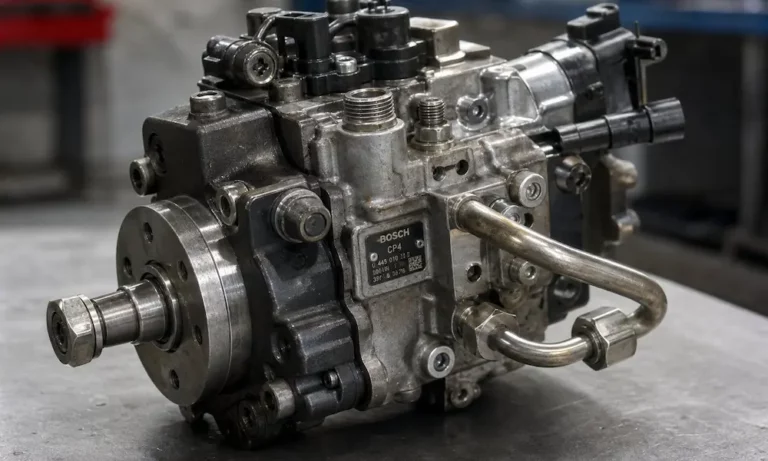
In late December 2024, Ford launched a massive safety recall officially designated by the National Highway Traffic Safety Administration as Campaign Number 24V-957. The recall targets the Bosch CP4 RP7 high-pressure fuel pump installed in 6.7-liter Power Stroke engines. When this pump fails, it can cause a sudden loss of engine power while you’re driving — a serious safety risk, especially if you’re towing heavy loads at highway speeds.
Ford estimates only about 4% of recalled trucks will actually experience the defect. But with nearly 300,000 trucks in the pool, that’s still roughly 12,000 catastrophic failures waiting to happen.
Which Trucks Are Affected?
| Vehicle | Model Years | Production Window | Units Affected |
|---|---|---|---|
| Ford F-250 through F-600 Super Duty | 2020, 2021, 2022 | Feb 19, 2019 – Aug 23, 2021 | 286,138 |
| Ford F-650 and F-750 Medium Duty | 2021, 2022 | May 14, 2019 – Aug 23, 2021 | 9,311 |
The critical cutoff date is August 23, 2021. On that exact date, Ford replaced the RP7 pump with an updated RP8 variant on the assembly line. The RP8 has wider internal clearances that allow better fuel flow and cooling, which prevents the thermal issues that kill the RP7. If your truck was built after August 23, 2021, you’re not in this recall.
Warning Signs Your CP4 Pump Is Failing
Don’t wait for your truck to die on the highway. These are the official warning symptoms outlined in Ford’s recall documentation:
- Extended cranking before the engine starts
- Check engine light coming on
- Unusual noises from the engine bay
- Noticeable power loss that doesn’t go away
- Rough running under load
If you notice any combination of these, get your truck to a dealer before the pump completely lets go. A partial failure is a $500 problem. A full failure is a $10,000–$15,000 disaster.
Why the CP4 Pump Fails: The Real Story
The Pump Lubricates Itself With Your Diesel Fuel
Here’s the core problem. The Bosch CP4 doesn’t use engine oil for internal lubrication. Its internal metal components — camshaft, roller lifters, and tappets — rely entirely on the diesel fuel flowing through it to stay lubricated. These components operate under a condition called boundary lubrication, where a microscopic film of fluid is the only thing separating metal from metal under extreme pressure.
When that film breaks down, metal grinds directly on metal. The results are ugly.
The “Grenading” Effect
When the CP4 fails catastrophically, diesel technicians describe it as the pump “grenading.” Here’s the sequence:
- The unlubricated metal components shear off microscopic metal particles
- A process called cavitation — essentially tiny internal explosions from collapsing air bubbles — erodes the pump further
- Metal shavings get forced directly into the fuel rails and injectors
- Those injectors, machined to microscopic tolerances, get destroyed instantly
- Contaminated fuel travels backward through return lines, destroying the fuel tank, supply lines, and lift pump
The entire fuel system needs replacement. That’s why repairs run $10,000 to $15,000 once the pump fully fails.
The Lubricity Problem Nobody Wants to Talk About
America’s Diesel Fuel Doesn’t Meet the Pump’s Requirements
Ford’s official recall documentation blames aged biodiesel deposits from pandemic-era vehicle inactivity. But engineers, diesel specialists, and class-action attorneys point to a deeper, systemic issue: American diesel fuel simply isn’t slippery enough for this pump.
The petroleum industry measures fuel lubricity using a High Frequency Reciprocating Rig (HFRR) test. The test presses a steel ball against a steel disk, both submerged in heated diesel fuel, and vibrates them against each other for 75 minutes. Technicians then measure the wear scar on the ball under a microscope. Smaller scar equals better lubricity.
Here’s where the numbers get damning:
| Region | Standard | Max Allowed Wear Scar | Result |
|---|---|---|---|
| Europe | EN 590 | 460 microns | Nominal operating range |
| United States | ASTM D975 | 520 microns | Severe lubricity deficit |
That 60-micron gap is enormous in the context of a precision fuel pump. The Bosch CP4 was engineered in Europe, designed around European fuel standards. It was never truly built for American diesel.
The reason American diesel lost its natural lubricity? The mid-2000s transition to ultra-low sulfur diesel required intense refining that stripped the fuel of the naturally occurring compounds that provided lubrication. Lubricity additives get blended in at the terminal to compensate, but domestic fuel still legally passes at a standard that leaves this pump without adequate protection.
The real-world consequence? The CP4 fails at roughly 1% in Europe. In the United States, that failure rate climbs to approximately 7%.
Ford’s Timeline: Three Years of “It’s Fine”
Ford didn’t exactly sprint to issue this recall. Here’s how the timeline actually played out:
- September 2021: Ford’s internal engineering team flags a spike in CP4 warranty claims to its Critical Concern Review Group
- Late 2021: The NHTSA contacts Ford, noting that competing manufacturers had already recalled trucks for the same pump failures
- January 7, 2022: Ford formally tells the NHTSA there’s no unreasonable safety risk and plans only to “monitor the situation”
- 2022–2023: Ford classifies failures as “no-start” conditions — an inconvenience, not a safety hazard
- 2024: Advanced connected vehicle telemetry confirms the pump failure can cause active power loss while driving. Physical pump teardowns confirm aged biodiesel deposits. Ford catalogs 3,070 warranty reports, 498 field reports, and 58 customer service reports
- December 2024: Ford officially approves the recall and notifies the NHTSA
Three years of mounting evidence, a federal agency knocking on the door, and thousands of documented failures later — here we are.
The Official Fix: A Software Update (Really)
This is where owners get angry. Ford’s official recall remedy is a free Powertrain Control Module (PCM) software reflash. That’s it. No pump replacement. No hardware fix.
The software update modifies the fuel system’s cooling strategy, increasing fuel flow to the pump’s vulnerable tappet area to prevent the thermal buildup that Ford says creates those biodiesel deposits. In theory, it mimics the wider clearances built into the newer RP8 pump — through software instead of metal.
Compare that to how other manufacturers handled the exact same pump:
- Ram/Cummins: Physically replaced the CP4 with a robust CP3 pump
- General Motors: Settled a massive class-action lawsuit for $50 million
- Ford: Software update
The skepticism is legitimate. A software patch can’t change the physical geometry of the pump. It can’t restore metal already worn away. And it can’t make American diesel fuel more lubricating.
Ford has stated that if your truck experiences a catastrophic pump failure, hardware repairs may still fall under standard warranty coverage depending on mileage. Ford also set up a reimbursement program for owners who already paid out of pocket for CP4 repairs before the recall notice arrived.
The Lawsuits: What the Legal Battle Means for You
GM Set the Precedent
General Motors used the Bosch CP4 in its 6.6-liter Duramax engines across Chevrolet Silverado and GMC Sierra heavy-duty trucks from model years 2011 through 2016. The resulting class-action lawsuit alleged GM knew the pump was incompatible with American diesel and deployed it anyway. After years of litigation, federal courts certified seven consumer classes and GM ultimately settled for $50 million in May 2025.
The settlement broke down as follows:
- $30 million directly reimbursed class members who already paid for CP4 repairs
- $5 million compensated owners for overpaying on a vehicle with a known defective part
- A forward-looking program covering 50% of future pump repair costs up to 200,000 miles
Coverage applied to buyers in California, Florida, Illinois, Iowa, New York, Pennsylvania, and Texas.
Ford’s Case Is Still Active
The ongoing class-action lawsuit Droesser et al. v. Ford Motor Company alleges that Ford knowingly put the CP4 in millions of diesel trucks while fully aware of the lubricity mismatch. Ford tried to get the case dismissed multiple times. Courts denied those attempts every time.
A landmark 2020 ruling upheld claims of fraudulent concealment, noting evidence that Ford tested the CP4 using only specification-compliant fuel — intentionally ignoring the lower-lubricity reality of American diesel at the pump. In March 2023, a federal judge issued a 65-page ruling affirming that a vehicle must provide safe, reliable transportation free of catastrophic systemic defects to meet the basic standard of merchantability.
With a $50 million GM settlement on the books, Ford’s financial exposure is substantial.
Your Real Options: Don’t Just Wait for the Software Fix
Option 1: Disaster Prevention Kit (~$500)
A CP4 Disaster Prevention Kit — commonly called a bypass kit — doesn’t stop the pump from eventually failing. It stops the failure from destroying your entire fuel system.
Here’s how it works. In a stock configuration, the fuel used to lubricate the pump’s lower crankcase passes directly into the high-pressure pumping chambers and out to your injectors. When the roller lifters fail, metal shavings travel that same path straight into your $10,000 worth of injectors and fuel rails.
A bypass kit physically separates those two fuel paths. If the lower crankcase generates metal debris, that contaminated fuel gets rerouted completely away from the high-pressure side.
The Gen 2.1 kit from S&S Diesel Motorsport takes it a step further with a dedicated secondary return filter — a billet aluminum filter head with a commercial-grade Donaldson spin-on filter that captures debris down to single-digit micron measurements. Metal shavings get caught before they can reach the tank. A physical split-off point 25 inches from the pump prevents back-feeding into the clean supply line.
Result: pump fails, you replace the pump. Not the injectors, rails, lines, and tank.
Option 2: DCR Pump Conversion (~$2,400)
If you want the CP4 completely gone from your truck, the S&S Diesel Motorsport DCR Pump Conversion replaces the Bosch pump entirely with a heavy-duty Stanadyne Diesel Common Rail pump.
The Stanadyne DCR uses a two-piston eccentric drive design with pressure-lubricated cams and heavy-duty bushings — components specifically validated for American ultra-low sulfur diesel. No roller lifters. No lubricity vulnerability.
Key highlights of the conversion:
- True plug-and-play installation — matches the exact footprint of the factory CP4
- No aftermarket tuning required — works with your factory engine control unit out of the box
- 25% more fuel delivery volume than the stock CP4 (1,250 cc/rev vs. stock)
- Fully emissions-compliant — carries a California Air Resources Board Executive Order D-756-7 and SEMA certification, meaning it’s legal in all 50 states
The extra fuel delivery capacity also helps older, high-mileage engines with worn injectors that return high volumes of fuel. It’s not just a safety fix — it’s a genuine upgrade.
Check If Your Truck Is in the Recall Right Now
Don’t guess. Go to the NHTSA recall lookup tool and enter your VIN. The Ford CP4 recall is listed under Campaign Number 24V-957. If your truck is affected, Ford will mail you a notification directing you to schedule the free PCM software update at any authorized Ford or Lincoln dealer.
If you previously paid out of pocket for CP4 pump repairs, document everything and contact Ford directly about the reimbursement program. Given the active class-action litigation at Hagens Berman, it’s also worth consulting with an attorney if your repair costs were significant.
The software update is free and takes the recall box off the checklist. But given what’s at stake financially, a bypass kit or DCR conversion isn’t paranoia — it’s just math.