Got a mystery stain on your car carpet and no idea where to start? You’re in the right place. This guide walks you through exactly how to get car carpet stains out — from fresh spills to stubborn, set-in messes that have been living rent-free in your floorboards for months. Stick around, because the method matters more than the muscle.
Why Your Car Carpet Is Harder to Clean Than You Think
Car carpets aren’t just fabric on a floor. They’re layered systems — fibers on top, foam padding underneath, and a metal chassis below that. When a liquid spills, it doesn’t just sit on the surface. It soaks through every layer.
That’s why a quick wipe rarely works. You clean the top, but the stain keeps wicking back up as it dries. Sound familiar?
Here’s the other thing most people miss: the type of fiber in your carpet changes everything about how you should clean it.
| Fiber Type | Stain Resistance | What to Watch Out For |
|---|---|---|
| Nylon | Moderate | Vulnerable to acidic stains like coffee and juice |
| Polypropylene | High against water-based stains | Melts easily with heat or aggressive brushing |
| Polyester | Moderate | Bonds with oily stains; prone to crushing |
| Wool Blend | Low | Never use alkaline cleaners or heat |
Most family cars use nylon or polypropylene. Luxury vehicles sometimes use wool blends — and those need a much gentler touch.
Step 1: Always Vacuum First (Seriously, Don’t Skip This)
This is the step most people skip, and it’s the reason their cleaning job looks worse after.
If you wet a dirty carpet before vacuuming, loose dirt turns into mud. That mud bonds to the fibers and the backing. Now you’ve created a deeper stain than you started with.
Pull out all floor mats. Vacuum the entire carpet in overlapping passes — side to side, then front to back. Use a crevice tool for the tight spots along seat rails and the center console.
For stubborn embedded grit or pet hair, try this trick: tap the carpet firmly with a rubber mallet a few times before vacuuming. The vibration shakes trapped particles up to the surface where the vacuum can grab them.
Step 2: Match the Cleaner to the Stain
This is where most DIY attempts fall apart. People grab whatever’s under the sink and start scrubbing. But different stains need different chemistry.
Coffee and Juice Stains (Acidic Tannins)
These need a pH-neutral or slightly alkaline cleaner. Apply a foaming carpet and upholstery cleaner directly onto the stain. Don’t rub — blot from the outside edge toward the center. Rubbing spreads the stain outward.
Grease, Oil, and Fast Food Spills
Water won’t touch these. Oil and water don’t mix, which means your standard carpet cleaner just pushes the grease around. You need a solvent-based degreaser formulated for automotive interiors.
Apply it, let it dwell for a few minutes, then blot. For heavy grease, sprinkle baking soda generously over the wet stain and let it sit for 20–30 minutes. The powder draws the oil out of the fibers through capillary action. Vacuum it away, then follow up with a light extraction using clean water.
Salt and Winter Road Treatment Stains
If you live anywhere with cold winters, you’ve seen these: white, crusty rings on your floor mats and carpet edges. That’s calcium chloride and rock salt — and they’re highly alkaline.
Using an alkaline carpet cleaner on them does nothing. You need an acidic solution to neutralize them. Mix equal parts hot water and white vinegar. Spray it on the stain and let it sit for 5 minutes. The acid dissolves the crystals. Agitate gently with a brush, then extract the liquid. Avoid over-saturating — excess moisture near the floor pan can cause rust over time.
Pet Urine and Other Biological Stains
Standard cleaners won’t fix this. They might kill the smell temporarily, but pet urine contains microscopic uric acid crystals that regular soap can’t break down. When humidity rises or the car heats up, the smell comes roaring back.
You need an enzymatic cleaner — one that contains live bacteria cultures specifically engineered to digest organic molecules. Saturate the affected area fully, cover it with a damp cloth to prevent evaporation, and let it work for several hours. Don’t rush it.
Important: Never use hot water or steam on fresh blood or egg. Heat cooks the protein and permanently bonds it to the fibers. Use cold water only on fresh protein stains.
Water Rings and Tide Marks
Here’s the counterintuitive one. If you see a dark ring on your seat or carpet, don’t just scrub the ring. Spot-cleaning it adds new moisture, which dries and leaves a new ring — usually bigger than the original.
Instead, lightly mist the entire affected panel with distilled water. Tap water contains minerals that create new deposits. Apply a foam fabric shampoo to a microfiber cloth and work it evenly across the whole section. Blot firmly, then allow the area to dry with good airflow at an even pace. Uneven drying is what causes the ring in the first place.
Step 3: Agitate Without Wrecking the Carpet
A soft-bristled upholstery brush works fine for light stains. For anything worse, a drill brush attachment dramatically speeds up the job and gets deeper into the pile.
But drill brushes need to be used carefully. High-speed rotation generates heat — and polypropylene fibers can melt if you stay in one spot too long. Keep the drill moving constantly, use low-to-medium speed, and make sure the surface is wet with cleaner before you start.
The color coding matters here:
- White: Soft bristles for delicate fabrics and cloth seats
- Yellow: Medium stiffness — the standard choice for car carpet
- Black: Stiff bristles for rubber mats and trunk liners only
Never use any rotary brush on leather, suede, or your headliner. It’ll tear or fray the material on contact.
Step 4: Extract the Dirty Water Completely
Applying cleaner is only half the job. The contaminated liquid — carrying dissolved dirt, old stains, and spent detergent — has to come back out. If it stays in the fibers, it dries into a sticky film that attracts new dirt within weeks.
A hot water extractor is the gold standard. It injects heated water into the carpet while simultaneously vacuuming the dirty water back out. The heat breaks down soils faster and helps the carpet dry more quickly.
Don’t have an extractor? Use a wet-dry shop vac with a narrow duck-foot nozzle. Scrub the treated area, mist it lightly with clean water, then press the nozzle firmly into the carpet and pull slowly. The narrow aperture increases suction velocity, closely mimicking the performance of a professional extraction machine.
A vapor steam cleaner is another excellent option — especially in winter when you want to minimize water. Steam at over 200°F melts grease and kills bacteria with minimal moisture. Wrap a microfiber towel around the nozzle to absorb the loosened soil as you work.
Step 5: Dry It Fast — Mold Grows in 24 Hours
This step protects everything you just did.
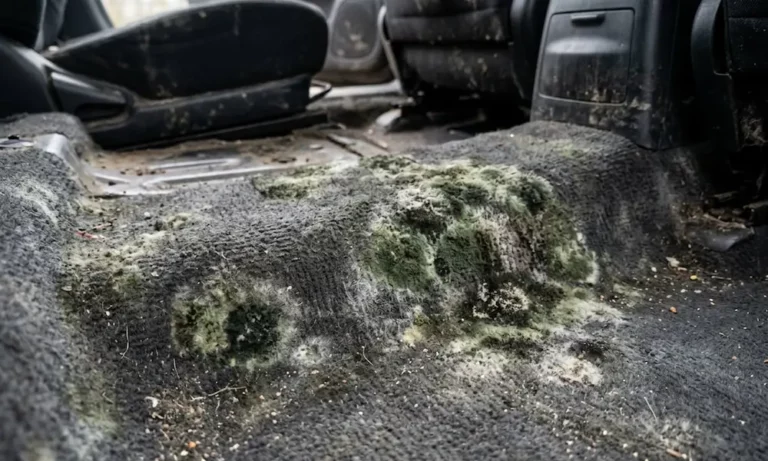
Wet carpet padding is a mold incubator. Mold colonies can start forming in 24 to 48 hours in a warm, closed vehicle. Some species — like Aspergillus and Penicillium — only need 60–70% relative humidity to thrive.
Once mold gets into the foam padding, surface cleaning can’t stop it. You’d need to pull the carpet entirely to treat it properly.
Here’s how to dry your carpet fast after cleaning:
- Open all doors and place a box fan or high-velocity air mover pointing into the footwell
- Run the A/C on maximum with the setting on fresh air (not recirculate) — the evaporator core pulls moisture from the air as it cools
- Use a dehumidifier inside the closed cabin on rainy or humid days
- Don’t close the car until the padding feels completely dry — not just the surface
The surface can feel dry while the padding underneath is still soaking wet. If you have one, a moisture meter is the only reliable way to confirm true dryness. The safe threshold is below 16% moisture content.
Best Car Carpet Cleaners: Tested and Ranked
Not all carpet cleaners are equal. Here’s a breakdown of the top products:
| Product | Best For | What Makes It Stand Out |
|---|---|---|
| Adam’s Carpet & Upholstery Cleaner | All-round heavy-duty stains | Top-rated overall; low residue, excellent on mud and wine |
| Meguiar’s Carpet & Upholstery Cleaner | High-traffic carpets | Deep foam penetration; built-in odor neutralizer |
| Turtle Wax Power Out! | Extreme mud and floor mats | Integrated scrub brush cap; dominates heavy soil |
| Bissell Professional Stain & Odor Remover | Pet accidents and bio stains | Enzymatic formula; permanently destroys odor at the source |
| Folex Instant Carpet Spot Remover | Fast grease and mystery stains | No rinsing required; works in seconds on set-in grease |
| OxiClean Carpet Stain Remover | Food dyes, wine, greasy chili | Oxygen-based; highly effective with 10-minute dwell time |
| Chemical Guys Nonsense All-Purpose | Sensitive interiors | pH-balanced; zero residue means dirt won’t reattach |
Denim Dye on Light Seats? Act Fast
If you’ve got light-colored seats and wear dark jeans, you’ve probably noticed blue staining on the upholstery. This is dye transfer — friction and body heat push indigo dye from the denim right into the fabric or leather.
On cloth seats, a good interior shampoo and some agitation usually handles it. On leather or vinyl, timing is critical. Fresh dye sits on top of the clear coat and wipes off easily with a mild cleaner. Left in a hot car for days, the pores of the clear coat expand, and the dye sinks through.
Once it’s penetrated the clear coat, you’ll need a solvent-based dye-transfer remover designed specifically for leather. Work slowly, check frequently, and don’t scrub hard. Isopropyl alcohol is a last resort — it’s aggressive and can strip the color layer if you’re not careful.
Protect Your Carpet After You Clean It
You’ve done the work. Now keep it that way.
Fabric protectant sprays bond with carpet fibers at a molecular level and create a hydrophobic barrier. Coffee, soda, and rain bead up on the surface instead of soaking in. Ceramic-infused protectants offer longer-lasting protection than older silicone-based sprays.
All-weather floor mats are your first line of defense. Thermoplastic elastomer mats stay flexible in winter, don’t outgas toxic fumes in summer heat, and wipe clean in seconds. They’re a much smarter investment than replacing carpet or paying for deep cleaning every few months.
Temporary carpet protection films — like those used by dealerships — are thick polyethylene sheets with a pressure-sensitive adhesive that grips carpet fibers without leaving residue. They’re ideal during repairs or detailing when foot traffic is unavoidable. Just remove them within 45–60 days to prevent the adhesive from baking in.
Knowing how to get car carpet stains out isn’t just about scrubbing harder — it’s about using the right chemistry, the right tools, and the right drying process for each specific type of stain. Vacuum first, match your cleaner to the stain, extract thoroughly, and dry fast. Do those four things consistently, and your car carpet will stay looking sharp for years.