Thinking about wrapping your car but can’t get a straight answer on price? You’re not the only one frustrated by vague quotes. Car wrap costs vary wildly depending on your vehicle, the finish you want, and where you live. This guide breaks down every cost factor so you know exactly what you’re paying for — and what to watch out for.
The Short Answer: What Does Car Wrapping Actually Cost?
Here’s the honest truth — how much does car wrapping cost depends on a lot of moving parts. But here’s a quick baseline:
- Compact cars: $2,000 – $3,500
- Mid-size sedans: $2,700 – $4,500
- Full-size SUVs: $4,000 – $6,500
- Trucks: $4,500 – $7,000
- Exotic/luxury cars: $5,500 – $10,000+
Those numbers assume a standard gloss finish with professional installation. Add specialty materials, paint correction, or ceramic coating, and the total climbs fast.
How Vehicle Size Drives the Price
The bigger the car, the more vinyl you need. Simple math. But professionals don’t just measure your car — they add a 10–20% surplus for overlaps, edge tucking, and mistakes.
Here’s how the numbers shake out across vehicle types:
| Vehicle Type | Example Models | Material Needed | Typical Price Range |
|---|---|---|---|
| Compact/Coupe | Honda Civic, Mini Cooper | ~200 sq ft | $2,000 – $3,500 |
| Mid-Size Sedan | Toyota Camry, Honda Accord | ~250 sq ft | $2,700 – $4,500 |
| Crossover/Small SUV | Toyota RAV4, Mazda CX-5 | ~275 sq ft | $3,200 – $4,800 |
| Full-Size SUV | Chevy Tahoe, Toyota 4Runner | 300+ sq ft | $4,000 – $6,500 |
| Pickup Truck | Ford F-150, Ram 1500 | 300+ sq ft | $4,500 – $7,000 |
| Commercial Van | Ford Transit, Ram ProMaster | 350+ sq ft | $4,200 – $7,500 |
| Exotic/Luxury | Porsche 911, Lamborghini | Varies | $5,500 – $10,000+ |
Trucks are especially tricky. The gap between cab and bed requires extra material and careful handling — that’s reflected in the price.
Why Car Shape Matters as Much as Car Size
Here’s something most people overlook: a big flat panel on a delivery van is actually easier to wrap than a compact sports car with aggressive curves and deep air intakes.
Complex aerodynamic bodywork demands more time, more heat manipulation, and a lot more patience from the installer. Stretch the vinyl too far and the color distorts. Miss a deep recess and it peels within months.
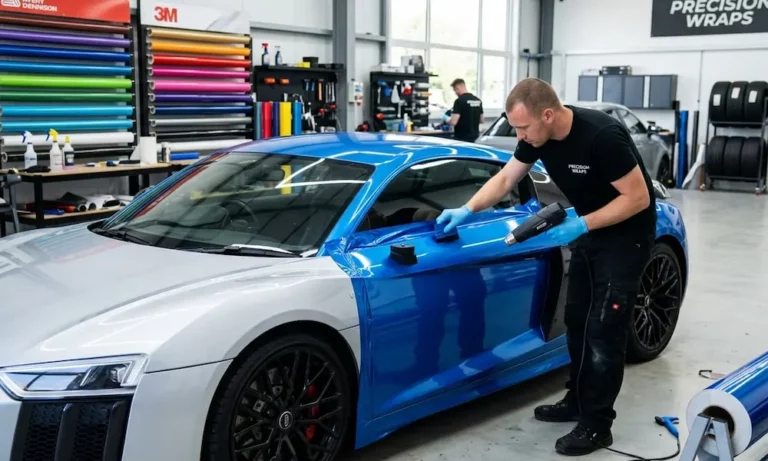
Premium shops also disassemble parts before wrapping — door handles, mirrors, badges, headlights. This lets them tuck vinyl edges cleanly out of sight. It looks factory-fresh, but it adds hours to the labor invoice. That’s the main reason exotic car wraps cost so much. The installer needs deep mechanical knowledge, extended labor time, and carries higher liability insurance just to touch those vehicles.
The Finish You Choose Changes Everything
The type of vinyl finish you pick acts as a cost multiplier on top of your vehicle’s base price. Here’s how each finish tier stacks up:
| Finish Type | Look | Full Wrap Price Range | Difficulty |
|---|---|---|---|
| Standard Gloss | Factory paint shine | $2,000 – $5,000 | Standard |
| Matte/Satin | Flat or silky, no reflection | $2,500 – $6,500 | Moderate |
| Textured/Carbon Fiber | 3D woven appearance | $4,500 – $6,500 | High |
| Color-Shift/Chameleon | Changes color by angle | $5,000 – $8,000+ | Moderate–High |
| Mirror/Chrome | Extreme mirror reflection | $6,000 – $10,000+ | Extreme |
Chrome wraps sit at the top for a reason. The material costs up to four times more per linear foot than standard gloss vinyl. Worse, it has almost no stretch. One too many degrees of heat and the mirror finish turns permanently cloudy — a defect called whitewashing. Some shops require two technicians working in sync just to lay a single chrome panel correctly. That level of precision doesn’t come cheap.
Cast vs. Calendared Vinyl: Why Material Quality Matters
Not all vinyl is the same. There are two main types, and choosing wrong can cost you later.
Cast vinyl starts as liquid, gets poured and cured into a thin sheet. It conforms easily to curves, doesn’t shrink, and lasts 5–7 years. It’s what professional shops use. Installed professionally, it typically costs $12–$16 per square foot.
Calendared vinyl gets pressed through rollers, which gives it a mechanical memory — meaning it constantly tries to shrink back to its original shape. It’s cheaper at $6–$10 per square foot installed, but it lifts and peels around curves and in heat. Professional installers use it only for flat commercial panels.
If a shop quotes you a suspiciously low price, ask what vinyl they’re using. Budget calendared film on a sedan won’t last two summers in a hot climate.
Partial Wraps: Big Impact, Lower Budget
You don’t need a full wrap to make a statement. Partial wraps target specific panels and cost far less.
Popular partial wrap options and typical costs:
- Roof wrap (blacked-out): $250 – $700
- Hood wrap: $200 – $600
- Chrome delete (window trim/grille): $300 – $600
- Side mirror wraps: $80 – $150 per pair
- Racing stripes: $250 – $800
For businesses, partial commercial wraps deliver excellent brand visibility at a fraction of full wrap pricing. A side panel logo with contact info on the rear doors often runs $1,000 – $2,000 per vehicle. Wrap five or more vehicles at once and many shops offer 10–15% volume discounts.
What’s Really Inside That Labor Cost
When you pay $4,000 for a wrap, you might wonder why — especially when raw vinyl only costs $700–$900 for a full car. Here’s the reality: labor makes up 50–60% of the total invoice.
Professional installers earn around $41,000 per year on average — roughly $19.76 per hour. But shops bill labor at around $130 per hour. That gap exists because running a professional wrap shop isn’t cheap.
What drives shop overhead:
- Climate-controlled bays — Too cold and vinyl tears. Too hot and the adhesive grabs instantly, making repositioning impossible.
- Specialized tools — Fresh surgical blades, heat guns, and precision squeegees get used constantly.
- Knifeless tape technology — Products like 3M Finish Line tape use an embedded filament wire to cut vinyl along body lines without a blade ever touching your paint. These tapes cost $16–$46 per 50-meter roll and are a consumable expense on every job.
When you skip the professional shop to save money, you’re also skipping all of that.
Where You Live Changes What You Pay
Geography plays a real role in car wrapping cost. Here’s a snapshot across major U.S. markets:
| City | Typical Full Wrap Range | Key Pricing Driver |
|---|---|---|
| Los Angeles, CA | $500 – $5,100 | Huge range of installer quality |
| San Diego, CA | $1,400 – $6,500 | Premium customization culture |
| New York, NY | $2,600 – $3,100 | High commercial real estate costs |
| Chicago, IL | $2,100 – $5,000 | Balanced urban market |
| Houston/Dallas, TX | $900 – $3,600 | Lower business operating costs |
| Phoenix, AZ | $1,600 – $5,100 | Strong demand due to sun damage concerns |
Rural areas often offer lower sticker prices, but qualified installers for specialty films like chrome are rare. Many rural customers drive to urban centers for complex jobs — adding travel and time to the real cost.
DIY Wrapping: Honest Numbers and Honest Risks
DIY wrapping looks attractive on paper. Materials for a full car run $700–$900. Tools add another $100–$300. Total outlay: roughly $800–$1,200.
But here’s what the savings don’t account for:
- Without training, you’ll likely trap air bubbles, overstretch panels, or miss edges
- Using a blade directly on the vehicle risks cutting into factory clear coat
- A botched wrap can require professional paint correction afterward — wiping out every dollar you saved
DIY works fine for small flat pieces like a hood accent or a roof stripe. A full vehicle wrap without professional experience? Most experts advise against it strongly.
Hidden Costs: Paint Prep Before the Wrap Goes On
A vinyl wrap doesn’t hide paint damage — it magnifies it. Rock chips, scratches, and peeling clear coat all show through the film. Worse, they cause the adhesive to fail faster.
If your paint isn’t perfect, you’ll need prep work before installation. Here’s what that costs:
| Correction Level | Paint Condition | Process | Added Cost | Labor Time |
|---|---|---|---|---|
| Single-Stage | Light swirls, dull finish | Mild polish | $300 – $600 | 4–6 hours |
| Two-Stage | Moderate scratches | Heavy compound + polish | $500 – $1,000 | 6–10 hours |
| Three-Stage | Deep etching, oxidation | Wet sand + compound + polish | $800 – $3,000+ | 12+ hours |
A minimum pre-wrap decontamination wash — stripping waxes, removing embedded brake dust, and clay bar treatment — is non-negotiable at any quality shop. Budget for it before you get a wrap quote.
Protecting Your Wrap: Ceramic Coating Costs
A premium wrap lasts 5–7 years — but only if you protect it. Vinyl is softer than factory clear coat. UV rays, bird droppings, and tree sap degrade it fast without a protective layer.
A ceramic coating applied over the wrap creates a hydrophobic shield that repels water and blocks UV damage. Here’s what it costs:
| Coating Tier | Longevity | Cost Range |
|---|---|---|
| Entry-Level | 1–2 years | $600 – $900 |
| Mid-Grade Professional | 3–5 years | $1,000 – $1,800 |
| Elite/Flagship | 7+ years | $2,000 – $3,000+ |
| Glass Coating (add-on) | 1–3 years | $150 – $300 |
| Wheel Coating (add-on) | 1–2 years | $200 – $400 |
Adding $1,000 for ceramic coating to a $3,500 wrap feels like a big jump. But it often extends wrap life by 1–2 years and cuts down on maintenance time. Over the lifecycle of the wrap, it pays for itself.
Wrap Removal: The Cost Nobody Talks About
Wraps don’t last forever. When it’s time to remove one, the age and condition of the film determines what you’ll pay.
Healthy wrap removed on time (under 5 years):
A technician heats the surface, peels it back cleanly in sheets, and removes adhesive residue. For a standard sedan, this takes 4–6 hours at $130/hour. Expect to pay $500–$800. Larger vehicles run $700–$1,200.
Neglected wrap left too long:
UV radiation destroys the vinyl’s flexibility. Instead of peeling in sheets, it shatters into stubborn flakes. Technicians must scrape inch by inch using chemical removers and plastic blades. This can turn a 6-hour job into a multi-day ordeal costing $2,000–$2,500+.
For fleet operators: leaving wraps on past their lifespan to save money almost always results in catastrophic removal costs when vehicles need to be returned at lease end.
Wrap vs. Paint: Which Actually Costs More?
A quality professional paint job runs $3,000–$10,000. Custom paint with metallic flakes or unique blends? That climbs to $20,000 or more. Budget paint jobs under $2,000 routinely cause overspray, poor masking, and early peeling — all of which hurt resale value.
A premium wrap delivers a flawless custom look for $3,000–$5,000, takes only a few days, and protects the factory paint underneath.
Here’s the resale value advantage: buyers and dealerships penalize vehicles with eccentric custom paint jobs. A wrap lets you enjoy a bold color like matte military green or brushed titanium, then peel it off before you sell — revealing pristine factory paint that commands top dollar.
The wrap market has matured enough that even manufacturers are in the game. Tesla now offers factory-applied urethane wraps at point of purchase for $5,700–$6,500 — a sign of just how mainstream wrapping has become.
The Real Total: Building Your Full Budget
Before you commit, stack up every potential cost:
Full wrap on a mid-size sedan (realistic total):
- Professional wrap installation: $3,000 – $4,500
- Paint correction (if needed): $300 – $1,000
- Ceramic coating (recommended): $600 – $1,800
- Future removal: $500 – $800
Realistic total range: $4,400 – $8,100
That’s a significant investment. But compared to a permanent respray at similar quality — which locks in a color and signals “modified” to future buyers — a wrap gives you flexibility, paint protection, and a reversible transformation. Get multiple quotes from certified installers, ask specifically about cast vinyl, and factor in the full lifecycle before you sign anything.