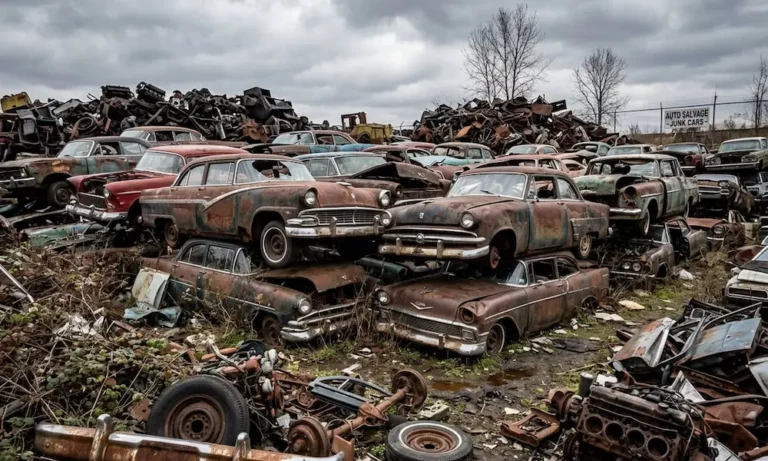
Got a dead car taking up space? You’re probably wondering if it’s worth anything — and the answer is almost always yes. How much are junk cars worth depends on more than just rust and age. This guide breaks down exactly what drives the price, what tanks it, and how to squeeze out every dollar possible.
The National Average — And Why It Barely Matters
The national average payout for a junk car sits at $475. Sounds simple, right? It’s not.
That number is a middle-ground figure that hides a massive range. Depending on your car’s weight, condition, location, and what’s still attached to it, your actual offer could land anywhere between $100 and $5,000.
A stripped-out economy sedan in rural Kansas? Probably closer to $100. A running full-size pickup in Los Angeles? You could pocket $1,500 or more.
So forget the average. Let’s talk about what actually moves the needle.
How Scrap Yards Calculate What Your Car Is Worth
Step One: The Metal Floor
Every junk car has a baseline scrap metal value — the absolute minimum a buyer will pay, regardless of condition.
Here’s how yards calculate it:
Vehicle weight (lbs) ÷ 2,000 = Weight in tons × Local scrap rate per ton = Baseline value
Simple math. Heavier car = more steel = more money. That’s why trucks almost always outpay sedans on scrap alone.
Step Two: What’s Still on the Car
A complete, fully assembled vehicle is worth far more than a picked-over shell. Buyers plan to resell your parts. When those parts are gone, so is their profit margin.
Here’s what missing components cost you:
- Car won’t start: −$300 to −$2,000 (buyer assumes worst-case engine damage)
- Missing engine or transmission: −$200 to −$500 (drops to metal floor instantly)
- Missing wheels or tires: −$80 to −$200 (makes loading harder and slower)
- Deployed airbags: Severe deduction — signals structural frame damage
- Missing catalytic converter: One of the worst hits you can take (more on this below)
- Fire or flood damage: Major reduction due to destroyed wiring and structural integrity
The takeaway? Don’t strip the car before you sell it. Leave everything attached.
Scrap Metal Prices: What’s Actually Inside Your Car
Your car isn’t just steel. Modern vehicles contain a mix of metals that yards separate and sell individually. Understanding this helps explain why some cars fetch surprising prices.
| Metal | Material Type | Mid-2026 Price |
|---|---|---|
| Steel | Mixed automotive scrap | $146–$206/ton |
| Copper | Bare bright wire (clean) | $5.40/lb |
| Copper | Insulated automotive wire | $0.75–$2.10/lb |
| Aluminum | Clean cast engine blocks | $0.58/lb |
| Aluminum | Alloy rims | $0.75–$0.95/lb |
| Brass | Automotive radiators | $2.15–$3.00/lb |
| Lead | Standard car batteries | $0.22–$0.28/lb |
That copper wiring running through your doors and dash? Worth real money. Same with aluminum engine blocks and alloy wheels. Yards track the Producer Price Index for iron and steel scrap daily and adjust their offers accordingly.
The Catalytic Converter: The Wildcard in Your Car’s Value
No single part swings junk car prices more than the catalytic converter. And most people have no idea why.
Why It’s So Valuable
Catalytic converters contain three precious metals: platinum, palladium, and rhodium. These metals trigger chemical reactions that convert toxic exhaust gases into harmless emissions — a process required by federal law.
Rhodium alone regularly trades at thousands of dollars per ounce on the global commodities market. A standard converter holds roughly 3–7 grams of platinum, 2–7 grams of palladium, and 1–2 grams of rhodium.
That’s why an intact factory catalytic converter adds $50 to $400 to your car’s value on its own.
Hybrid Cars Are the Exception
Toyota Prius converters are in a league of their own. Because hybrids run their gas engines far less, the precious metals inside suffer far less degradation. Some late-model hybrid converters independently fetch several hundred to over a thousand dollars at recycling facilities.
That’s a big reason why a 3,000-pound Prius — a lightweight car by any measure — averages $914 as a non-running junk car. The converter carries serious weight in that number.
What Happens If It’s Missing
Thieves target catalytic converters because they’re easy to cut off and immediately valuable. If yours was stolen before you sell, expect a significant hit to your offer. It’s one of the single worst deductions a buyer can apply.
What Your Car Is Worth by Vehicle Type
Curb weight drives baseline value. Here’s how different vehicle classes stack up in 2026:
| Vehicle Class | Approx. Weight | Baseline Scrap Range |
|---|---|---|
| Compact Car | 2,500–3,000 lbs | $180–$310 |
| Midsize Sedan | 3,200–3,600 lbs | $230–$370 |
| Full-Size Sedan | 3,800–4,500 lbs | $275–$440 |
| Crossover / Small SUV | 3,300–4,000 lbs | $240–$390 |
| Minivan / Cargo Van | 4,300–6,000+ lbs | $315–$585 |
| Pickup Truck | 4,500–7,000+ lbs | $325–$680 |
| Large / Full-Size SUV | 5,000–6,000+ lbs | $360–$618 |
| Class A Motorhome | 13,000–30,000+ lbs | $945–$2,925 |
Trucks and large SUVs dominate. They’re heavier, so they win on metal weight — and their parts are in higher demand at repair shops.
Real Payouts by Make and Model
Baseline scrap is just the floor. What salvage yards actually pay factors in parts demand, catalytic converter value, and regional market conditions. Here’s what non-running junk cars actually averaged in early 2026:
| Vehicle | Weight | Baseline Scrap | Avg. Non-Running Payout |
|---|---|---|---|
| Toyota Prius | 3,000 lbs | $220–$310 | $914 |
| Toyota Corolla | 3,000 lbs | $220–$310 | $888 |
| Honda CR-V | 3,700 lbs | $270–$380 | $1,004 |
| Honda Civic | 3,000 lbs | $220–$310 | $564 |
| Ford F-150 | 5,500 lbs | $400–$570 | $636 |
| Hyundai Elantra | 3,000 lbs | $220–$310 | $633 |
| Ford Escape | 3,500 lbs | $260–$360 | $565 |
| Hyundai Sonata | 3,500 lbs | $260–$360 | $560 |
| Toyota Camry | 3,400 lbs | $250–$350 | $543 |
| Jeep Grand Cherokee | 5,000 lbs | $370–$520 | $531 |
| Nissan Sentra | 3,000 lbs | $220–$310 | $505 |
| Honda Accord | 3,499 lbs | $260–$360 | $474 |
| Chevrolet Impala | 3,500 lbs | $260–$360 | $343 |
Notice the Honda CR-V at over $1,000 — a crossover that barely clears the compact weight threshold. That premium comes from strong secondary parts demand from repair shops that trust Honda components to last.
Where You Live Changes Everything
Scrap metal is heavy. Moving it costs money. Yards near coastal ports and industrial hubs can ship crushed metal cheaply. Landlocked yards pay more in freight costs — and pass that pain directly to you.
Here’s how scrap rates break down by state tier in 2026:
| Tier | Price Per Ton | States |
|---|---|---|
| Tier 1 (Highest) | $170–$200 | California, Michigan |
| Tier 2 | $165–$195 | Illinois, Massachusetts, New Jersey, New York |
| Tier 3 | $160–$190 | Indiana, Ohio, Pennsylvania, Texas |
| Tier 4 | $155–$185 | Arizona, Colorado, Nevada, Oregon, Washington |
| Tier 5 | $150–$180 | Florida, Georgia, Tennessee, Virginia, Wisconsin |
| Tier 6 | $145–$175 | Alabama, Iowa, Mississippi, Nebraska, South Carolina |
| Tier 7 (Lowest) | $140–$170 | Alaska, Arkansas, Hawaii, Idaho, Montana, Wyoming |
The same car in Los Angeles earns more than the same car in Boise. Full stop.
How Your Car’s Age Affects the Offer
Age predicts parts demand better than almost anything else.
- 2015–2024: Highest premiums. Running vehicles fetch $1,500–$7,000+. Non-runners get $500–$1,500. Modern safety tech and electronics drive demand.
- 2010–2014: Still a strong market. Running models pull $800–$4,000. Non-runners get $300–$800. Dealers actively seek common parts.
- 2005–2009: Parts demand declining, but factory catalytic converters still hold significant value. Non-runners: $200–$600. Runners: up to $2,500.
- Pre-2004: Mostly metal value at this point. Expect $100–$400 for non-runners unless the car has collector appeal.
The Title Question: Don’t Leave Money on the Table
A clean title unlocks full market value. Without one, buyers apply a standard deduction of around $160 — and some yards refuse to buy at all to avoid accidentally purchasing stolen vehicles.
Here’s the smart move: check your state’s replacement title cost before you sell.
| State | Replacement Fee | Processing Time | Net Savings |
|---|---|---|---|
| Arizona | $4 | Same day | +$156 |
| Texas | $5 | 5–10 days | +$155 |
| Kentucky | $6 | Same day | +$154 |
| Georgia | $8 | 3–5 days | +$152 |
| California | $23 | 3–6 weeks | +$137 |
| Florida | $75 | 7–10 days | +$85 |
| Illinois | $95 | 2–4 weeks | +$65 |
In states like Arizona, Kentucky, and Michigan, you can walk into the DMV and walk out with a title the same day. That $4 investment returns $156 in avoided deductions. That’s the best ROI you’ll find anywhere.
No Title? Check Your State’s Age Exemption
Many states let older vehicles sell for scrap without a title, using an affidavit and photo ID instead:
- 10-year exemption: Louisiana, Mississippi, North Carolina
- 12-year exemption: Alabama, Arizona, Georgia, South Carolina, Tennessee
- 15-year exemption: Indiana, Kentucky, Vermont
- 20-year exemption: Connecticut, Maine
If your car qualifies, the process gets much simpler. Just know the vehicle gets permanently scrapped — no future registration, ever.
Local Yards vs. National Brokers: Who Pays More?
This one’s straightforward. Local salvage yards almost always pay more.
Here’s why:
Local yards own the tow trucks, the dismantling bays, and the parts inventory. They extract a working engine, harvest the catalytic converter, pull the alternator, and sell all of it directly. They can afford to pay you more because they capture 100% of the downstream value.
National online brokers don’t own any of that. They’re lead generators. They collect your info, quote you a number, and sell that lead to a local tow operator — keeping a cut for themselves. That cut comes straight off your payout. Expect $70 to $300 less than a direct local yard offer, every time.
The math isn’t complicated. Skip the middleman.
Scams to Watch For When Selling a Junk Car
The cash-for-cars space has its share of bad actors. Here’s what to watch out for:
The Bait-and-Switch
A buyer quotes you a high number over the phone, then the tow driver shows up and suddenly finds “problems” that slash the offer. You’re stuck with a truck blocking your driveway and a lowball number.
Fix: Get the quote in writing. If the price changes on arrival, send them away.
Hidden Towing Fees
Reputable yards include towing in their offer. Shady operators quote well, then deduct surprise “logistics fees” from your payout after the car is already on the truck.
Fix: Confirm in writing that towing is free before scheduling pickup.
Fake Checks and Overpayment Scams
A private buyer sends a check for more than the agreed price and asks you to wire back the difference. The check bounces. You’re out the car and the refund.
Fix: Only accept cash or verified payment at the moment of exchange. No wire transfers. No third-party escrow from strangers.
What Happens to Your Car After the Sale
Once a licensed yard takes possession, environmental processing is mandatory before any crushing begins. Trained technicians drain engine oil, transmission fluid, brake fluid, coolant, refrigerant, and fuel using closed-loop systems that prevent ground contamination.
Lead-acid batteries go to specialized lead recyclers. Mercury switches get carefully removed. Airbag inflators — which are essentially small explosive devices — require certified handling and disposal.
Only after full hazmat processing does the remaining steel shell get crushed, shredded, and shipped to a foundry. It’s a surprisingly regulated process — which is also why unlicensed buyers cutting corners are a liability, not a bargain.
Three Moves That Maximize What You Get
You don’t need to be an expert to get a fair deal. Just do these three things:
- Keep the car intact. Don’t strip parts before selling. Every component you remove cuts into the offer.
- Get a duplicate title if you don’t have one. In most states, it costs under $25 and saves you at least $160 in deductions.
- Call a local salvage yard directly. Skip national brokers and their built-in cut. A real yard with real infrastructure pays real money.
How much are junk cars worth? Anywhere from $100 to over $5,000 — and now you know exactly which side of that range your car lands on.