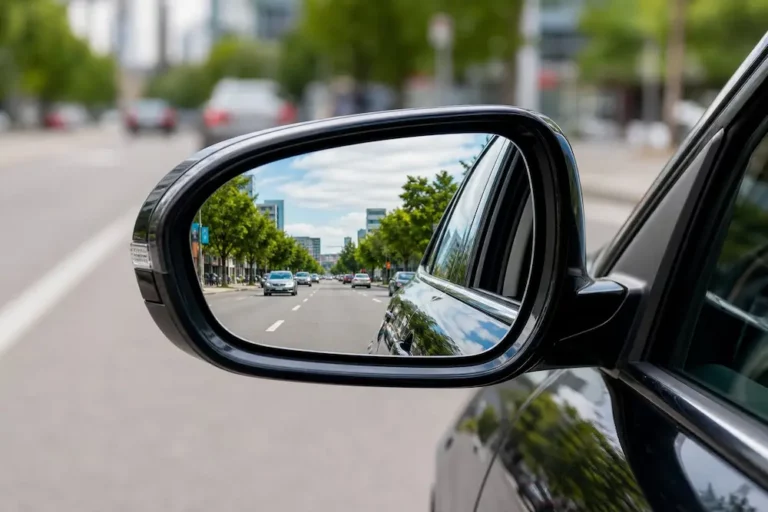
Your side mirror is cracked, hanging off, or completely gone. Now you need a number. The truth is, how much does a side view mirror cost depends on a surprisingly wide range of factors. This guide breaks down every cost you’ll face — parts, labor, paint, and the sensor calibration nobody warns you about.
The Short Answer: What Does a Side Mirror Replacement Cost?
For most drivers, a side view mirror replacement runs $150 to $870. But that’s a wide range, and both ends are real.
A basic manual mirror on an older car? You might pay under $100 doing it yourself. A sensor-packed mirror on a new Ford F-150 or luxury sedan? You could easily hit $1,500 to $2,000 when everything’s said and done.
Here’s a quick breakdown by mirror type:
| Mirror Type | Parts Cost | Labor Cost | Total Estimate |
|---|---|---|---|
| Manual Adjustment | $40 – $120 | $50 – $100 | $90 – $220 |
| Basic Power Adjust | $80 – $250 | $75 – $125 | $155 – $375 |
| Heated + Turn Signal | $150 – $450 | $100 – $150 | $250 – $600 |
| Cameras & ADAS Sensors | $300 – $1,200+ | $125 – $250+ | $425 – $1,500+ |
What Actually Needs Replacing?
Before you panic, figure out what’s actually damaged. The repair shop certainly will.
Just the Glass
If the housing, motors, and wiring are fine but the glass is shattered, you don’t need a full assembly. Replacement mirror glass typically costs $15 to $75, and many of these snap right onto the existing motor base with adhesive backing.
This is the ideal DIY situation. It takes under 30 minutes and basic tools.
Just the Housing or Skull Cap
A sideswipe or parking lot scrape might crack the outer plastic shell while leaving the motors and glass intact. Replacing just the cap is a middle-ground fix, but you’ll still need it painted to match your car. More on that cost below.
The Full Assembly
When the mirror gets sheared off completely or internal motors and wiring are damaged, you need a full replacement unit. This is the most expensive scenario and where calibration costs enter the picture.
How Mirror Technology Drives Up the Price
The biggest cost driver isn’t your zip code or which shop you use. It’s what’s inside your mirror.
Manual mirrors are the cheapest fix on the market. No wiring, no motors. Parts run $29 to $120, and installation is simple. These are mostly on older vehicles and fleet base models.
Power mirrors add a small electric motor for remote adjustment. Still widely available from aftermarket brands, parts run $50 to $250. Labor stays manageable.
Heated mirrors with turn signals cost more because of the thermal grid behind the glass and extra wiring tied into your climate system. Expect parts alone at $150 to $500 before labor or paint.
ADAS-equipped mirrors are where costs get serious. These housings hold downward-facing cameras for 360-degree parking views, puddle lights, auto-dimming electrochromic glass, memory motors, and more. The parts alone run $300 to $1,200+. A BMW 330i mirror averages $1,060 total. A Mercedes-AMG C43 mirror can hit $1,340.
Real Costs by Vehicle Model
Here’s how side view mirror replacement costs break down across popular vehicles using OEM parts and professional labor:
| Vehicle | Estimated Total Cost | Main Cost Drivers |
|---|---|---|
| Chevrolet Silverado 1500 | $258 – $284 | High aftermarket availability |
| Nissan Altima | $520 – $548 | Standard power mechanisms |
| Toyota Corolla | $641 – $675 | Heated elements, turn signals |
| Toyota Camry | $747 – $779 | Blind-spot indicators, folding |
| Honda Civic | $845 – $872 | Camera systems (higher trims) |
| Honda Accord | $857 – $885 | Multi-angle cameras, memory |
| Honda CR-V | $927 – $965 | Full ADAS integration |
| Ford F-150 (high trim) | $1,801 – $1,832 | Telescoping, 360-degree cameras |
OEM vs. Aftermarket vs. Salvage: Which Parts Should You Buy?
Where you source your mirror matters as much as which mirror you buy.
OEM parts come straight from the manufacturer. They fit perfectly, work with all your car’s electronics, and carry a warranty. They’re also the most expensive option — often 20% to 50% more than aftermarket. Dealerships use OEM exclusively.
Aftermarket parts from brands like TYC, Dorman, K-Source, and Kool Vue cost significantly less and work well for most standard mirrors. A basic aftermarket power mirror might run $50 to $100 versus $200+ for the OEM version. The trade-off? Quality can vary, and complex camera systems may not communicate properly with your car’s computer.
Salvage or LKQ (Like Kind and Quality) parts are used OEM mirrors pulled from wrecked vehicles. They range from $30 to $300 depending on the technology level. The huge upside: you might find one already painted to match your car, which completely eliminates painting costs. The downside is availability — finding the exact match takes some searching.
Labor Costs: Dealership vs. Independent Shop
The hourly rate at your chosen shop is the second biggest cost variable.
Independent shops charge $70 to $130 per hour. They’re flexible on parts sourcing, tend to work faster on standard jobs, and cost significantly less for basic repairs. For an older car with a manual or simple power mirror, an independent shop gets the job done well.
Dealerships charge $120 to $180 per hour for mainstream brands. Luxury brands (BMW, Mercedes, Land Rover) and big cities push that to $200 to $350 per hour. That high rate isn’t going straight to your technician — it covers factory software licenses, manufacturer training, loaner fleets, and operational overhead. You do get certified technicians, OEM parts, and warranty coverage.
Most mirror installations take 0.5 to 2 hours of labor. Simple mirrors on older vehicles? Less than 30 minutes. Complex door panels on modern trucks with hidden fasteners? Closer to two hours.
The Hidden Cost Nobody Mentions: Paint Matching
New mirror assemblies almost never arrive painted. They come in raw black plastic or gray primer. If your car has a color-matched mirror cap, you’ll pay to have it painted.
Professional paint matching runs $50 to $150 for most colors. But here’s the catch: body shops charge minimum labor hours regardless of the job’s actual size. The setup time for mixing exact paint, cleaning spray guns, and running the curing booth is the same whether they’re painting a full fender or a tiny mirror cap. Some shops charge 1.5 to 2.8 refinishing hours minimum.
At a luxury dealership body shop, this small job can balloon. One BMW M5 owner was quoted $1,200 just to paint and install mirror caps, citing camera removal complexity and paint blending overhead.
Ways to reduce paint costs:
- Buy a pre-painted aftermarket mirror if available
- Source a color-matched salvage yard part
- Cover the cap with automotive vinyl wrap for a contrasting look
- Buy aftermarket carbon-fiber mirror covers
ADAS Calibration: The Cost That Catches People Off Guard
This is the one most people don’t see coming.
When your mirror houses a camera for 360-degree parking views, replacing the assembly isn’t enough. The camera needs to be digitally recalibrated so your vehicle’s computer knows exactly where it’s looking.
First, Let’s Clear Up the Blind Spot Confusion
Here’s something worth knowing: in most vehicles, the blind spot radar sensors aren’t in the side mirror. They’re mounted behind the rear bumper. The mirror just displays the warning light as an output signal. Replacing a blind spot indicator mirror generally doesn’t require a radar recalibration. If a shop insists on charging $400 for rear radar calibration because you replaced a mirror with a warning light, verify the manufacturer’s procedures first.
When Calibration Is Mandatory
If your mirror contains an actual downward-facing camera for surround-view parking, calibration isn’t optional. An uncalibrated camera produces distorted images, triggers constant warning lights, and can disable safety systems entirely.
There are two calibration methods:
- Static calibration: Your car sits on a level surface while technicians position large geometric target boards at precise distances. Diagnostic software aligns the camera optically to those targets.
- Dynamic calibration: A technician drives the car on a marked highway at specific speeds. The system self-calibrates using lane lines and surrounding infrastructure.
ADAS calibration services typically cost:
| Calibration Type | Average Cost Range |
|---|---|
| Backup/Side Camera | $250 – $300 |
| Lane Keep Assist | $300 – $400 |
| Blind Spot Monitor (Rear Radar) | $300 – $400 |
| 360-Degree All-View Monitor | $350 – $450 |
According to AAA research via Kelley Blue Book, average repair costs for ADAS-equipped vehicles hit $5,300 for minor front or rear damage — more than double the cost for vehicles without these systems. That’s the financial reality of modern safety technology.
Is This a DIY Job?
For simple mirrors, absolutely. Here’s an honest look at when to attempt it yourself and when to step back.
DIY works well when:
- Your car has a manual or basic power mirror
- You’re only replacing the glass (30-minute job, no special tools)
- You’re comfortable removing interior door trim panels
- No cameras or sensors are involved
Replacement mirror glass with adhesive backing starts around $15. Basic assemblies can be sourced for under $100. Removing most older door panels only requires a trim removal tool, socket wrench, and some patience.
Step back when:
- Your mirror has cameras or sensors
- You’re not comfortable around electrical connectors and wiring harnesses
- The car is under factory warranty
- ADAS calibration is required — you won’t have the software for it
Breaking a wiring harness pin or snapping hidden door panel clips can turn a $200 repair into a much more expensive one.
Should You Use Insurance?
The math here is straightforward.
If your repair is less than your deductible, don’t file a claim. Pay out of pocket and move on. Filing a claim that doesn’t pay out still shows up in your claims history.
If your repair significantly exceeds your deductible, insurance makes sense. A sensor-equipped mirror replacement at $1,500+ total, minus a $500 deductible, saves you $1,000. That’s worth the filing.
Industry guidance suggests filing a claim only when the repair exceeds your deductible by at least 50%. Below that margin, the potential future premium impact isn’t worth it.
Legal Reality: Can You Drive Without a Side Mirror?
Short answer: it depends on your state, but driving without one is risky legally and physically.
Federal Motor Vehicle Safety Standards (FMVSS) require new cars to have a driver’s side mirror and sufficient rear visibility. State laws handle ongoing requirements.
Texas and Florida require mirrors capable of providing a clear view at least 200 feet to the rear. If your interior rearview mirror achieves that, some states technically allow you to drive without a passenger-side mirror. But if you’re towing, carrying cargo, or have tinted rear windows, both side mirrors become legally required in most states.
California requires at least two functional mirrors at all times, with the driver’s side mirror being mandatory regardless.
Getting stopped for a mirror violation typically results in fines from $30 to $200, depending on the state. Virginia’s fine starts at $30 plus a $51 administrative fee. Texas classifies it as a Class C misdemeanor with fines up to $200. Many jurisdictions offer “fix-it tickets” that get dismissed once you show proof of repair.
The civil liability risk is just as real. In a lane-change collision, driving without functioning mirrors can assign you a higher percentage of fault under comparative negligence laws, even if the other driver caused the accident.
Before You Pay Anything: Check for Recalls
Do this before you hand over a credit card. Manufacturers issue recalls for mirror defects more often than people realize.
Honda issued a recall for specific 2020-2022 Odyssey, Passport, 2020-2021 Pilot and Ridgeline models because mirror glass adhesive was failing, causing the glass to detach while driving. Dealers replaced the entire mirror assembly free of charge.
Check your VIN at NHTSA’s recall database before paying out of pocket. A repair you’re legally entitled to receive for free is one you should never pay for.
The Bottom Line on Side Mirror Replacement Costs
Here’s where things land depending on your situation:
- Older car, basic mirror, DIY: $15 to $100
- Modern car, basic power mirror, independent shop: $155 to $375
- Mid-size sedan with heating and signals, professional install: $250 to $600
- ADAS-equipped vehicle, OEM parts, dealership labor, calibration, paint: $800 to $2,000+
The technology inside your mirror is the biggest single cost driver. Know what features your car has before getting a quote. And always check for active recalls — you might save yourself hundreds of dollars before you even pick up the phone.