Picking between the TH400 vs TH350 can feel like a coin flip — both are legendary GM automatics, both use the same basic Simpson planetary design, and both have been building reputations since the muscle car era. But they’re not the same transmission. The right choice depends on your engine, your goals, and yes, your budget. Read to the end and you’ll know exactly which one belongs in your build.
A Quick History of Both Transmissions
The TH400 came first. GM dropped it into production in 1964, initially in Cadillacs and Buicks before rolling it out across the rest of the lineup. The goal was straightforward — build a transmission tough enough to handle big-block torque and heavy-duty commercial applications. It worked so well that Rolls-Royce, Ferrari, and Jaguar eventually used it too.
The TH350 arrived in 1969 as a joint Chevrolet and Buick project. It replaced the old two-speed Powerglide in lighter vehicles and struck a balance between the Powerglide’s simplicity and the TH400’s brute strength. It became one of the most-produced transmissions in automotive history before the four-speed 700R4 phased it out in the early 1980s.
Both transmissions share the same basic architecture. The differences come down to size, strength, and how each one handles power.
Physical Differences: Size and Weight
The TH350 is the compact option. Its total length runs between 21.75 and 22.75 inches, and it tips the scales at around 120 pounds dry. That light build wasn’t an accident — GM engineered it that way to reduce front-end weight and help fuel efficiency in passenger cars.
The TH400 is noticeably bigger. Its main case stretches to approximately 24.375 inches, and it runs 20 to 40 pounds heavier than the TH350 depending on the tailshaft setup. The walls are thicker, the casting is heavier, and every inch of it is built to absorb punishment.
Here’s a look at how the tailshaft configurations affect total length:
| Transmission | Tailshaft Style | Total Length | Rear Mount Location |
|---|---|---|---|
| TH350 | 6-inch | 27.687 in. | 20.375 in. |
| TH350 | 9-inch | 30.687 in. | 20.375 in. |
| TH350 | 12-inch | 33.843 in. | 20.375 in. |
| TH400 | C-Style (Short) | 28.375 in. | 24.312 in. |
| TH400 | D-Style (Medium) | 33.843 in. | 27.937 in. |
| TH400 | 13-inch (Long) | 37.875 in. | 27.656 in. |
That difference in rear mount location matters a lot when you’re doing a swap. The TH400’s mount sits further back on the case, which usually means moving the frame crossmember. Plan for that before you start unbolting things.
Gear Ratios: How They Compare
Both transmissions use the Simpson planetary geartrain and offer three forward speeds. The ratios are close, but not identical:
| Gear | TH350 Ratio | TH400 Ratio |
|---|---|---|
| First Gear | 2.52:1 | 2.48:1 |
| Second Gear | 1.52:1 | 1.48:1 |
| Third Gear | 1.00:1 | 1.00:1 |
The TH350’s slightly deeper first gear (2.52:1) gives lighter, lower-torque engines a small advantage off the line. The TH400’s 2.48:1 first gear suits big-block motors where traction — not gear ratio — is the real limiting factor.
One major structural difference: the TH400 uses overrunning clutches for both first and second gear reaction. That design eliminates the need to simultaneously release a band and apply a clutch during the 2-3 shift. The result is a transmission that handles extreme torque and high shift-cycle counts far better than the TH350 in demanding applications.
How to Tell Them Apart
You don’t need a spec sheet to identify these transmissions. A quick look underneath tells you almost everything.
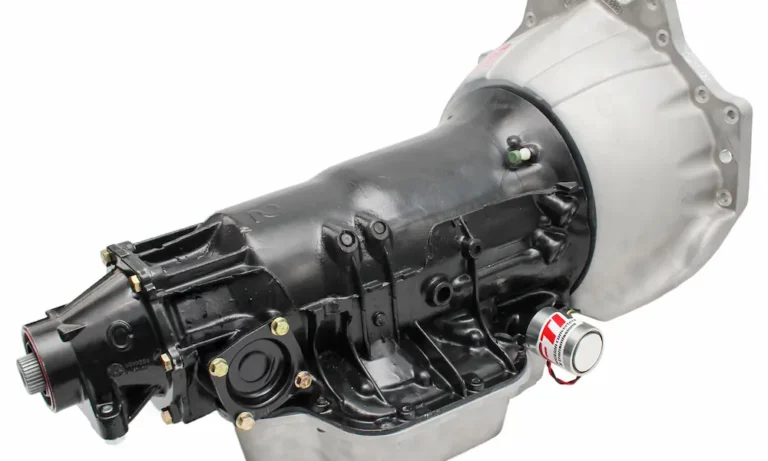
TH350 pan: Roughly square with one corner cut at an angle — it’s got a five-sided look. The vacuum modulator sits at the very rear of the passenger side of the case. It uses a mechanical kickdown cable connected to the throttle linkage.
TH400 pan: Larger, highly irregular shape — most people say it looks like the state of Texas or Illinois. The modulator sits much further forward on the passenger side. Instead of a cable, it uses an electrical kickdown solenoid with a connector on the driver’s side of the case.
Both units typically use 13 pan bolts. Still not sure what you’ve got? Check the output shaft. The TH350 runs a 27-spline shaft. The TH400 uses a larger 32-spline shaft.
Decoding ID Tags and Stamps
GM stamped identification codes directly into the casting on later units. Here’s where to look:
- TH350: Tags or stamps near the passenger-side bellhousing flange or shift linkage. Codes like MV4, MX2, and MX3 identify the TH350C lock-up converter variant built from 1979 to 1984.
- TH400: Stamps on the driver’s side of the case above the oil pan. A code like P9E03 means: P = transmission type, 9 = year (1969), E = month, 03 = day.
Torque Capacity and Performance Potential
This is where the TH400 vs TH350 debate gets real.
The TH350’s weak point in high-power builds is the intermediate sprag. Stock, it starts to fail around 400 horsepower — the outer race cracks or rolls over and you lose second gear. With upgraded clutch packs, a hardened shaft, and an aftermarket valve body, a fully built TH350 can hold 700 to 800 horsepower while keeping its weight advantage.
The TH400 handles 1,000+ horsepower with relatively modest upgrades. In professional drag racing, specialized aftermarket cases handle 2,500 to 3,000 horsepower. Even the stock TH400 sprag is significantly stronger than the TH350’s — though at extreme power levels, upgrading to a 34-element aftermarket sprag is a smart move.
For bracket racers and street machine owners, the TH350 wins on weight savings and reduced parasitic loss. For serious big-block builds and anything over 600 horsepower, the TH400 is the safer long-term choice.
Swapping One for the Other
Swapping a TH350 for a TH400 (or vice versa) is doable, but it’s not a straight bolt-in. Here’s what you’re dealing with:
Output shaft and driveshaft: The TH400’s 32-spline output shaft won’t work with a TH350 yoke. You’ll need to swap the yoke and shorten the driveshaft by roughly one to two inches to account for the TH400’s extra length.
Crossmember location: The TH400’s mount sits further back. Many GM frames from that era have a secondary set of pre-drilled holes for exactly this reason. If yours doesn’t, you’re cutting and welding. Also check your emergency brake cable routing — the longer TH400 can interfere with the original path.
Kickdown system: Going from a TH350 to a TH400 means switching from a mechanical cable to an electric kickdown switch. That’s a wiring job, not just a parts swap.
Speedometer gears: The driven and drive gear counts need to match your rear-end ratio and tire size after the swap. Don’t skip this step or your speedometer will lie to you.
Cooler lines: TH350 cooler fittings use 1/8-inch pipe thread. The TH400 uses different sizes, so stock TH350 lines won’t bolt up without adapters.
Fluid Health and Maintenance
Both transmissions tell you a lot through their fluid. Healthy fluid is red. Brown or black fluid means thermal damage or worn clutch material is already in suspension. A burnt smell means internal slippage is happening right now.
Change the filter and clean the pan on a regular service interval. Metal debris in the pan clogs internal passages and accelerates wear. For any towing or performance application, install an auxiliary transmission cooler in series with the radiator. It’s cheap insurance against the biggest killer of these transmissions: heat.
Watch for delayed engagement when the transmission is cold. That’s usually a sign that internal lip seals have hardened from years of thermal cycling. If the vacuum modulator diaphragm ruptures, the engine pulls transmission fluid through the vacuum line and burns it — white smoke from the exhaust is the tell.
Also check your flexplate. A cracked flexplate produces a rhythmic knock that sounds like an engine problem. Left alone, it throws the torque converter out of alignment and destroys the front pump seal and pump bushing.
TH400 vs TH350 With an LS Engine
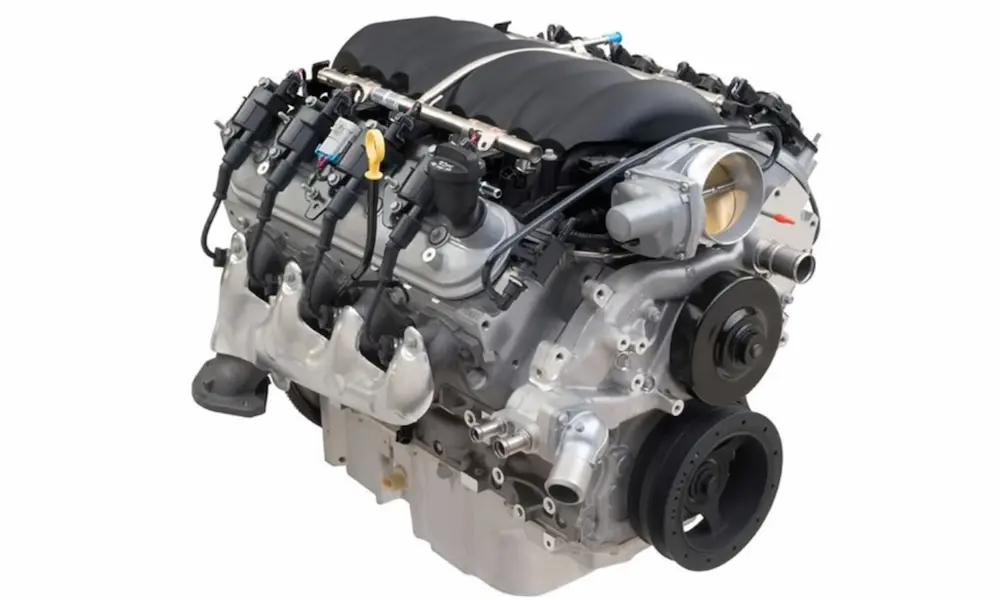
Running either of these transmissions behind an LS motor requires one extra step. The LS crankshaft is slightly shorter than older small-block or big-block cranks, so a vintage torque converter won’t engage the pump correctly. The fix is a dished flexplate and a pilot spacer — the flexplate provides the correct bolt pattern and the spacer centers the converter pilot in the crank. Adapter kits for this are widely available and make the pairing completely reliable.
Which One Should You Choose?
Here’s the honest answer: it depends entirely on what you’re building.
Choose the TH350 if:
- You’re running a small-block or mild big-block under 500 horsepower
- Weight matters to you — track prep, autocross, lighter builds
- You want a simpler, cheaper rebuild
- You’re building a street car that needs decent fuel economy
Choose the TH400 if:
- Your engine makes serious torque — think 454, 502, or any stroker motor
- You’re towing, hauling, or wheeling off-road
- You’re building a dedicated drag car or high-horsepower street machine
- Long-term durability matters more than saving 30 pounds
The TH350 is the efficiency choice. The TH400 is the bulletproof choice. Both are genuinely excellent transmissions — the key is matching the right one to your specific build instead of just grabbing whatever’s on the shelf.