Your car’s AC is blowing warm air, and you’re sweating through your commute. You’re probably wondering how often to recharge car AC — and whether you’re overdue. The answer isn’t what most people expect. Read on, because getting this wrong can cost you thousands.
Your Car AC Refrigerant Doesn’t Actually “Run Out”
Here’s the thing most people get wrong. Your car’s AC system is a completely sealed loop. The refrigerant inside doesn’t get used up like gas in a tank. It just cycles back and forth between liquid and gas, pulling heat out of your cabin.
So if your refrigerant is low, something is leaking. Full stop.
A study from the Automotive Service Association found that 85% of AC recharge services were performed on systems with actual, detectable leaks. Not natural depletion. Leaks.
A well-maintained AC system can run for 10 to 15 years without a recharge. Car manufacturers don’t set a recharge schedule for a reason — refrigerant isn’t a maintenance consumable like oil or brake fluid.
Bottom line: if your AC needs a recharge, find the leak first. Otherwise, you’re just watching your money evaporate along with the refrigerant.
So Why Does Refrigerant Level Drop Over Time?
Even in a “leak-free” system, tiny amounts of refrigerant can escape. The AC circuit uses a mix of rigid aluminum tubing and flexible rubber hoses to handle engine vibration. Those rubber sections, plus every threaded fitting and Schrader valve, allow micro-permeation.
According to SAE engineering standards, each fitting can seep up to ¼ oz of refrigerant per year. A typical car has around eight fittings. That adds up to roughly 2 oz of refrigerant lost annually — even in a perfectly healthy system.
That sounds minor, but here’s the catch. Older AC systems held 36+ oz of refrigerant. Losing a few ounces over several years? Barely noticeable. Modern vehicles run leaner systems — sometimes just 15 oz total. Lose 3–4 oz and the pressure drops below what the compressor needs to kick on. Suddenly, you’ve got no cold air.
Winter Inactivity Makes It Worse
Skipping the AC all winter isn’t harmless. The refrigerant carries lubricating oil that keeps your compressor healthy and your rubber seals pliable. When the system sits idle for months, that oil pools at the bottom of the lines. The seals dry out, shrink, and crack.
Run your AC for 10–15 minutes once a month, even in January. It keeps oil circulating and seals in good shape.
Where You Live Changes How Often You Need AC Service
Climate plays a huge role in how fast your AC system degrades. Hot, sunny states put far more strain on the system than cooler ones. Higher ambient temps mean higher operating pressure, which accelerates micro-permeation through rubber hoses. Extreme under-hood heat also speeds up rubber deterioration.
Here’s how annual refrigerant leakage varies by state, based on published emissions data:
| State | Low Leakage Rate (g/year) | High Leakage Rate (g/year) | Main Driver |
|---|---|---|---|
| Alaska | 6.83 | 7.51 | Minimal operational strain |
| New York | 12.56 | 13.81 | Moderate seasonal wear |
| North Carolina | 15.73 | 17.30 | Warm temps, elevated humidity |
| Florida | 22.94 | 25.23 | Prolonged annual use cycles |
| Arizona | 25.93 | 28.52 | Extreme heat, high system pressure |
If you’re in Florida or Arizona, an annual pre-summer AC inspection makes a lot of sense. In Alaska or New York, you might go several years without needing any service at all.
Warning Signs Your Car AC Needs Attention
Don’t wait until you’re melting in traffic. Your system will telegraph problems early if you know what to look for.
Cooling performance issues:
- Air feels cool but not cold from the vents
- Takes much longer than usual to cool the cabin
- Blower works but warm or hot air comes out
- Windshield defroster stops working properly in damp weather
Mechanical and visual clues:
- Compressor clutch rapidly clicks on and off, or doesn’t engage at all
- Greasy, oily residue around hoses, fittings, or the condenser
- Ice or frost forming on refrigerant lines or the evaporator coils
- Greasy puddles forming under a parked car
Sounds and smells:
- Hissing, bubbling, or faint whistling from behind the glove box
- Musty or moldy smell from the vents — a sign of mold on a damp evaporator core
- Sweet chemical smell — possible refrigerant leaking directly into the cabin
Performance dips:
- Sudden drop in fuel economy
- Engine running hotter than normal on hot summer days — a low-charge AC system strains the engine
Spot two or more of these? Get a diagnostic, not just a recharge.
Professional AC Service vs. DIY Recharge Kits
Those $30 cans at the auto parts store look like an easy fix. They’re not. Here’s how professional service and DIY interventions stack up — and why the difference matters a lot.
| System Parameter | Professional Service | DIY Kit | What Goes Wrong |
|---|---|---|---|
| Charge measurement | By weight, using precision digital scales | Estimated via pressure gauge | Overcharging causes compressor damage |
| Moisture removal | Deep vacuum for 30–45 minutes | None — adds on top of existing moisture | Trapped water forms corrosive acids inside the system |
| Leak repair | UV dye or electronic sniffer locates the leak | Stop-leak sealant tries to plug it | Sealant clogs expansion valves and destroys the compressor |
| Fluid purity | Evacuated and refilled with vehicle-specific refrigerant | Risks mixing incompatible refrigerants | Mixed fluids swell seals and void warranties |
Why DIY Stop-Leak Sealants Are a Trap
That stop-leak additive in many DIY kits polymerizes when it hits moisture or air. It might plug a tiny hose leak temporarily. But it also reacts with moisture already inside the lines, solidifying inside the system. It permanently clogs your expansion valve and can destroy the compressor.
Worse, it contaminates professional recovery machines. Most shops will refuse to service your car if you’ve used stop-leak. You’ll pay for a full flush before any repair work even starts.
The Refrigerant Compatibility Problem
Pre-1994 vehicles use R-12. Cars from 1994 into the late 2010s use R-134a. Newer models use R-1234yf. Most DIY cans contain generic R-134a. Put the wrong refrigerant in a modern vehicle and you’ll swell the seals, destroy the compressor, and void any component warranty you have.
What a Professional AC Service Actually Looks Like
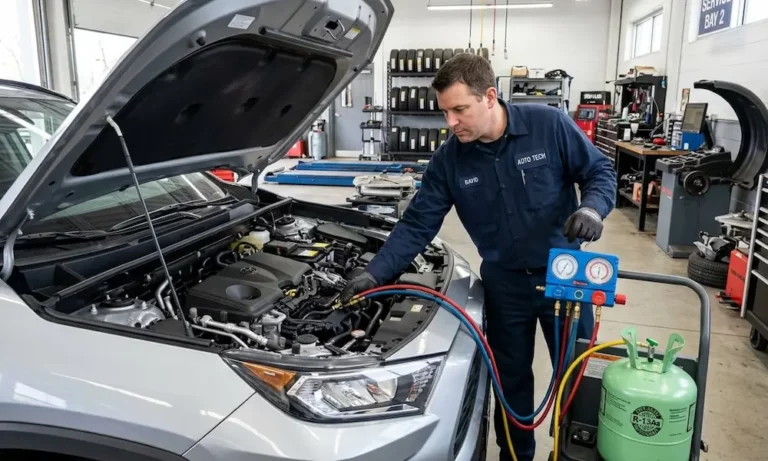
A proper service from a certified technician follows a specific sequence:
- Visual inspection — belts, hoses, fittings, and accessible lines checked for cracks and oil residue
- Full evacuation — all remaining refrigerant recovered and weighed to confirm the deficit
- Deep vacuum — system pulled to vacuum for 30–45 minutes, which vaporizes and removes all trapped moisture
- Leak detection — electronic sniffer or UV fluorescent dye pinpoints the exact leak location
- Repair — damaged O-rings, hoses, or components replaced
- Recharge by weight — refrigerant added using precision digital scales to the manufacturer’s exact specification
That last step matters more than most people realize. Overcharging by even a small margin raises hydraulic pressure across the whole system and accelerates wear on the compressor clutch.
The Real Cost of Ignoring Your Car’s AC
Skipping a small repair today usually means a much bigger bill later. Here’s what different levels of AC service actually cost:
| Service Type | Cost Range (USD) | Key Detail |
|---|---|---|
| Cabin air filter replacement | $30–$60 | Replace every 15,000–30,000 miles to protect airflow |
| AC inspection and diagnostics | $150–$250 | Catches small leaks before they destroy the compressor |
| Professional AC recharge | $100–$310 | Cost varies by refrigerant type and regional labor rates |
| O-ring and hose replacement | $300–$450 | Re-seals the system properly |
| Compressor clutch replacement | $600–$1,100 | Catches early compressor trouble before full seizure |
| New compressor replacement | $1,300–$2,500 | Often the result of ignoring a small leak too long |
| Full AC system replacement | $2,750+ | Completely avoidable with annual professional inspections |
When a compressor fails, it doesn’t just fail quietly. It often sheds metal debris throughout the entire system. At that point, your tech also needs to replace the condenser, receiver-dryer, and expansion valve. A $200 seal repair becomes a $2,500+ overhaul.
The cabin air filter is easy to overlook, but it’s a surprisingly important piece of the puzzle. A clogged cabin filter restricts airflow across the evaporator, forces the blower motor to work harder, and puts unnecessary thermodynamic strain on the compressor. It’s a cheap part. Change it regularly.
How Often to Recharge Car AC — The Simple Summary
The real answer to how often to recharge car AC depends entirely on whether your system has a leak.
- No leak, temperate climate: You may go 10–15 years without needing a recharge at all
- No leak, hot climate (Florida, Arizona): Schedule a professional inspection every year before summer
- Active leak: Get the leak fixed first, then recharge — otherwise you’re wasting money
- Any warning signs present: Don’t wait. Get a diagnostic before the problem reaches your compressor
Run your AC for 15 minutes every month year-round, change your cabin air filter on schedule, and book that annual inspection if you live somewhere hot. That’s genuinely all most car owners need to do to keep their AC running cold for years.