Got a mystery paint smear on your door after a tight parking lot squeeze? Before you panic or call a body shop, there’s a good chance you can fix it yourself. This guide walks you through exactly how to remove paint scuff from car surfaces safely, without wrecking your clear coat in the process. Read to the end — the order you do this matters a lot.
First, Figure Out What You’re Actually Dealing With
Not every mark on your car is the same. Treating a deep scratch like paint transfer — or vice versa — will make things worse.
Here’s the key distinction:
- Paint transfer = foreign paint sitting on top of your clear coat (additive defect)
- A scratch = your clear coat has been physically gouged or removed (subtractive defect)
Run your fingernail lightly across the mark. If it glides over smoothly or feels slightly raised, you’re dealing with surface transfer or a light scuff — great news. If your nail catches in a groove, the damage runs deeper and may need professional attention or touch-up paint.
Next, dab the mark gently with a damp white microfiber cloth. If the foreign color transfers onto the cloth, it’s sitting on the surface and you can remove it. If you see bare gray metal or primer underneath, stop — that panel needs paint, not polishing.
| Test | What You See | What It Means | What to Do |
|---|---|---|---|
| Visual inspection | Foreign color sitting above glossy surface | Paint transfer | Proceed with removal |
| Microfiber wipe test | Color transfers onto the cloth | Surface-level transfer | Safe to clean and polish |
| Fingernail test | Nail glides over or feels a slight bump | Minor scuff or transfer | Standard removal methods work |
| Fingernail test | Nail catches in a groove | Deep scratch | Touch-up paint or professional repair |
Wash the Area First — Don’t Skip This
This step stops most DIY attempts from turning a small scuff into a scratched-up mess.
Rubbing a dirty panel grinds road grit, brake dust, and silica particles directly into your clear coat. Even if your hands feel clean, the panel isn’t.
Use the two-bucket wash method: one bucket with pH-neutral car shampoo, one with plain rinse water. Load your microfiber wash mitt from the soap bucket, wash the panel, then rinse the mitt in the clean water bucket before going back for more soap. This keeps grit from cycling back onto your paint.
Work in straight lines. Use zero downward pressure. Let the soap do the lifting.
Here’s a bonus: fresh, light paint transfer sometimes wipes away during this wash step alone. If the scuff is recent, a well-lubricated microfiber mitt might clear it completely without any further effort. Check the panel after drying before moving on.
The Golden Rule: Start Mild, Escalate Slowly
Professional detailers follow one core principle when learning how to remove paint scuff from car surfaces: always use the least aggressive method first.
Your factory clear coat is incredibly thin — roughly the thickness of a single piece of plastic wrap. Every abrasive step removes a microscopic layer of it. Once it’s gone, it’s gone.
The escalation order looks like this:
- Penetrating oil (WD-40)
- Toothpaste (mild abrasive)
- Detailing clay
- Abrasive compound or polish
- Chemical solvents (last resort, professionals only)
Work through these steps patiently. Don’t jump to step four because step one feels slow.
Method 1: WD-40 for Light Paint Transfer
WD-40 works as a mild softening agent and heavy lubricant, not an abrasive. It seeps into the porous structure of the foreign paint and loosens its bond to your clear coat.
How to do it:
- Spray WD-40 generously over the scuffed area
- Let it sit for 1–2 minutes — don’t skip the dwell time
- Wipe with a clean, dry microfiber towel using light circular pressure
- Check progress, repeat if needed
- Wash the entire area with car shampoo to remove the oily residue
The hydrocarbon solvents in WD-40 are mild enough that they won’t etch a healthy clear coat. Just make sure you wash all the residue away after — leftover oil will prevent any wax or sealant from bonding properly.
This method takes patience and some elbow grease. Expect to repeat the process two or three times on moderately bonded transfer.
Method 2: Toothpaste for Minor Scuffs
Whitening toothpaste contains finely milled calcium carbonate — a mild abrasive similar in principle to a light automotive polish. It gently removes the softer foreign paint without immediately cutting into your harder clear coat.
What you need:
- White paste toothpaste (not gel — gel has no abrasive texture)
- A damp microfiber cloth or soft cotton towel
How to do it:
- Apply a small amount of toothpaste to the damp cloth
- Rub onto the scuff using light pressure in tight circular motions
- Wipe residue away with a clean section of cloth periodically to check progress
- Stop as soon as the transfer is gone — continuing will dull your clear coat
- Rinse with clean water, dry, and apply wax to protect the bare area
Don’t get aggressive here. The abrasive action builds up over multiple gentle passes. Continuing to scrub after the transfer is gone will create dullness you’ll need a polish to fix.
Method 3: Detailing Clay for Stubborn Transfer
When WD-40 and toothpaste don’t cut it, a polymer detailing clay bar physically grabs and shears the bonded transfer off the surface without aggressively cutting into the paint beneath.
Two formats exist:
- Clay towel — easier to handle, safer, covers more area, good first choice
- Clay bar — more aggressive grip, better for heavily bonded transfer
Critical rule: Heavy lubrication is non-negotiable. Dry clay on dry paint causes instant, severe scratching. Spray the panel generously with a dedicated clay lubricant or diluted car shampoo before you touch the surface.
How to do it:
- Spray clay lubricant heavily across the scuffed panel
- Glide the clay in straight, even strokes — not circles
- Apply minimal downward pressure; let the clay’s stickiness do the work
- Fold the clay frequently to expose a clean surface
- If you drop the clay bar, throw it away immediately — it picks up grit from the floor and will scratch your paint instantly
Expect light marring after claying. It’s normal. A finishing polish in the next step removes it.
Method 4: Abrasive Compound or Polish
If the transfer is still there, or if earlier steps left the clear coat looking hazy, it’s time for a dedicated abrasive product. This is the most powerful DIY method for how to remove paint scuff from car finishes without a body shop.
Choosing the Right Product
| Product | Best For | Application |
|---|---|---|
| Meguiar’s Ultimate Compound | Heavy transfer, moderate scratches, diminishing abrasive technology | Hand or DA polisher |
| Turtle Wax Heavy Duty Rubbing Compound | Very stubborn, thick transfer and oxidation | Hand application |
| Chemical Guys VSS | Light to moderate scuffs, swirl removal | Hand or DA polisher |
| Quixx Paint Scratch Remover Kit | Pro-level multi-stage scuff repair | Hand application |
How to Apply by Hand
- Work in a shaded area on a cool panel — sunlight flash-dries the compound and causes dry abrasion
- Dispense a dime-sized amount onto a foam or microfiber applicator pad
- Work the compound into the scuff using overlapping circular motions with moderate pressure
- As the transfer breaks down and the compound turns translucent, ease up on the pressure to let it polish rather than cut
- Remove residue with a clean microfiber towel before it dries
- Inspect the area — if transfer remains, repeat the process
- Follow with a finishing polish if the area looks dull
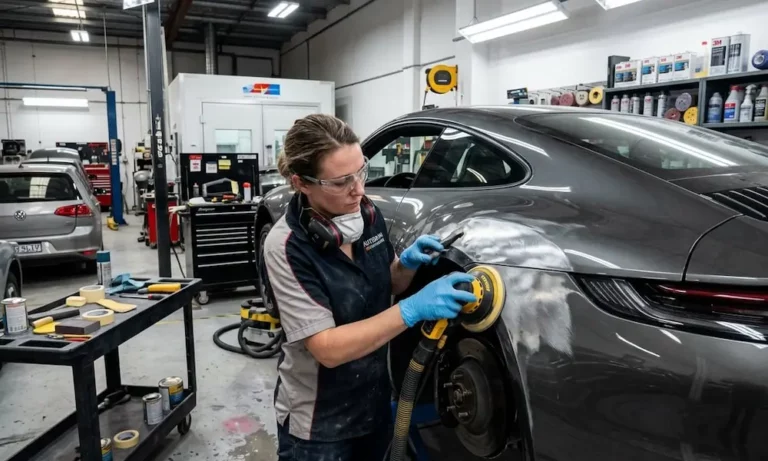
For large panels or long streaks of damage, a dual action (DA) random orbital polisher makes this dramatically faster and safer than hand compounding. Unlike old rotary buffers, a DA polisher oscillates randomly, so it can’t burn through your clear coat the way a single-axis machine can.
What NOT to Use: Two Methods That Cause Real Damage
Acetone and Nail Polish Remover
Acetone dissolves paint transfer fast, but it doesn’t stop at the foreign paint. It leaches plasticizers from your clear coat, causes brittleness, cracking, and dullness — and if it drips onto rubber trims or plastic cladding, it can melt them.
If a professional uses it as a last resort, they dilute it 50/50 with water, dab — don’t rub — and flush the area with soapy water within seconds. Leave this one to the pros.
Magic Erasers (Melamine Foam)
These feel soft in your hand but operate at the equivalent of 3,000–4,000 grit sandpaper under a microscope. Every microscopic cell edge acts as a tiny scraper.
A Magic Eraser will remove the transfer — and simultaneously scour the clear coat underneath it into a dull, hazy, swirl-marked mess. Heavy enough use burns straight through the clear coat to the base color. Fixing that damage requires machine compounding at minimum, and sometimes a full panel repaint.
Keep Magic Erasers away from glossy exterior paint, full stop.
Protect the Repaired Area Immediately
Every single removal method — even a light clay — strips away any wax, sealant, or ceramic coating on that section of paint. Leaving it bare exposes the clear coat to UV damage, oxidation, and accelerated fading.
Apply protection the same day you finish the repair. Here’s how the three main options compare:
- Carnauba wax — warm, rich gloss, easy hand application, lasts 1–3 months
- Synthetic polymer sealant (like Meguiar’s Hybrid Ceramic Liquid Wax) — stronger UV resistance, intense water beading, lasts up to 6 months
- Ceramic coating — liquid quartz that cures into a hardened glass-like shell, lasts multiple years, maximum hydrophobic protection
Spread the product thinly and evenly, let it haze, then buff it off with a clean high-pile microfiber towel. That’s the whole job done.
How Much Does Professional Paint Transfer Removal Cost?
If the damage is extensive or you don’t want to risk DIY compounding, professional detailers can handle it. In the US market, pricing typically breaks down like this:
- Single stage paint enhancement (light scuffs, minor transfer, swirl removal): starts around $675, one to two days
- Multi-stage paint correction (heavy transfer, deep scuffs, extensive damage): starts around $1,200, multiple days
Compare that to the cost of a full panel respray at a body shop — usually $500–$1,500+ for a single panel — and suddenly a $20 bottle of Meguiar’s Ultimate Compound looks very appealing for a minor scuff.
For truly minor, fresh paint transfer, the total DIY cost is almost nothing. WD-40 and a microfiber cloth might be all you need. The expensive mistakes happen when people skip diagnosis, grab the wrong product, and sand their clear coat into oblivion.
Take it step by step, stay patient, and your paint can look like it never happened.