
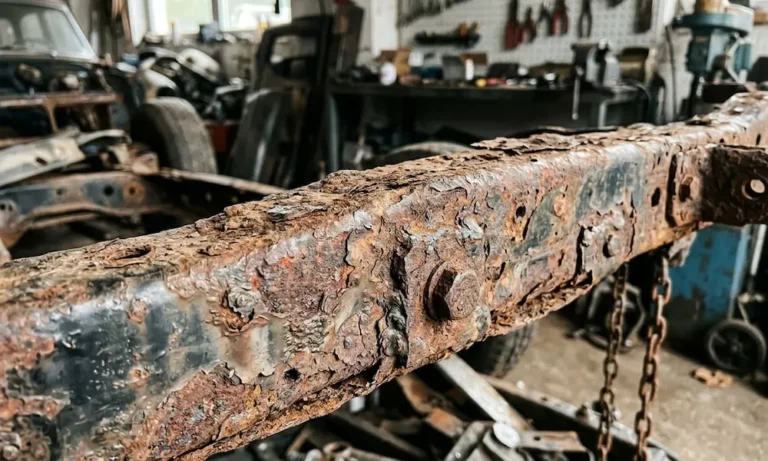
Got a rusty car frame? You’re probably wondering if it’s fixable—or if you’re throwing money into a black hole. Good news: most frames are salvageable. This guide walks you through every step, from stripping the rust to sealing the steel so it stays clean for years.
First, Figure Out What Kind of Rust You’re Dealing With
Before you grab any tools, you need to know your enemy. Not all rust is equal—and the type you’re dealing with dictates your entire plan.
Surface rust is a light, dusty orange layer sitting on top of the steel. It hasn’t eaten into the metal yet, so the frame is still structurally solid. This is the easiest stage to fix.
Scale rust is what happens when surface rust gets ignored. The oxidation expands, creating thick, brittle, flaky chunks that separate from the base metal. There’s some pitting now, but the frame may still be strong enough to work with. You can’t just paint over this—the scale has to go first.
Penetrating rust (also called rot) is the scary one. It’s eaten all the way through the steel. You’ll see actual holes. No chemical treatment fixes this. The only real solution is cutting out the compromised section and welding in fresh steel. If you find penetrating rust on a structural part of the frame, stop and assess carefully before going further.
How to Remove Rust From a Car Frame: The Mechanical Phase
Mechanical removal is your first step. You’re physically breaking off and extracting loose rust, old coatings, and degraded metal before any chemicals touch the surface.
Pneumatic Needle Scaler
If you’re dealing with heavy scale rust, a pneumatic needle scaler is the best tool for the job. It uses a bundle of hardened steel needles driven by a compressed air piston. The needles deliver 4,000 to 5,000 percussive strikes per minute, shattering and lifting brittle rust without gouging the healthy steel underneath.
The big advantage? Each needle floats independently, so the tool reaches into pits, around bolt heads, and along irregular welds that flat discs completely miss.
The downsides: it’s loud, it vibrates heavily, and it needs a serious air compressor. Also—never use it on thin sheet metal or aluminum. It’ll dimple and stretch the panels instantly.
Strip Discs (Polycarbide Abrasive Discs)
For large, accessible sections of the frame, strip discs mounted on an angle grinder work well. Their open nylon-web design strips paint and surface rust without loading up with debris. They clean without gouging, leaving a slightly etched surface that helps primer stick.
They’re not great for tight corners or deep pitting, but on flat frame rails, they’re efficient.
Wire Wheels: Use With Caution
Wire wheels are cheap and work fine for light surface rust and crevice cleaning. But on heavy scale rust, they cause a real problem. The high heat and friction from a spinning wire wheel burnishes the rust instead of removing it. It creates a shiny surface that looks clean but traps active oxidation underneath.
Apply a coating over burnished rust and you’ll watch it blister and peel within months. There’s also a safety hazard: the bristles snap under load and launch as high-velocity projectiles. Always wear a full face shield.
Flap Discs: Not the Right Tool Here
Flap discs are great for grinding welds and heavy stock removal, but they’re too aggressive for rust removal on a structural frame. They’ll strip rust and healthy metal simultaneously, thinning your frame steel in the process. Stick to strip discs for this job.
Abrasive Media Blasting
For a full frame restoration, nothing beats abrasive blasting. It’s thorough, uniform, and reaches every pit and seam that hand tools miss. Here’s how the common media types compare:
| Media Type | Aggressiveness | Best For | Notes |
|---|---|---|---|
| Coal Slag (Medium Grade) | High | Heavy rust, thick undercoating | 3.0–4.8 mil anchor profile |
| Coal Slag (Fine Grade) | Moderate | Light rust, standard frame prep | 2.0–3.5 mil anchor profile |
| Crushed Recycled Glass | Moderate–High | Eco-friendly paint stripping | Low dust, low free silica |
| Aluminum Oxide | Very High | Fast etching, cabinet blasting | Expensive but recyclable |
| Glass Beads | Moderate | Final polishing on delicate parts | Peens rather than cuts |
| Silica Sand | High | — | Avoid entirely: causes fatal silicosis |
Silica sand was the old standard, but the NIOSH strongly recommends against it. Inhaling fractured silica particles causes silicosis—an irreversible and often fatal lung disease. Use coal slag or crushed glass instead.
Chemical Rust Conversion: Neutralize What You Can’t See
Even after thorough mechanical stripping, microscopic rust remains inside the pores of the steel. Primer applied over that will eventually fail. Chemical conversion takes care of what your tools can’t reach.
Phosphoric Acid Treatments
Phosphoric acid is the professional’s choice. When it contacts iron oxide, it converts the rust into iron phosphate—a hard, chemically stable compound that doesn’t react with oxygen or moisture anymore. Rust stopped.
On top of that, phosphoric acid etches bare steel, opening the pores microscopically and creating a better surface for primer to grip. Products like Ospho work on this chemistry.
The Neutralization Step You Can’t Skip
Here’s where a lot of DIY frame restorations fall apart. If you let phosphoric acid dry completely without neutralizing it, it leaves a white crystalline residue. Apply epoxy primer over that, and the acid interferes with the curing catalyst. The result is lifting, blistering, and complete coating failure.
The correct process:
- Re-wet the dried acid with fresh phosphoric acid solution
- Aggressively scrub with a synthetic abrasive pad to break up the residue
- Flush thoroughly with clean water
- Blow dry immediately with compressed air
Water neutralizes the acid, but it also invites flash rust on bare steel. You need to dry the frame instantly and apply primer the same day.
Tannic Acid Converters and Chelating Agents
Tannic acid converters combine an acid with a polymer resin in one product. They’re convenient for light-duty work, but their films aren’t as durable as straight phosphoric acid for heavy frame restoration.
For small removable hardware—bolts, brackets, suspension bits—chelating agents work brilliantly. Soak the part and the chelating molecules pull rust away without touching the base metal. Not practical for a full frame, but great for hardware.
Sealing the Frame: High-Performance Coatings That Actually Last
Bare steel rusts fast. Once the frame is clean and neutralized, you need it sealed immediately. Standard spray paint won’t cut it under a vehicle. You need industrial chemistry.
Moisture-Cured Urethane (MCU) Systems
MCU coatings cure by pulling water molecules from the air, not by evaporating solvents. In humid environments, they cure harder and faster. Once cured, they form a dense, non-porous shell that resists road salt, fuel, battery acid, and hydraulic fluid.
The most well-known MCU system—POR-15—uses a rigid three-step process: degrease, metal prep with phosphoric acid, then apply the coating. Skip any step and it fails badly. Applied over smooth, unprepared metal without acid etching, MCU coatings will peel in sheets.
One important limitation: MCUs degrade under UV light. If any part of the frame sees direct sun, cover the MCU with a UV-stable topcoat.
Some MCU formulas are heavily loaded with aluminum flake—over two pounds per gallon. The aluminum pigment acts as an additional physical barrier against oxygen and moisture, and it helps fill surface pitting.
Two-Component (2K) Epoxy Primer
For frames blasted down to bare white metal, 2K epoxy primer is the gold standard. You mix a base epoxy resin with a chemical hardener right before spraying. That internal reaction produces a coating far stronger than anything in an aerosol can.
Cured epoxy is completely non-porous and waterproof. It creates an absolute barrier between the steel and the atmosphere. It’s also compatible with body filler—if you want to fill pits for a smooth finish, body filler adheres perfectly to cured epoxy.
Don’t use self-etching primer here. It’s porous, so moisture slowly penetrates the film. Worse, the solvents in body filler dissolve self-etching primer on contact, destroying adhesion completely. For structural frame work, 2K epoxy is the only smart choice.
| Feature | MCU Coating | 2K Epoxy Primer | 1K Self-Etching Primer |
|---|---|---|---|
| Curing Mechanism | Atmospheric humidity | Internal chemical catalyst | Solvent evaporation |
| Film Porosity | Non-porous | Non-porous | Porous—absorbs moisture |
| Best Substrate | Converted rust, etched metal | Freshly blasted bare steel | Touch-ups on smooth bare metal |
| Body Filler Compatible | Requires scuffing first | Excellent—bonds securely | Poor—solvents lift the primer |
Don’t Forget the Inside of the Frame Rails
A boxed frame rail is hollow. Road water and salt brine flood in through factory drainage holes and sit there in the dark with no airflow. The interior rots while the exterior looks fine.
No standard spray gun reaches inside a boxed rail. You need a dedicated internal frame coating—a specialized aerosol with a 24-inch flexible wand and a 360-degree conical brass nozzle. These products use a capillary-creeping formula that wicks under scale and into seams, encapsulating rust with phenolic resin and sealing the metal with zinc phosphate.
Insert the wand fully into each access hole, press the trigger, and slowly withdraw while the multidirectional spray coats every interior surface. Repeat through every opening until the entire cavity is saturated.
Secondary Undercoating: What Works and What’s a Trap
Once the frame is sealed, a sacrificial outer layer protects against gravel strikes and salt spray. But the wrong product can cause more damage than nothing.
Rubberized Undercoating: Avoid It
Rubberized undercoating looks tough, but it’s widely condemned by restoration experts for daily-driven vehicles. Over time, temperature swings and road impacts crack the rubber shell. Salt water seeps through the cracks and gets trapped between the rubber and the steel. It can’t evaporate, so it sits there year-round, rotting the frame under a layer that looks perfectly intact.
Lanolin-Based Undercoatings: Excellent but High Maintenance
Lanolin-based products like Fluid Film or Woolwax never fully dry or cure. That’s a feature, not a flaw. The fluid nature means it self-heals over rock chips and creeps into seams and bolt threads where rust starts. It actively repels water on contact.
The catch: it washes off over time. Expect to reapply every 12 to 24 months.
Wax-Based Undercoatings: The Long-Term Option
Products like Cosmoline RP-342 spray on as a liquid but cure into a firm, amber wax. It’s dry to the touch, doesn’t drip in summer heat, resists pressure washing, and flexes with the chassis—so it won’t crack like rubber. Multi-year protection without annual reapplication.
Zones You Must Never Undercoat
| Component | Why You Must Avoid It |
|---|---|
| Exhaust and catalytic converters | Flammable coatings create a serious fire hazard |
| Brake rotors, pads, calipers | Oil contamination causes immediate braking failure |
| Rubber bushings and seals | Petroleum-based products chemically degrade rubber |
| Sensors, cameras, drain holes | Blocks drainage and causes electronic failure |
| Steering and driveline joints | Interferes with articulation needed for safe steering |
Safety Gear: Don’t Skip This
Rust removal and frame coating work involves serious hazards. Basic dust masks don’t cut it here.
- Wire wheels and grinding: Use a full-face ANSI-rated shield. Bristles snap and launch like shrapnel.
- Abrasive blasting: Use a supplied-air hood or a tightly fitted NIOSH-approved respirator. Rust dust and pulverized paint destroy lung tissue.
- 2K epoxy and urethane coatings: These contain isocyanates—highly toxic compounds that cause severe respiratory sensitization. Once sensitized, even trace exposure can trigger a potentially fatal asthmatic reaction. Solvents like xylene and toluene cause permanent neurological damage with prolonged exposure. A charcoal respirator is not enough. Use a NIOSH-approved vapor and particulate respirator. In enclosed spaces, use a positive-pressure supplied-air unit.
Learning how to remove rust from a car frame properly means treating the safety side as seriously as the technical side. The chemicals that save your frame can permanently damage your lungs if you rush the PPE.


