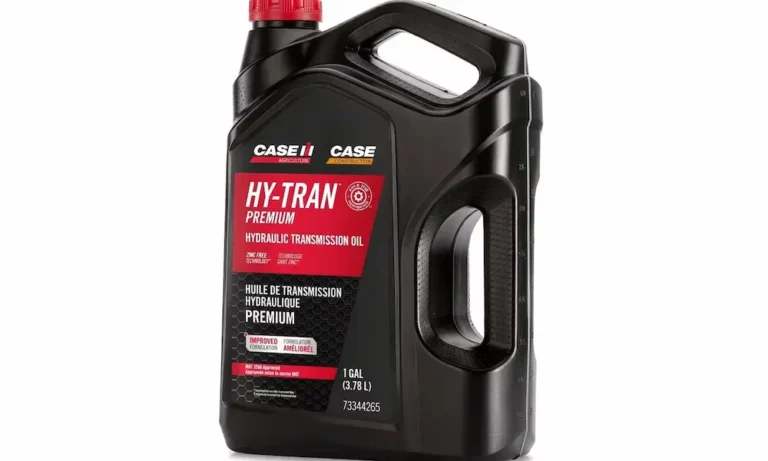
Finding the right Hy-Tran hydraulic oil equivalent feels overwhelming — especially when the wrong choice can wreck an expensive transmission. This guide cuts through the noise and shows you exactly which fluids work, which specs matter, and why some cheap alternatives aren’t worth the gamble. Stick around — the tiered breakdown alone will save you hours of research.
What Is Hy-Tran and Why Does It Matter?
Hy-Tran is Case IH’s proprietary hydraulic transmission fluid. It’s not just a hydraulic oil — it pulls triple duty as a gear lubricant, a wet-brake friction modifier, and a heat transfer fluid, all from the same reservoir.
That shared reservoir design is smart engineering, but it puts a lot of pressure on the fluid. Get the wrong one, and you’ll notice it fast — chattering brakes, slipping clutches, or worse, a hydraulic pump that cavitates and fails.
The good news? Several quality alternatives exist. But you need to match the right spec to your machine first.
Understanding Case IH MAT Specifications (The Key to Finding the Right Equivalent)
Case IH uses a Material Standard (MAT) system to define fluid requirements. Think of MAT specs as the rulebook any equivalent must pass before it goes near your machine.
Here’s how the spec lineup evolved:
| Specification | Primary Application | Related Standards |
|---|---|---|
| MS-1209 | Legacy Case IH Tractors | Hy-Tran Plus |
| MAT 3505 | General Utility / Legacy | MS-1204, MS-1206, MS-1207, MS-1209 |
| MAT 3525 | Multi-Purpose / Universal | M2C134-D, FNHA-2-C-201.00, NH 410B |
| MAT 3540 | Modern High-Precision / CVT | Hy-Tran Ultraction |
| MAT 3506 | Hydraulic / Transmission | MS-1210, TCH Fluid |
The older MS-1209 spec handled the tractors of the late 20th century just fine. But as power-shift and continuously variable transmissions (CVTs) became standard, MAT 3540 — the spec behind Hy-Tran Ultraction — raised the bar significantly.
Before you buy any equivalent, open your operator’s manual and find the exact MAT or MS number your machine requires. That number is everything.
3 Things That Make Hy-Tran Hard to Replace
Not all tractor fluids are created equal. Here’s what makes Hy-Tran uniquely demanding to match:
1. Water Tolerance Through Emulsification
Most hydraulic oils separate water so it sinks to the bottom of the reservoir. Hy-Tran does the opposite — it holds water in suspension through emulsification.
Why does that matter? Water slugs hitting a hydraulic pump cause instant cavitation. Cavitation destroys pumps fast. Hy-Tran Ultraction’s industry-leading water tolerance keeps those slugs from ever forming. Any true equivalent needs to do the same.
2. Shear Stability Under Pressure
Modern transmissions brutally stress the oil — a process called shearing. Low-quality fluids thin out permanently once sheared, leaving your gears and bearings under-protected. MAT 3540 fluids demand exceptional shear stability to maintain viscosity throughout the full service interval.
3. Frictional Control for Wet Brakes and Clutches
Wet brakes and clutches sit in the same fluid that runs your hydraulics. Too slippery, and clutches slip. Not slippery enough, and brakes chatter loudly. The friction modifier package in Hy-Tran is tuned specifically to Case IH brake disc and clutch plate materials. A generic hydraulic oil won’t have it.
The Best Hy-Tran Hydraulic Oil Equivalents (Tiered by Application)
Here’s how top alternatives stack up across three tiers:
Tier 1: Best for Modern and CVT Equipment (MAT 3540)
These fluids meet the highest current standard. Use them in power-shift and CVT transmissions.
- Mobilfluid 428 — Excellent thermal stability, superior air handling, and strong rust protection. Great for equipment that sits idle in humid winters.
- Petro-Canada DURATRAN — Made with 99.9% pure base oils. Outstanding resistance to thermal breakdown and oxidation. Extends drain intervals safely.
- Phillips 66 PowerTran XP — Specifically engineered for improved shear stability in modern agricultural CVTs. Also available in a low-viscosity grade for extreme cold climates.
- Case IH Hy-Tran Ultraction — The OEM benchmark. If you’re under warranty, this is the safe call.
Tier 2: Best for Standard Fleets and Utility Tractors (MAT 3525 / MS-1209)
These fluids balance performance and compatibility across most tractor brands. Smart picks for mixed fleets.
- Shell Spirax S4 TXM — A premium 10W-30 fluid widely trusted for MAT 3525 compliance. Anti-oxidation and anti-foam properties give it a long service life.
- Mobilfluid 424 — The long-standing gold standard for universal tractor fluids. Excellent frictional control, solid anti-wear performance, decades of proven reliability in Case IH equipment.
- Chevron 1000 THF — Distinctive orange color makes leak identification fast and easy. Available in Isoclean pre-filtered versions for high-precision hydraulic valves.
- Valvoline Unitrac — All-weather, multi-purpose fluid with solid wet-brake chatter control. Easy to find at most ag parts stores.
Tier 3: Retail and Value Brands (Best for Older Equipment)
These options work for legacy machines where the latest specs aren’t required. Don’t use them in modern CVTs.
- Blain’s Farm & Fleet Case/IH Trans-Hydraulic Fluid — A solid Midwestern choice. Meets MAT 3525, maintains flow down to -44°F. Good for late-season harvesting and snow removal.
- Super Tech Heavy Duty Tractor Fluid (Walmart) — Meets MS-1207 and MS-1209. Fine for older tractors, budget-friendly, widely accessible.
- Traveller Premium (Tractor Supply) — A versatile multi-purpose fluid best suited for top-offs and general utility maintenance.
How the Top Tier Fluids Compare Side by Side
Numbers tell the real story. Here’s a direct technical comparison of the major Hy-Tran equivalents:
| Product | Equivalent Spec | Viscosity @ 40°C | Pour Point | Flash Point |
|---|---|---|---|---|
| Shell Spirax S4 TXM | MAT 3525 | 60.0 cSt | -42°C | 220°C |
| Shell Spirax S6 TXME | MAT 3525 / MS-1209 | 64.4 cSt | -48°C | 226°C |
| Mobilfluid 424 | MAT 3525 / MS-1209 | 55.0 cSt | -42°C | 198°C |
| Mobilfluid 428 | MAT 3540 / MAT 3525 | 59.0 cSt | -48°C | 243°C |
| Chevron 1000 THF | MAT 3525 / MS-1209 | 58.4 cSt | -44°C | 235°C |
If you’re running equipment in the northern US through winter, pay attention to pour point. Mobilfluid 428 and Shell Spirax S6 TXME both hit -48°C — a clear advantage during cold morning startups.
SAE vs. ISO: Don’t Let the Labels Confuse You
Older Case IH manuals list hydraulic oil requirements in SAE weights. Newer fluids often show ISO grades instead. Here’s a quick conversion reference:
| SAE Grade | ISO Equivalent | Typical Use |
|---|---|---|
| 10W | ISO 32 | Cold climate hydraulics |
| 15W–20W | ISO 46 | General purpose / mild climates |
| 20W | ISO 68 | Heavy-duty / warmer climates |
| 30W | ISO 100 | High-temperature gear systems |
Most Hy-Tran equivalents are 10W-30 multigrades. This grade spans multiple ISO categories, which is exactly what you need for wet brakes and hydraulics to work correctly across a full temperature range. A straight ISO 46 or ISO 68 hydraulic oil won’t cut it — those fluids lack the friction modifiers and shear stability additives that make tractor hydraulic fluids work.
What Happens If You Use the Wrong Fluid
This isn’t hypothetical. Mechanics who’ve drained poorly-maintained Case IH systems describe pulling filters coated in dark, murky sludge — the calling card of a fluid that broke down under heat or couldn’t handle moisture.
The practical risks of the wrong fluid include:
- Wet brake chatter — loud, grinding vibration during braking
- Clutch slippage — especially under heavy load during tillage
- Hydraulic pump cavitation — caused by water slugs in a fluid that can’t emulsify moisture
- Premature transmission wear — from a fluid that sheared thin early and lost its protective film
- Voided warranty — Case IH maintains that only MAT-certified fluids qualify for CNH limited warranty coverage
A quality fluid like Mobilfluid 424 or Hy-Tran Ultraction costs more per gallon than a generic alternative. But it’s a fraction of the cost of a transmission rebuild.
Mixed-Fleet Strategy: One Fluid to Rule Them All
Running Case IH, John Deere, and New Holland tractors on the same farm? Managing separate fluids for each brand is a recipe for a misapplication mistake.
High-quality universal tractor transmission oils like Mobilfluid 424 and Shell Spirax S4 TXM meet the major standards across brands simultaneously — including John Deere J20C, Massey Ferguson M1145, and Case MAT 3525. By standardizing on a single fluid that meets the highest spec in your fleet (MAT 3540 if you run modern CVTs), you simplify your inventory and eliminate misapplication risk entirely.
How to Pick the Right Hy-Tran Equivalent in 3 Steps
Don’t overthink it. Follow these steps:
- Find your MAT or MS spec — Check your operator’s manual. It’ll list the exact fluid specification your machine requires.
- Match the spec on the label — The container must specifically state MAT 3525 or MAT 3540 (or equivalent). “Universal tractor fluid” labels without specific spec claims aren’t enough for modern equipment.
- Consider your conditions — Operating in extreme cold? Prioritize fluids with lower pour points. Running a CVT? Don’t compromise on MAT 3540 compliance. Managing a mixed fleet? Pick a universal fluid that covers all your machines.
The right Hy-Tran hydraulic oil equivalent protects your equipment, keeps your warranty intact, and saves you from expensive repairs. The research is done — now you just need to match your spec and choose accordingly.