
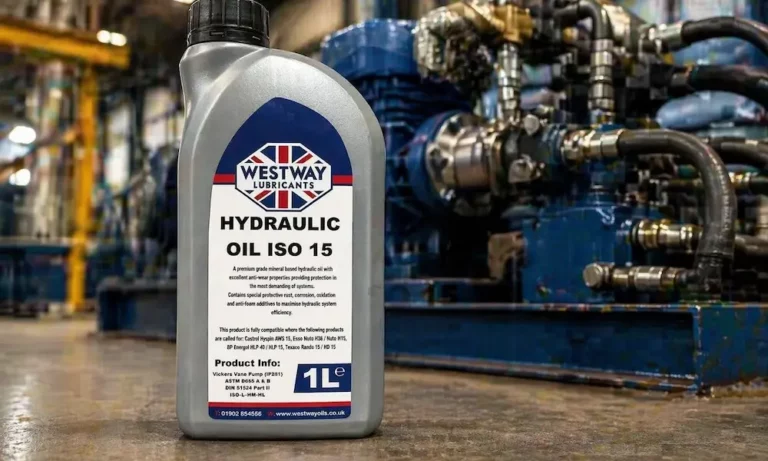
Finding the right ISO 15 hydraulic oil equivalent shouldn’t feel like decoding a chemistry textbook. Whether your spindle oil ran dry, you’re swapping brands, or you just need a cold-weather upgrade, this guide breaks down every major equivalent, what the specs actually mean, and which fluid fits your machine.
What Is ISO 15 Hydraulic Oil, Exactly?
ISO 15 is a viscosity grade, not a brand. The “15” tells you the oil’s kinematic viscosity at 40°C sits between 13.5 and 16.5 centistokes. That’s a tight window, and it’s intentional.
This grade targets applications that need fast, free-flowing fluid — think high-speed spindles, marine steering systems, and cold-climate mobile equipment. It’s thinner than your typical ISO 32 or ISO 46 hydraulic oil, which means it generates less drag and responds faster in tight-tolerance systems.
Use the wrong viscosity here, and you’re either starving components of a protective film or choking flow entirely.
Why Viscosity Index Matters More Than You Think
Kinematic viscosity only tells half the story. The Viscosity Index (VI) tells you how much the oil thickens when it gets cold or thins when it heats up.
A standard mineral ISO 15 oil carries a Viscosity Index around 100. That’s fine for a climate-controlled shop floor. But if your excavator fires up in Minnesota at -20°F and runs through a Texas afternoon, you need something more stable.
Premium HVI (High Viscosity Index) fluids push that number above 140 — sometimes past 160. The result is consistent flow protection from startup to peak operating temperature, without the guesswork.
Quick comparison:
| VI Range | Category | Best For |
|---|---|---|
| ~100 | Standard mineral | Indoor, stable temps |
| 140–160+ | HVI / HV grade | Mobile, outdoor, cold climates |
| 150–164 | Premium synthetic | Servo valves, precision systems |
The ISO 15 Hydraulic Oil Equivalent Chart — Major US Brands
Here’s what you actually came for. These are the direct equivalents across the brands you’ll find in the US market.
| Manufacturer | Product Name | VI | Pour Point (°C) | Flash Point (°C) | Specs Met |
|---|---|---|---|---|---|
| Mobil | DTE 10 Excel 15 | 164 | -57 | 210 | DIN 51524-3, ISO 11158 HV |
| Shell | Tellus S2 VX 15 | 143 | -42 | 200 | DIN 51524-3, ASTM D6158 HV |
| Chevron | Rando HDZ 15 | 140 | -54 | 150 | ASTM D6158 HV, DIN 51524-3 |
| Phillips 66 | Megaflow AW HVI 15 | 151 | -61 | 181 | DIN 51524-3, Eaton M-2950-S |
| Castrol | Hyspin HVI 15 | 150 | -33 | 195 | DIN 51524-3, Denison HF-0 |
| Valvoline | Ultramax 15 | 108 | -42 | 197 | DIN 51524-2, Parker Denison HF-0 |
| Lucas Oil | Nautical ISO 15 | 148 | -42 | 204 | MIL-H-5606G Equivalent |
Each of these is a legitimate ISO 15 hydraulic oil equivalent — same viscosity grade, different additive recipes.
Breaking Down the Big Players
Mobil DTE 10 Excel 15
This is the benchmark for precision hydraulic systems. It’s zinc-free, uses synthetic technology base oil, and delivers up to 6% better pump efficiency compared to standard fluids. Its “keep-clean” formulation protects sensitive servo and proportional valves from deposit buildup.
That VI of 164 is the highest in its class. If you’re running a CNC machining center or a high-pressure industrial hydraulic circuit, this is a strong pick.
For spindle-specific applications, Mobil Velocite Oil No. 8 is the dedicated ISO 15 spindle oil. It’s engineered for high-speed lathes, grinders, and machining centers where heat from friction is a real threat to dimensional accuracy.
Shell Tellus S2 VX 15
Shell’s Tellus S2 VX 15 uses Group II base oil technology, making it a solid step up from basic mineral formulations. It’s mechanically shear-stable, meaning the viscosity doesn’t drift after extended use — important in mobile equipment that runs long hours.
The -42°C pour point handles most North American winter conditions without breaking a sweat.
Chevron Rando HDZ 15
The Rando HDZ 15 stands out for one specific reason: a pour point of -54°C. That’s exceptional cold-weather performance. It also meets Eaton-Vickers and Parker Hannifin (Denison) specifications, making it compatible with a wide range of mobile and industrial pump platforms.
It’s a popular choice in marine on-deck systems and outdoor construction equipment in cold climates.
Phillips 66 Megaflow AW HVI 15
Here’s where things get interesting. The Phillips 66 Megaflow AW HVI 15 carries a dielectric strength of 35 kilovolts at the point of manufacture. That’s not a spec you see on most hydraulic oils.
It makes this fluid the go-to choice for electrical utility equipment — bucket trucks, aerial lifts, and cherry pickers that work near live power lines. The oil acts as an electrical insulator through the hydraulic boom, protecting operators from conductivity hazards.
It also holds the lowest pour point in the group at -61°C.
Castrol Hyspin HVI 15
Castrol Hyspin HVI 15 uses a zinc-free additive system, which means it won’t corrode silver-plated components or cause issues in systems with fine filtration down to 5 microns. It meets the Denison HF-0 specification, a benchmark widely used in industrial hydraulic systems.
For comparison, the Castrol Hyspin AWS 15 is the more budget-friendly option with a low-zinc formulation — solid for general industrial use, but it’s not an HVI product.
Valvoline Ultramax 15
The Valvoline Ultramax 15 is the standard mineral-grade option here, with a VI of 108. It’s the right pick when wide temperature ranges aren’t a concern and you need a reliable, cost-effective fluid for indoor industrial hydraulics. It meets Parker Denison HF-0 specs, which covers a large chunk of industrial pump requirements.
Lucas Nautical ISO 15
The Lucas Nautical Hydraulic Fluid ISO 15 is a synthetic fluid designed to replace the MIL-H-5606G military/aviation standard. It’s the marine steering specialist in this lineup. The synthetic base stock delivers a light, responsive feel on the helm — no hesitation, no noise at cold start.
Additive Chemistry: Zinc vs. Zinc-Free
You’ll notice some fluids are zinc-based and others are zinc-free (ashless). Here’s why it matters:
Zinc-based additives (like ZDDP):
- Excellent anti-wear protection for vane, gear, and piston pumps
- Widely used in general industrial applications
- Can react with silver-plated components
Zinc-free (ashless) additives:
- Safe for systems with yellow metals and silver components
- Better filterability in systems with 5-micron or finer filters
- Preferred in marine and forestry applications where environmental exposure is a risk
- Required by some OEM specifications for servo valve systems
The trend in US industrial maintenance is moving toward zinc-free chemistry, especially where precision valves and fine filtration are involved.
Where ISO 15 Hydraulic Oil Is Actually Used
CNC Spindles and Machine Tools
ISO 15 is the standard for high-speed CNC spindles. The low viscosity reduces drag at thousands of RPMs, which directly limits heat generation. Haas CNC machines, for example, specify ISO 15 or ISO 32 depending on the specific spindle and taper design. Even a slight temperature increase from friction can affect machined tolerances — which is why a light-grade oil with good thermal stability isn’t optional here, it’s essential.
Marine Steering Systems
Chevron Rando HDZ and Lucas Nautical ISO 15 are the typical choices for marine hydraulic steering. Cold ocean water temperatures mean your steering fluid needs to flow freely from the moment you turn the key. A sluggish steering response isn’t just an inconvenience on the water — it’s dangerous.
Electrical Utility Equipment
Bucket trucks and aerial lifts need dielectric-grade hydraulic oil in their boom systems. Phillips 66 Megaflow AW HVI 15 is the specific product for this. Moisture contamination destroys dielectric strength rapidly, so sealed storage and clean handling practices are non-negotiable for utility fleet managers.
Cold-Climate Mobile Equipment
Excavators, backhoes, and agricultural equipment in northern states need HVI-grade ISO 15 with pour points well below -40°C. Petroleum Service Company stocks the Kendall Hyken Glacial Blu for extreme Arctic conditions, and Chevron Rando HDZ 15 handles most other cold-climate needs.
Switching Brands? Read This First
Swapping to a different ISO 15 equivalent isn’t always plug-and-play. Here’s what to check before you drain and refill:
- Zinc vs. zinc-free compatibility: Mixing these two chemistries can cause additive dropout or sludge formation
- Seal compatibility: Some synthetic base stocks and additive packages cause elastomeric seals to swell or degrade
- Residual contamination: Always drain thoroughly before switching fluid types — don’t assume a flush-free swap
- OEM specs: Confirm your equipment manufacturer’s approved fluid list before substituting brands
When in doubt, drain the reservoir completely and clean it before adding the new fluid. A few extra minutes here prevents weeks of troubleshooting later.
Keeping ISO 15 Hydraulic Oil in Good Condition
ISO 15 fluids are sensitive to contamination because they’re used in precision systems. Sloppy maintenance habits here hurt more than they would with heavier grades.
Filtration:
Many ISO 15 applications — servo valves, spindles — require particle counts monitored to the ISO 4406 cleanliness code. Use high-efficiency filters (5 microns or finer) and check them regularly.
Water contamination:
If the oil looks milky, you’ve got emulsified water. In marine and outdoor systems, check for this regularly. High-quality ISO 15 fluids demulsify quickly, letting water settle at the reservoir bottom for easy drainage.
Storage:
- Store containers under cover — moisture and UV degrade both the oil and labels
- Don’t expose stored oil to temperatures above 60°C
- Seal opened containers tightly — dust and moisture get in fast
- Use first-in, first-out rotation to avoid using oil past its shelf life
For dielectric fluids specifically, even brief exposure to open air can compromise the dielectric strength. Handle these with extra care.
Choosing the Right ISO 15 Equivalent for Your Application
Not all ISO 15 oils are equal. Here’s a quick decision framework:
- High-speed CNC spindle? → Mobil Velocite No. 8 or Mobil DTE 10 Excel 15
- Cold-climate mobile equipment? → Chevron Rando HDZ 15 or Phillips 66 Megaflow AW HVI 15
- Marine steering? → Lucas Nautical ISO 15 or Chevron Rando HDZ 15
- Electrical utility bucket truck? → Phillips 66 Megaflow AW HVI 15 (dielectric grade only)
- General indoor industrial? → Castrol Hyspin AWS 15 or Valvoline Ultramax 15
- Servo valves + fine filtration? → Mobil DTE 10 Excel 15 or Castrol Hyspin HVI 15
Match the fluid to the application, verify it against your OEM spec sheet, and don’t mix additive chemistries without checking compatibility first. That’s it — no mystery, no guesswork.


