You’ve heard the tick. Maybe you’ve seen the blue puff in your mirror. Then you spot a $12 bottle that promises to fix both. Sometimes it does. Sometimes that same bottle quietly shortens your engine’s life. This review covers every Lucas formula, what the lab numbers say, and who should actually buy one. Stick around to the end and you’ll know whether to grab a bottle or leave it on the shelf.
The Short Answer: Is Lucas Oil Stabilizer Worth It?
It depends on your engine, not the bottle.
For a tired old truck, a worn tractor, or a whining manual gearbox, the heavy formulas do real work. For a late-model car running 0W-20, that same thick syrup does damage. Lucas knows this, which is why they now sell a Low Viscosity version built for modern engines.
So here’s the honest verdict: great tool, wrong application ruins it.
What’s Actually Inside The Bottle
Heavy Duty Oil Stabilizer is pure petroleum. No synthetics, no fancy chemistry. It pours like honey on a cold morning and smells like, well, oil.
Here’s the part that matters. Its thickness at 100°C runs between 110 and 112.4 centistokes. A 50-weight racing oil sits around 20. That makes this stuff roughly five times thicker than the heaviest passenger car oil on the shelf. The manufacturer’s product data sheet lists a 470°F flash point and about 7.458 pounds per gallon.
Dosage matters too. Lucas suggests 20% stabilizer for routine use. For an engine burning oil or knocking, they push that to 60% or even 80%. In manual transmissions, 25% to 50%. In open gearboxes, up to 100%.
That’s a lot of thickener going into your crankcase.
The Full Lineup, Broken Down
Heavy Duty Oil Stabilizer
The original. Amber, tacky, 100% petroleum. It’s the bottle in the store display that climbs the gears when you turn the crank. Best for old engines, worn gearboxes, and anything built before fuel injection got smart.
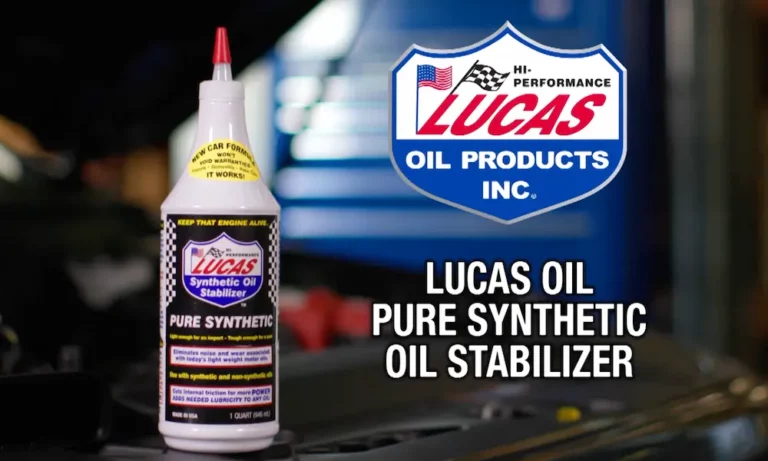
Pure Synthetic Oil Stabilizer
Built for synthetics and racing. Much thinner at 44.1 centistokes. Lucas suggests one quart per oil change for diesel rigs like the Ford Powerstroke. It blends with synthetic base stocks without breaking warranties that demand full synthetic oil.
Low Viscosity Stabilizer
The black sheep, in a good way. It doesn’t thicken anything. Instead it adds friction modifiers, dispersants, and oxidation inhibitors to thin oils like 0W-20 and 5W-20. If you drive a modern car or a hybrid, this is the only one worth considering.
High Mileage Oil Stabilizer
Same thickness as Heavy Duty at 112.4 centistokes, but tuned to fight sludge and swell tired seals. It targets the smoking and noise that show up past 200,000 miles.
Motorcycle Oil Stabilizer
Formulated without friction modifiers that would make a wet clutch slip. It also handles the extreme pressure inside a shared-sump transmission. Lucas claims up to 50% longer oil life and lower running temps in air-cooled engines.
Spec Sheet, Side By Side
| Product | Thickness @ 100°C | Base Oil | Best For |
|---|---|---|---|
| Heavy Duty | 110–112.4 cSt | 100% petroleum | Worn engines, gearboxes, storage |
| High Mileage | 112.4 cSt | Petroleum blend | 150k+ mile engines burning oil |
| Pure Synthetic | 44.1 cSt | Full synthetic | Turbo diesels, heavy towing |
| Low Viscosity | Matches your oil | Synthetic | Modern cars, hybrids, VVT engines |
| Motorcycle | Matches your oil | Proprietary | Wet-clutch bikes, air-cooled engines |
The Low Viscosity and Motorcycle formulas don’t publish full numbers. That’s on purpose. Their thickness is engineered to sit close to the oil you already run.
Three Jobs It Genuinely Does Well
It stays on the metal overnight. That tackiness isn’t a gimmick. When your engine sits, gravity drains oil into the pan, leaving cam lobes and lifters nearly dry. The heavy formulas leave a sticky film behind, so parts stay coated until the pump catches up. Ask any mechanic who works on older engines and they’ll tell you most engine wear happens in those first few seconds.
It props up oil pressure. Worn bearings mean wider gaps. Thin oil shoots through them and pressure drops. Thick oil moves slower, so the gauge climbs back up.
It cushions gears and diffs. In a differential, oil has to climb a spinning gear set. Heavier, stickier oil clings better and quiets the whine of a tired rear end.
Farm equipment and boats that sit for months see the biggest gain. That clinging film stops rust from starting, and the first crank after winter isn’t a dry one.
Do The Lab Tests Prove Anything?
Sort of. Independent bench tests on Timken and friction machines routinely show that adding the heavy stabilizer raises the force required to seize a metal bearing. The sticky film really does resist point-pressure scraping.
But critics point out the obvious flaw. A spinning metal bearing isn’t an engine. An engine needs oil to flow fast, carry heat, dodge aeration, and neutralize acid. A single-point friction rig tests none of that. So a “wins the test” result doesn’t mean the product helps a healthy engine.
Where The Science Pushes Back
It Waters Down Your Oil’s Additives
Motor oil isn’t just slippery liquid. Roughly 20% of it is a chemical package: detergents, dispersants, anti-foam agents, and anti-wear additives like zinc and phosphorus.
Independent lab analyses paint a stark picture. One widely read oil analysis thread found the Heavy Duty formula carries about 2 parts per million of zinc, 4 ppm of phosphorus, and 3 ppm of calcium. A normal heavy-duty oil packs around 1,200 ppm zinc, 1,100 ppm phosphorus, and 2,500 ppm calcium.
Pour in 20% stabilizer and you’ve pulled 20% of your oil’s defense system out of the pan. That’s simple math.
| Additive | Normal Heavy Duty Oil | Raw Stabilizer | 20% Blend | Its Job |
|---|---|---|---|---|
| Zinc | ~1,200 ppm | 2 ppm | ~817 ppm | Anti-wear barrier |
| Phosphorus | ~1,100 ppm | 4 ppm | ~604 ppm | Protects camshafts |
| Calcium | ~2,500 ppm | 3 ppm | ~1,442 ppm | Fights acid |
| Total Base Number | 10.0 | 0.1 | 8.5 | Acid-fighting reserve |
It Foams
Next time you’re in a parts store, watch that gear display closely. Crank it fast and the Lucas side turns cloudy. Those are air bubbles.
Good oil carries anti-foam additives that pop bubbles in seconds. The stabilizer has none, and it thins out yours. A documented forum test mixed 25% stabilizer into a manual transmission, idled for 15 minutes, then drained thick white foam that took over an hour to settle.
Why care? Air compresses. Oil doesn’t. Bubbles that collapse against a bearing or gear tooth pit the metal like tiny charges. That’s cavitation, and it eats hard parts.
It Fights You In The Cold
Thick oil gets thicker when it’s freezing. A 20-30% mix turns gelatinous. Your pump struggles to haul it up the pickup tube.
Worse, every oil filter has a bypass valve. When oil can’t push through cold filter paper, that valve opens and sends unfiltered oil straight to your bearings. On a January morning, that can last 10 to 15 minutes. Every speck of grit rides along for the trip.
It Breaks Modern Engines
This is the big one. Engines built in the last 15 years use oil as a hydraulic fluid, not just a lubricant.
Variable valve timing solenoids pulse oil through tiny passages to rotate cam phasers. Hydraulic timing chain tensioners use oil pressure to keep the chain tight. Both need thin oil to arrive fast. A thick additive starves them. You get check-engine lights, rough idle, and lost power.
The Ford 5.4 Triton and 3.5 EcoBoost are famous for cold-start rattle. Plenty of owners pour in heavy stabilizer hoping to hush it. Threads on owner forums show it sometimes works, for a while. But the chain is still loose. The goo muffled the sound while delaying oil pressure to the tensioner. A chain that jumps one tooth means pistons meeting valves.
Why It Still Earns 4.8 Stars
Here’s the puzzle. Labs warn about dilution and foaming. Meanwhile customer reviews on AutoZone and Walmart sit near perfect.
Both are true. Here’s why.
When someone hears a rod knock, they face a $3,000 rebuild on a car worth $2,000. A $12 bottle that quiets the noise feels like a miracle. The thick oil fills the gap, the tick fades, the smoke stops. Five stars.
But the bearing never grew metal back. The noise left; the problem stayed. Old-school mechanics call this the used car lot trick: quiet a dying engine just long enough to sell it.
For an engine already headed to the scrapyard, none of the chemistry complaints matter. You need three more months out of it. That’s exactly what this product does well.
Quick Pick: Which One For Your Ride?
- 2015+ car, hybrid, or VVT engine: Low Viscosity Stabilizer, or nothing at all
- Turbo diesel pickup: Pure Synthetic, one quart per change
- Motorcycle or ATV with a wet clutch: Motorcycle formula only
- 150,000+ miles and burning oil: High Mileage
- Farm, marine, or seasonal equipment: Heavy Duty, worth it for storage
- Manual transmission or worn differential: Heavy Duty at 25-50%
- Fresh rebuild: Heavy Duty as assembly lube
- Knocking engine you’re nursing along: Heavy Duty, and start pricing replacements
One more money note. The same five-quart jug runs about $36 at Walmart and about $45 at a parts store. Additives tempt people who are trying to stretch cheap oil into premium protection. Buy the better oil first. It costs less than dosing a weak one.
Final Thoughts
Lucas Oil Stabilizer isn’t a scam and it isn’t magic. It’s a very thick, very sticky petroleum product that does a few things well and a few things badly.
On a worn engine, a tractor, an old gearbox, or a fresh build, it earns its spot on the shelf. It seals, it clings, and it buys time. On a modern engine with tight clearances and hydraulic everything, the heavy stuff is a liability. That’s why Lucas built the Low Viscosity version, and that’s the one most drivers should reach for.