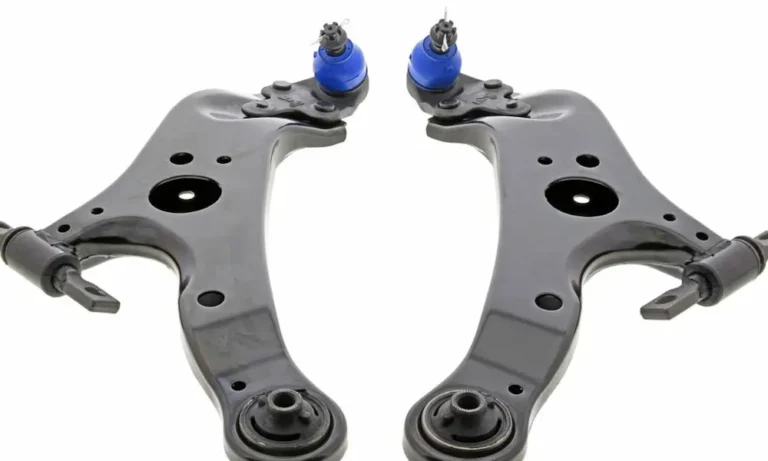
Your suspension is making noise. Your steering feels vague. You’ve got a repair to do, and now you’re staring at a wall of options online. Mevotech keeps popping up — but are they any good? This breakdown cuts through the noise and gives you honest, practical answers about Mevotech control arms across every tier, every use case, and every comparison that matters. Stick around.
What Mevotech Actually Is (And Why It Matters)
Mevotech launched in 1982 and has grown into one of North America’s most recognized steering and suspension brands. They’re not a garage startup — they engineer purpose-built aftermarket control arms specifically for the U.S. market.
Their catalog targets everyone from daily drivers on a budget to commercial fleet managers running trucks hard. That wide range is intentional. Modern vehicles need more control arms than ever before. A 2021 Ford Explorer uses ten control arms total, compared to just four on the 2001 model. That’s a 150% increase. More complexity means more parts will eventually fail, and Mevotech built its business around being ready for exactly that.
The Three Mevotech Product Tiers Explained
Mevotech splits its lineup into three distinct tiers. Picking the wrong one for your situation is a common — and costly — mistake.
Original Grade: Budget-Friendly Baseline
The Original Grade line (look for the “CMS” prefix) mirrors factory specs exactly. It’s the most affordable entry point and works fine for light-duty daily driving on older vehicles.
That said, field technician feedback tells a mixed story. Some mechanics report bushing degradation and ball joint wear within a year of installation. The general consensus? Save the Original Grade for tight-budget repairs on vehicles near the end of their useful life. Don’t lean on it for high-mileage reliability.
Mevotech Supreme: The Sweet Spot for Most Drivers
The Supreme line is where things get genuinely interesting. It adds meaningful upgrades over the base tier:
- Greasable ball joints — you can flush contaminants and extend joint life
- Upgraded bushing materials — more resistant to oil, salt, and heat
- Stronger hardware — more reliable under load
- Limited lifetime warranty — a real confidence booster
Parts use “GS” or “GK” prefixes. For standard passenger vehicles — sedans, crossovers, light trucks — Supreme hits the optimal balance between cost and performance. Most mechanics who recommend Mevotech point squarely at this tier.
Mevotech TTX: The Heavy-Duty Flagship
TTX (Terrain Tough Extreme) is Mevotech’s most overbuilt offering. It’s designed for work trucks, commercial fleets, lifted 4x4s, and any vehicle taking serious punishment daily.
Here’s what separates it from everything else:
| TTX Feature | What It Actually Does |
|---|---|
| Repel-TEK Coating | Fights rust and road salt corrosion aggressively |
| Sintered Metal Bearings | Metal-to-metal design handles extreme impact loads |
| Quad Sealing System | Four-layer protection keeps dirt and water out |
| PWR-Grip Knurling | Textured surfaces prevent component shifting under load |
| Reinforced Forgings | Extra material at high-stress points for maximum rigidity |
| Snap Locking Pins | Speed up ball joint installation in commercial shops |
TTX parts carry “CTXMS” or “CTXK” prefixes. If you run a fleet, haul heavy loads, or drive a lifted truck daily — TTX is built for that life.
The GM 1500 Material Problem You Can’t Ignore
Here’s something that trips up even experienced mechanics. The 2014–2020 GM 1500 trucks and large SUVs used three completely different control arm materials during production. Get this wrong and you’re looking at a dangerous misfit.
| Material | Lower Arm Years | Upper Arm Years | How to Identify |
|---|---|---|---|
| Cast Iron | 2007–2016 | 2007–2016 | Heavy, magnetic, rough casting surface |
| Aluminum | 2015–2020 | 2014–2016 | Lightweight, non-magnetic, smooth forged look |
| Stamped Steel | 2016–2018 | 2016.5–2018 | Thin welded multi-piece construction |
Installing an aluminum-spec replacement on a cast iron application creates a mismatched ball joint taper. That means a loose joint, and a loose joint at speed means catastrophic steering failure. Mevotech offers distinct part numbers across CMS, GS, and CTXMS lines for each configuration — but you need to identify what’s on your vehicle first.
Why Lifted Ram 1500 Owners Specifically Need TTX
The 2009–present Ram 1500 has a well-documented upper ball joint failure mode when leveling kits or spacer lifts enter the picture. The factory upper arm uses a ball joint pressed into stamped steel — a design that handles factory geometry fine but struggles badly under lifted conditions.
When the suspension droops hard at full extension — think hitting a pothole after a 2-inch lift — the steep angle generates severe stress. The stamped steel flexes. The ball joint pops out. Steering control disappears instantly.
Mevotech TTX upper control arms solve this completely. They’re engineered with a revised ball joint angle for lifted geometry, a larger ball pin sphere to spread impact loads, and a reinforced housing that physically can’t eject the joint. Ram forum owners and off-road communities consistently confirm — swapping to TTX uppers eliminates the failure mode for good.
Mevotech vs. The Competition: Honest Comparisons
Mevotech vs. OEM
OEM parts fit perfectly and restore factory feel. But they cost significantly more — a Honda Accord OEM control arm can run $325 per side, while Mevotech Supreme or TTX equivalents land between $80 and $150.
More importantly, OEM parts don’t fix design flaws. If the factory part failed at a specific weakness point, replacing it with another OEM part just restarts the countdown. Mevotech engineers specifically study field failures and upgrades the replacement to outlast the original.
Mevotech vs. Moog
This is the comparison that dominates mechanic forums. Moog divides its catalog into the budget R-Line and the premium Problem Solver line — Mevotech mirrors that structure with Supreme and TTX.
At the premium passenger level, both brands compete closely. Mevotech Supreme often carries longer warranty terms. At the heavy-duty level, recent mechanic sentiment is shifting. Some experienced techs report inconsistent quality from Moog recently and have switched entirely to TTX for high-liability truck repairs. Mevotech’s sintered metal internals and forged aluminum arms are hard to argue with.
Mevotech vs. TRW and Delphi
TRW and Delphi are direct OEM suppliers for many manufacturers. They prioritize factory-correct feel — sealed-for-life joints, compliant rubber bushings, smooth NVH suppression. That’s ideal for European luxury vehicles where ride refinement is non-negotiable.
But for lifted trucks, off-road builds, or fleet vehicles? Mevotech TTX’s greaseable, rebuildable architecture wins that comparison cleanly.
The Installation Mistake That Destroys New Control Arms
Here’s the number one cause of premature Mevotech control arm failure — and it has nothing to do with the part itself.
Torquing the bushing bolts with the suspension fully drooped.
When you tighten the mounting hardware while the vehicle’s on a lift with the wheels hanging free, the bushing sets its neutral position at full droop. The moment you lower the car and its weight compresses the suspension to ride height, the rubber twists severely just to let the car sit normally.
That constant shear stress — called bushing pre-load — tears the rubber core away from the steel housing within weeks. Ride quality degrades. Clunking starts. A warranty claim gets filed. And it gets denied, because it’s an installation error.
The correct procedure:
- Install the control arm and thread mounting bolts loosely
- Lower the vehicle onto the tires (or jack stands under the lower arms) until suspension sits at normal ride height
- Torque all bushing pivot bolts to spec in the loaded position
On air suspension vehicles like the Tesla Model S, Jeep Grand Cherokee, or Dodge Durango — the air system must be active and set to standard height before final torque. No exceptions.
How to Grease Mevotech Joints Without Destroying Them
Mevotech Supreme and TTX arms with grease fittings (zerk fittings) are built to be serviced. That’s a feature, not a complication — done right, it extends joint life significantly. Done wrong, it destroys the boot instantly.
Critical rule: never use a pneumatic or battery-powered grease gun.
High-speed guns deliver grease too fast and at too much pressure. The rubber dust boot ruptures. The joint is now exposed. The part is ruined — and the warranty won’t cover it.
Use a manual hand-pump grease gun only. Follow this process:
- Wipe the zerk fitting completely clean before attaching the coupler
- Pump slowly — two to three pumps per service interval
- Stop when the rubber boot just begins to swell slightly firm
- Watch for grease emerging from the duckbill relief valve — that’s normal and means old grease is purging out
- Wipe everything clean afterward to prevent abrasive dirt from sticking
Mevotech recommends NLGI Grade 2 extreme pressure grease for all serviceable joints. Sync greasing intervals with oil changes or tire rotations.
How to Diagnose a Failing Mevotech Control Arm
Even quality parts wear out. Know what to look for before it escalates.
Early warning signs:
- Vague or disconnected steering feel
- Memory steer — the car doesn’t return to center after a turn
- Increased road noise transmitting through the cabin
Moderate failure signs:
- Vehicle pulling hard to one side under braking or acceleration
- Clunking or knocking over speed bumps
- Popping sounds during slow parking lot maneuvers
Advanced failure:
- Heavy metallic knocking on rough pavement
- Rapid uneven tire wear, especially inner edge camber wear on front tires
- Visible play at the control arm pivot points when checked with a pry bar
For accurate diagnosis, grab the tire at 12 and 6 o’clock and rock it hard — any slop in the ball joint shows up immediately. Electronic chassis ears attached directly to the arm can isolate elusive noises during a test drive.
Understanding the Mevotech Warranty (The Fine Print That Matters)
Both Mevotech Supreme and TTX carry a Limited Lifetime Warranty covering defects in materials and workmanship. That’s a strong backing for aftermarket parts.
How to actually use it:
- Claims go through the retailer where you bought the part — not Mevotech directly
- If you bought through RockAuto, you navigate their return portal
- You must return the defective part inside the new Mevotech box
- You need your original purchase receipt and a professional installation invoice
What the warranty won’t cover:
- Labor costs to reinstall the replacement
- Wheel alignment fees
- Towing or rental costs
- Return shipping on the defective unit
That last point is critical. A bushing failure caused by improper torquing at full droop is not a manufacturing defect. The claim gets denied. The shop eats the labor. Get the installation right the first time.
Frequently Asked Questions
Can Mevotech control arms provide extended alignment adjustment for lowered vehicles?
Yes. Mevotech Supreme offers adjustable alignment components with a correction range from ±0.75 degrees up to ±2.75 degrees of camber and caster. These specialized kits let technicians dial in alignment on modified chassis that are well outside factory spec.
If I adjust camber with a Mevotech adjustable arm, will it mess up my toe?
Yes — this is called alignment cross-talk. Changing camber shifts the steering knuckle laterally, which changes toe. Any camber correction requires a follow-up four-wheel alignment to bring toe back into spec. Skip that step and you’ll burn through tires fast.
Does Mevotech include special installation tools with their parts?
Sometimes. The TTX line often includes upgraded hardware. For certain press-in ball joint applications, Mevotech includes a proprietary “Bootstaller” tool that helps press the joint evenly without damaging the dust boot during installation.
Should I reuse the factory cotter pin when installing Mevotech control arms?
No. Cotter pins are single-use components. They experience metal fatigue when bent and removed. Always use the new cotter pins included in the Mevotech hardware package — they’re there for a reason.
Can I swap in polyurethane bushings to replace the rubber ones in a Mevotech arm?
Technically yes, but it voids the Limited Lifetime Warranty immediately. Polyurethane doesn’t allow the torsional flex that Mevotech arms are designed around. You’ll get harsher NVH, you’ll need specialized grease to prevent squeaking, and you risk stress fractures in the arm itself from increased impact transmission. For street use, stick with the rubber.