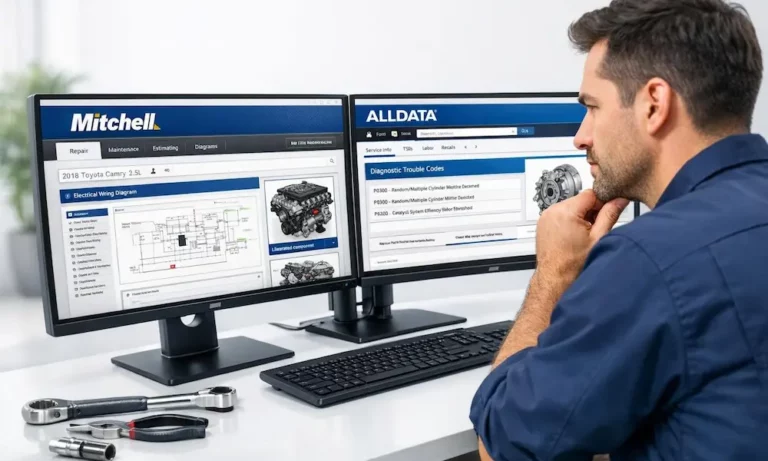
Picking the wrong repair information software costs you time, money, and frustrated technicians. This Mitchell vs ALLDATA breakdown cuts through the marketing noise and tells you exactly what each platform does well — and where each one falls short. Stick around, because the answer might surprise you.
They’re Not the Same Thing (Despite What You’d Think)
Most shop owners assume Mitchell 1 and ALLDATA do the same job. They both give you repair data, wiring diagrams, and labor times — so what’s the difference?
Quite a lot, actually.
Mitchell 1 has been around since 1918, starting as a physical repair manual publisher. That century of experience shaped a platform built around workflow integration — repair data, shop management, customer marketing, all in one place.
ALLDATA launched in 1986 as a digital-first company with one mission: deliver unedited OEM factory data. No rewrites, no condensed content, just straight from the manufacturer. Today, it serves over 400,000 technicians across 115,000+ shops.
Two different philosophies. Two different strengths.
How the Software Actually Works
Mitchell 1: Hybrid Setup
Mitchell 1’s ProDemand runs in a browser, but its shop management tool (Manager SE) often needs a local data host machine on-site. That machine requires a multi-core processor and at least 8GB of RAM to handle concurrent connections properly. The upside? Your shop keeps running even if the internet goes down.
ALLDATA: Cloud-First
ALLDATA leans harder into cloud-native access. Technicians can pull data on tablets, phones, or laptops without a central computer. The flexibility is great, but some users report slow load times during peak hours — which gets old fast in a busy shop.
| Specification | Mitchell 1 (ProDemand/Manager SE) | ALLDATA (Repair/Collision) |
|---|---|---|
| Primary OS | Windows 10/11 | Windows, macOS, Android, iOS |
| Mobile Access | Mobile ManagerPro (Tablet) | ALLDATA Mobile (Phone/Tablet) |
| Deployment Model | Web-Based / Hybrid | Web-Based / Cloud-Native |
| Browser Support | All major browsers | Optimized for Firefox/Chrome |
| Recommended RAM | 8GB+ for Data Host | Standard web-app requirements |
OEM Data: Unedited vs. Expert-Enhanced
This is the heart of the Mitchell vs ALLDATA debate.
ALLDATA delivers unedited OEM repair data — the exact factory procedures, diagrams, and specs the manufacturer wrote. Nothing gets rewritten or condensed. For collision repair and ADAS calibrations, that matters enormously. Liability protection depends on following factory-specified procedures to the letter.
Mitchell 1 takes a different approach. ProDemand includes OEM data plus real-world knowledge through its SureTrack ecosystem. Factory manuals assume a pristine new vehicle. SureTrack adds millions of verified “Real Fixes” from actual shop experiences — which is invaluable when you’re dealing with a rusty 12-year-old truck that’s nothing like the factory scenario.
Neither approach is wrong. They solve different problems.
Diagnostic Tools: Where Mitchell 1 Pulls Ahead
Diagnostic time directly impacts your shop’s profitability. Every minute spent chasing a ghost code is money out of your pocket.
Mitchell 1’s SureTrack “Top 10 Repairs” feature pulls from real repair orders. Enter a VIN and you instantly see the most commonly replaced parts, frequent DTCs, and common symptoms for that exact vehicle. It’s statistical shortcutting that works.
ALLDATA counters with its Community “Find-A-Fix” feature — a technician-to-technician network of verified repairs from 300,000+ technicians globally. More importantly, ALLDATA offers a Tech-Assist hotline staffed by 30+ ASE-Certified Master Technicians. They’ll walk you through live troubleshooting via phone or even live video using the “Rescue Lens” app.
| Feature | Mitchell 1 SureTrack | ALLDATA Community / Tech-Assist |
|---|---|---|
| Resource Type | Statistical “Real Fixes” | Technician forums & live hotline |
| Fix Database | Millions of verified repair orders | 100,000+ verified/suggested repairs |
| Live Interaction | Local rep-led training | Live video & Master Tech hotline |
| Expert Access | ASE-certified editorial staff | 30+ Master Tech consultants |
| Diagnostic Goal | Statistical probability of failure | Collaborative troubleshooting |
Wiring Diagrams: Two Very Different Views
Wiring diagrams are now the most-used feature in automotive information systems. Both platforms redraw OEM schematics in color, but they handle navigation completely differently.
Mitchell 1 highlights a circuit automatically when you search a component. That intelligent highlighting carries across multiple pages — trace a circuit from start to finish without losing your place. Component names inside diagrams act as live links to connector views and testing procedures.
ALLDATA lets you view multiple schematic pages side-by-side horizontally. In Firefox, you can span all pages of a schematic and pan/zoom across the entire system. Technicians dealing with complex multi-page electrical issues love this.
Here’s how techs actually feel about it: Mitchell 1 wins for interactive depth; ALLDATA wins for that full-system horizontal view. Many experienced electrically-focused techs keep both subscriptions for this reason alone.
Labor Times: Factory Perfect vs. Real-World Accurate
Labor estimating directly ties to your shop’s bottom line.
Mitchell 1 uses its own internal time studies, built around aftermarket realities — corrosion, seized bolts, worn hardware. Times tend to run more generous on older vehicles, which protects your techs from being underpaid on messy jobs.
ALLDATA provides direct OEM factory labor times, which align with manufacturer standards and insurance compliance requirements. These times assume ideal conditions, which is great for newer vehicles but can underpay your tech on a 15-year-old rust bucket.
Many high-volume shops subscribe to both and cross-reference times on complex jobs. That says everything you need to know about this debate.
| Metric | Mitchell 1 ProDemand | ALLDATA Repair |
|---|---|---|
| Labor Time Source | Mitchell 1 Time Studies | OEM Factory Labor Times |
| Parts Integration | Multi-vendor parts matrix | Direct AutoZone punch-out |
| Workflow Alignment | Integrated with RO management | Integrated with Shop Manager Pro |
| Precision | Detailed disassembly breakdowns | Factory-direct procedural times |
ADAS and EVs: Both Are Keeping Up
Modern vehicles are mobile computers with wheels. ADAS and EV coverage isn’t optional anymore.
Mitchell 1’s ADAS Quick Link portal shows every ADAS feature for a specific vehicle — what needs calibration, what special tools it requires, and what scan tool procedures apply. For collision shops, Mitchell Diagnostics Predictive ADAS automatically generates calibration reports from estimate data, so nothing safety-critical gets missed.
On EV coverage, Mitchell 1 now covers 98% of all EVs and hybrids — including Tesla, Ford, Toyota, and Volkswagen Group — with high-voltage disconnect procedures and cooling system specifics.
ALLDATA’s ADAS Quick Reference lets techs identify ADAS components with a single click. Their “Repair Planner” tool reviews estimates line-by-line against OEM-required procedures, which significantly reduces shop liability. ALLDATA targets 95% vehicle coverage with weekly updates for new EV and hybrid data.
Shop Management and Marketing
This is where Mitchell 1 genuinely separates itself.
Manager SE covers everything from initial estimate to final invoice and integrates directly with ProDemand. Beyond repair management, SocialCRM and LocalSearch handle automated customer follow-ups, Google optimization, and review management. It’s a full business platform.
ALLDATA’s Shop Manager Pro focuses on connecting repair data to shop workflow. It includes inventory management, technician time tracking, two-way customer texting with photo/video attachments, and direct integration with the AutoZone parts catalog for real-time ordering. Cleaner and more focused, but less feature-rich on the marketing side.
What It Actually Costs
| Product / Service | Estimated Monthly Cost |
|---|---|
| ALLDATA Repair | ~$199/month |
| ALLDATA Collision | ~$249/month |
| ALLDATA Mobile (add-on) | ~$39/month |
| ALLDATA Tech-Assist (add-on) | ~$59/month |
| Mitchell 1 ProDemand | ~$194/month (12-month lease) |
| Mitchell 1 TeamWorks Bundle | ~$265/month |
| Mitchell 1 TechWorks Bundle | ~$280/month |
ALLDATA’s modular pricing lets you build exactly what you need. Mitchell 1’s bundle deals can be better value if you need both repair data and shop management tools in one subscription.
So Which One Do You Choose?
Here’s the honest answer: it depends on what your shop actually does.
Choose Mitchell 1 if you want integrated shop management, real-world diagnostic shortcuts, generous labor times on older vehicles, and local hands-on support. The local representative model is a genuine advantage in regions where it’s available.
Choose ALLDATA if you prioritize unedited OEM data fidelity, need ADAS liability protection through factory-exact procedures, want live expert diagnostic support via the Tech-Assist hotline, or prefer that horizontal wiring diagram view for complex electrical work.
Choose both if you run a high-volume shop, handle complex electrical diagnostics regularly, or work on a mix of collision and mechanical repairs. Many professional shops do exactly this — and the combined cost still beats hiring a second experienced tech to fill the knowledge gap.
The right software saves your techs 10–15 minutes per diagnostic session. At shop labor rates, that pays for itself faster than you’d expect.