
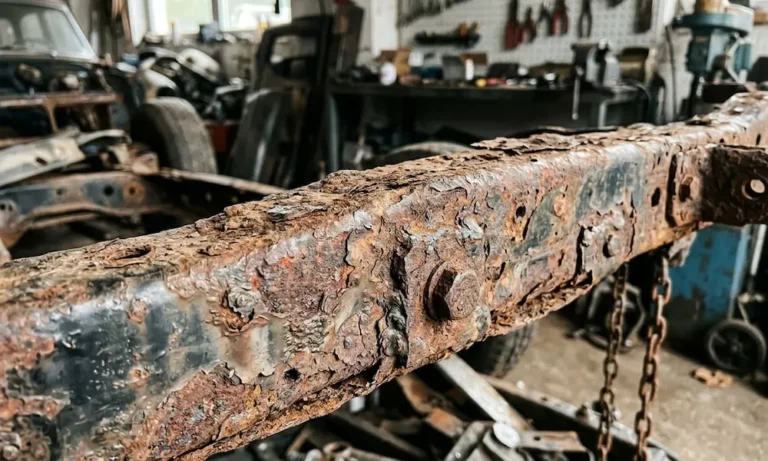
Got rust on your frame? You’re probably wondering if your wallet is about to take a serious hit. The answer depends on how bad the damage is — and knowing the difference could save you thousands. Read this before you hand over any keys.
What Rusty Frame Repair Actually Costs
Rusty frame repair cost isn’t a single number. It’s a range that swings wildly based on how deep the rust goes, what kind of vehicle you own, and where you live.
Here’s a quick breakdown before we dive deeper:
| Repair Type | Typical Cost (USD) |
|---|---|
| Surface rust treatment | $50 – $200 |
| Scale rust repair | $200 – $1,000 |
| Patch welding / minor structural work | $500 – $2,500 |
| Crossmember replacement | $800 – $2,500 |
| Frame reinforcement | $1,500 – $3,500 |
| Hydraulic frame straightening | $1,500 – $5,000 |
| Single rail replacement | $8,000 – $15,000 |
| Complete frame swap (truck/SUV) | $15,000 – $30,000+ |
| Unibody structural reconstruction | $12,000 – $25,000+ |
These aren’t guesses. They reflect real industry repair data from shops across the U.S.
The 3 Stages of Frame Rust (And Why They Change Everything)
Not all rust is the same. The stage your rust is at completely controls your rusty frame repair cost.
Stage 1: Surface Rust
This is cosmetic. The paint cracked, moisture got in, and you’ve got an orange patch. The steel underneath? Still solid.
A tech grinds it down to bare metal, applies a rust-converting primer, and seals it up. You’re looking at $50 to $200 for professional treatment — or a Saturday afternoon DIY job.
Catch it here and you’ll never worry about it again.
Stage 2: Scale Rust
Now the metal is thinning. The rust expanded, lifted the paint, and created a crusty, flaking surface. It hasn’t punched through yet, but it’s losing tensile strength fast.
Repair requires aggressive wire brushing or media blasting, chemical treatment, and heavy sealing. Costs jump to $200–$1,000 depending on how much area is affected.
Stage 3: Penetrating Structural Rust
This is the one that keeps mechanics up at night. The rust has eaten completely through the steel. You’ve got holes, jagged edges, and zero load-bearing ability in that zone.
The only real fix is cutting out the dead metal and welding in new steel. This is where rusty frame repair cost escalates fast — from $1,200 to well over $4,000 for localized work, and much more for widespread damage.
Body-on-Frame vs. Unibody: Which Costs More to Fix?
Your vehicle’s construction type dramatically changes repair complexity — and your final bill.
Body-on-Frame Trucks and SUVs
Trucks like the Ford F-150, Chevy Silverado, and Jeep Wrangler use a separate steel ladder frame. That modularity works in your favor. A shop can cut out the rusted section and weld in replacement steel without touching the cab.
In catastrophic cases, they can unbolt the body entirely and drop it onto a brand-new frame. It’s expensive and labor-heavy, but it’s possible. That’s a $15,000–$30,000 job, but it can save a high-value truck.
The catch? These frames often rust from the inside out. Boxed frame rails trap moisture and road salt, so the damage is worse than it looks externally.
Unibody Cars and Crossovers
Most sedans, hatchbacks, and crossovers use unibody construction — where the body and frame are one integrated structure. That’s great for crash safety, but terrible for rust repair economics.
You can’t just bolt on a new section. Technicians have to cut, fit, and weld high-strength sheet metal with surgical precision, then verify the entire structure hasn’t shifted. One mistake destroys the car’s crash performance.
The result? Unibody structural rust almost always leads to a total loss declaration. A $12,000–$25,000 repair bill on a $9,000 car doesn’t make financial sense.
Signs Your Frame Rust Is Serious
Don’t wait for a failure. These symptoms mean the damage is already structural:
- The screwdriver test fails — a mechanic pushes a pick through the frame rail. It goes straight through. That’s a total structural failure.
- Doors stick or gaps look uneven — the frame is sagging and distorting under its own weight.
- Steering wanders at highway speed — rust has compromised the suspension mounting points, so your wheels aren’t held in proper geometry anymore.
- Tires show uneven wear — especially bald inner edges. This isn’t an alignment problem. It’s a frame problem.
- Creaking or cracking over bumps — weakened steel flexing beyond its design limits.
- Water inside the cabin — floor pans have rusted through, and road moisture is entering from below.
If you’re experiencing more than one of these, get your frame inspected immediately. The longer you wait, the more steel you’ll need to replace.
What Labor Actually Costs — And Why It’s the Big Number
Here’s something that surprises most people: labor drives the majority of rusty frame repair cost, not the steel itself.
Structural welding isn’t basic auto body work. It requires certified technicians who understand automotive metallurgy, operate laser frame measurement systems, and run hydraulic frame-pulling jigs. That expertise costs money.
National auto body labor rates span roughly $50–$120/hour for standard work. But structural frame repair commands a premium. In high-cost metros like Chicago or Los Angeles, you’re looking at $140–$175/hour for structural work.
Regional variations are real:
- North Carolina: $85–$105/hour
- Iowa: $130–$145/hour
- California: $155–$175/hour
- Wyoming / Mississippi: $150+/hour (scarce specialists drive prices up)
A comprehensive frame repair on a Jeep TJ that uses a Safe-T-Cap sleeve system — where heavy-gauge steel caps slide over the existing rails — typically runs $2,800–$4,000 total once you factor parts, labor, and a post-repair undercoating. The steel caps themselves only cost $150–$210 per section. But the 5–8 hours of labor per section, plus brake line and fuel line removal to prevent welding fires, is where the bill climbs.
State Inspections and Frame Rust: What Will Fail Your Car
If you live in a salt-belt state, your rusted frame isn’t just a mechanical problem. It’s a legal one.
States like Pennsylvania, New York, Maryland, and Massachusetts have strict structural inspection standards. Fail one, and your car is off the road until you fix it.
Key automatic failures include:
- Rust holes in floor pans that could let carbon monoxide enter the cabin — Pennsylvania mandates immediate rejection
- Floor weakness where holes exceed six square inches — Maryland regulations treat this as an automatic fail
- Protruding jagged metal pointing in any direction — laceration hazard
- Improper repairs — duct tape, foam, fiberglass resin, or tar paper over a rust hole is illegal and an instant failure
Legally acceptable repairs require cutting out the compromised section and welding in steel of equal or greater thickness. No shortcuts. No cover-ups.
The Repair vs. Replace Decision
Here’s the number you need to know: 50%.
If your rusty frame repair cost exceeds 50% of the car’s current fair market value, the repair is economically inviable. Full stop. That money is gone — and more hidden rust will follow.
A 12-year-old sedan worth $6,000 with $4,500 in frame repair estimates isn’t worth saving. Even after the repair, you’re driving a car with compromised resale value, potential hidden corrosion elsewhere, and an odometer that keeps ticking.
But there are real exceptions:
- Jeep Wranglers, Toyota Tacomas, and 4Runners hold value exceptionally well. A $4,000 frame repair on a Wrangler that’s worth $18,000 is a smart investment.
- Commercial trucks cost $70,000–$100,000 new. Spending $15,000 on a frame swap for an otherwise solid diesel work truck makes complete business sense.
One more thing: always add a 30–60% contingency buffer to any estimate. Rust hides. Once a tech starts cutting, they regularly find far worse damage inside box sections than what the initial inspection revealed.
The Toyota Frame Disaster: A $3.4 Billion Warning
The clearest example of what frame rust costs at scale? Toyota’s frame crisis.
Between 1995 and 2010, Toyota built over 1.5 million Tacoma, Tundra, and Sequoia trucks with frames that corroded from the inside out. The boxed design trapped road salt, and the internal rust eventually caused rear leaf springs to detach — puncturing fuel tanks and cutting brake lines on moving vehicles.
The outcome: a $3.4 billion class-action settlement in 2016. Toyota allocated roughly $15,000 per vehicle for full frame replacements on the worst-affected trucks — covering an estimated 225,000 individual units.
Affected models included 2005–2010 Tacomas, 2007–2008 Tundras, and 2005–2008 Sequoias. If yours is in that range, check your eligibility.
Can You DIY Frame Rust Repair?
For surface and scale rust, yes — absolutely. Grab a wire wheel, some KBS rust encapsulating coating, a cavity wax like Fluid Film or Woolwax, and you can arrest early corrosion for a few hundred dollars. Wash the undercarriage regularly, clear drainage holes, and apply inhibitors before winter. That’s your best long-term defense.
For structural rust with holes in the frame? No.
Entry-level MIG welders now cost under $500. That doesn’t mean you’re qualified to weld load-bearing steel. Too much heat warps the chassis geometry or destroys the temper of high-strength alloys, making them brittle. Too little heat produces surface welds that will tear apart at highway speed.
A failed weld on a suspension mount at 65 mph isn’t a repair problem. It’s a fatality risk. Structural frame repairs belong to certified professionals with commercial-grade equipment.
Classic Car Frame Repair Costs: A Different World Entirely
Restoring a vintage vehicle operates on a completely different financial scale. Many classic parts don’t exist anymore, so fabricators build them by hand from raw sheet steel.
| Classic Restoration Scope | Estimated Hours | Cost at $130/hr |
|---|---|---|
| Light structural rust | 20–80 hrs | $2,600–$10,400 |
| Moderate frame reconstruction | 80–250 hrs | $10,400–$32,500 |
| Heavy rust with custom fabrication | 250–600 hrs | $32,500–$78,000 |
| Full concours body-off restoration | 600–1,200+ hrs | $78,000–$156,000+ |
A heavily rusted Toyota FJ40 Land Cruiser? Expect $20,000–$40,000 in metalwork alone before paint and assembly. For the rarer FJ55, complex structural work routinely exceeds $35,000.
These numbers sound extreme — but for collector vehicles that appreciate in value, the math works differently than it does for your daily driver.
The Smartest Move You Can Make Right Now
Rusty frame repair cost is almost always higher than people expect — and it gets worse the longer you ignore it. Surface rust costs $50 to fix. The same spot ignored for two winters can turn into a $5,000 structural repair.
Get under your vehicle before winter. Look at the frame rails, rocker panels, and suspension mounts. If you see heavy flaking, pitting, or any holes, get a professional inspection this week. The cost of catching it early is almost always a fraction of what waiting will cost you.


