Your car clicks on every turn, and a shop just quoted you $800 for one axle. Ouch. This trakmotive cv axle review covers what you get for a lot less: how the axles are built, which line fits your ride, where they fall short, and what the warranty really covers. Read to the end. You’ll know whether TrakMotive suits your car or whether you should spend more.
What Is TrakMotive, and Why Do Drivers Care?
TrakMotive is a division of Advanced Innovative Technology Corporation, based in Redlands, California. It sells 100% new CV axles across the U.S. aftermarket.
That “new” part matters. Most old-school replacement axles are remanufactured. A rebuilder takes a used core, cleans it, swaps in oversized ball bearings, and adds a fresh boot. Quality depends on how good the core was. TrakMotive builds from raw steel instead, so the joint geometry matches the blueprint every time.
You also skip the core charge. No hauling your greasy old axle back to the store. For a weekend DIYer, that alone sounds nice.
How TrakMotive Builds Its Axles
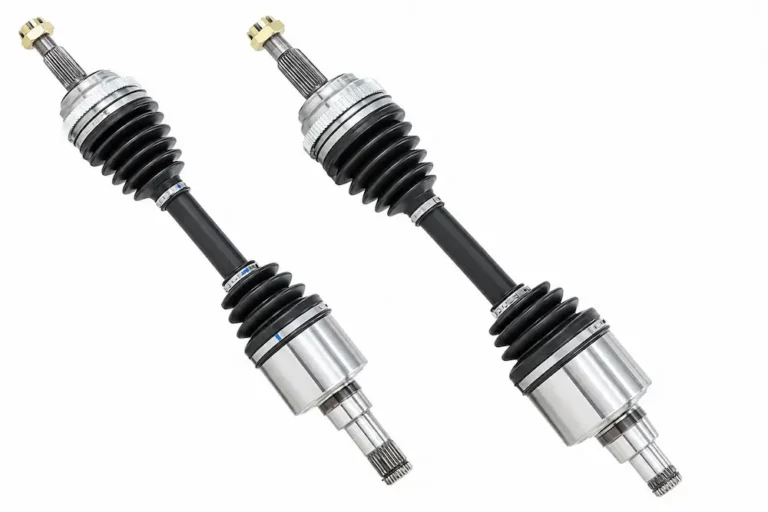
The standard TrakMotive axle uses heat-treated solid steel center shafts. The joint parts (balls, cages, and races) are precision-machined and heat-hardened. That helps them resist pitting and wear when the joint turns at steep angles.
Here’s what else you get in the box:
- Neoprene boots with stainless steel band clamps that resist stretching and grease leaks
- Pre-installed ABS tone rings, so you don’t press old ones onto the new shaft
- Precision-rolled splines and threads for a clean hub fit
- Molybdenum-based grease to cut friction inside the joint
Working on an older car without ABS, like a classic BMW? You can usually knock the tone ring off with a hammer and a drift punch, according to one owner’s write-up. Take it slow.
Fixes for Factory Design Headaches
TrakMotive studies parts that fail on factory cars and redesigns them. Two examples stand out in its common problems guide.
Forged steel bearing brackets. Many Mini Cooper and Toyota models (Highlander, Venza, Camry, Avalon, Sienna) use brittle cast aluminum brackets. Press a new bearing in, and the bracket often cracks. TrakMotive’s forged steel version won’t. You can buy it alone or pre-installed on the axle.
A clip tool for Ford and Mazda. Models like the Ford Escape, Contour, and Mazda Tribute use a triangular inboard clip. It’s hard to seat and can slice the transaxle seal. TrakMotive puts an alignment tool in the box. That’s a thoughtful touch.
TrakMotive Product Lines: Pick the Right One
Not every driver needs the same axle. TrakMotive splits its catalog into several lines. Here’s the quick view:
| Line | Best For | Key Feature |
|---|---|---|
| Premium | Daily commuters, vans, light trucks | OEM-level fit, moly grease |
| XTT (Xtended Travel) | Lifted trucks and SUVs | Up to 44 mm extra plunge |
| HDX (HD Xtreme) | Fleets, rideshare, extreme climates | Grease rated -40°F to 280°F |
| Black Line | European luxury and performance cars | Chemically bonded phosphate finish |
| EV | Electric vehicles | High-strength alloys, low NVH |
| Monobloc / Subaru HD | Long-span shafts, Subarus | Hollow one-piece tube, more travel |
Premium: The Everyday Workhorse
This is the bread and butter. It targets commuters, minivans, and standard light-duty trucks. It’s built to meet or exceed OEM specs for normal driving. If your car never sees a mud pit, start here.
XTT: For Lifted Trucks
Lift a Tacoma, 4Runner, or Ram, and the axle angle gets steeper. Standard axles then run near their limits. During big suspension droop, the inner joint can bind or pull out. Steep angles also make the boot folds rub, which wears them out fast.
The Xtended Travel line tackles this with three changes:
- Sliding spline center shaft. It adds up to 44 mm of plunge travel.
- Eight-ball joint design. It allows up to 47 degrees of articulation, compared with about 23 degrees on a typical OEM joint.
- Thermoplastic elastomer boots. They resist rocks, sticks, and trail junk better than standard neoprene.
HDX: Built for Abuse and Weather
Think delivery vans, rideshare cars, and places with brutal winters or scorching summers. The HDX line uses a special grease that stays slick from -40°F to 280°F. Its boots resist ozone damage. Stepless stainless clamps give a full 360-degree seal, so heat and cold swings don’t loosen them.
Black Line: Premium Finish for Luxury Cars
TrakMotive aimed the Black Line at cars like AMG Mercedes and BMW M models. It debuted at AAPEX.
Instead of paint or zinc, the shaft gets a chemically bonded phosphate treatment. The company claims up to ten times the corrosion resistance of untreated steel. Because it doesn’t add a thick coating, splines and threads keep their exact size. You also get a chloroprene boot and fresh mounting hardware in the box, so you don’t reuse tired flange bolts.
EV Axles: Handling Instant Torque
Electric motors hit full torque from zero rpm. That shock can wear out a standard axle. The EV line uses high-strength alloys and tight balancing. Since EVs have no engine noise to hide vibration, the shafts are tuned to run quiet.
Monobloc and Subaru HD
Monobloc axles use a one-piece hollow tube. That cuts unsprung weight and lets engineers tune out chassis vibration. The Subaru HD program offers 45 degrees of articulation and 50% more linear travel than the stock-style axle, aimed at inner-joint binding.
TrakMotive vs. OEM, Remanufactured, and Budget Axles
Price tells half the story. Here’s how the options stack up, based on the research and owner feedback:
| Source | Cost Per Axle | Core Return? | Commuter Lifespan | Off-Road Toughness |
|---|---|---|---|---|
| Dealer OEM | $400–$900 | No | 150,000+ miles | Excellent |
| Specialist remanufactured (e.g., CVJ) | $250–$370 | Yes (about $70–$100) | 100,000+ miles | Excellent |
| TrakMotive | $100–$250 | No | 50,000–100,000 miles | Moderate |
| Budget aftermarket (e.g., GSP) | $70–$120 | No | 20,000–60,000 miles | Poor |
Those lifespans are estimates, not promises. Your driving, roads, and install quality all change them.
Versus OEM
A factory axle can run 150,000 to 200,000 miles if the boot stays intact. It’s also the gold standard for fit. But at $300 to $900 a side, it stings. Mechanics and off-roaders generally agree that aftermarket steel rarely matches genuine Japanese or German OEM parts. For a commuter car near the end of its life, though, TrakMotive makes more financial sense.
Versus Remanufactured
Rebuilt OEM axles keep the original steel and spline tolerances. That’s why many Toyota off-roaders prefer CVJ units for rock crawling and big tires. The trade-off is price, shipping, and the core return. TrakMotive sits on local store shelves. If you need the car back on the road today, that wins.
Versus Budget Brands
Budget shelves hold GSP, Detroit Axle, and store labels like Duralast Gold and Import Direct. Owner sentiment puts TrakMotive a notch above GSP for boot life and fit. Cardone’s recent corporate troubles also pushed many mechanics toward TrakMotive as a steadier supplier. The specialty lines (XTT, Black Line) lift it above the generic pack.
Real-World Performance: The Good and the Not-So-Good
Specs look great on paper. Driveways tell the truth.
Where TrakMotive Does Well
Most owners of unmodified sedans, crossovers, and minivans on paved roads report smooth power delivery. The clicking goes away. The lack of a core charge makes DIY repairs cheap. For everyday driving, this is the sweet spot.
Isolated Defects Do Happen
No brand is perfect. Owners have reported a few problems:
- A Pontiac Vibe inner joint that clicked and loosened after one month
- A 2008 Honda Accord axle that rubbed the steering knuckle
- A Mazda Miata axle that measured nearly half an inch shorter than the OEM part, which could matter for track driving
These are individual reports, not proof of a widespread flaw. Still, compare the new axle against the old one before you install it.
The Honda and Subaru Vibration Problem
This one gets the most complaints in the repair world. After an aftermarket axle goes into a Honda Accord, CR-V, or Subaru (Outback, Forester, Crosstrek), some drivers feel a shudder under hard acceleration. It usually peaks between 20 and 40 mph.
Why? These drivetrains are picky. OEM axles often have finely tuned plunging joints and weighted rubber dampers on the shaft. If the aftermarket joint binds slightly under load, engine vibration doesn’t get absorbed. It travels into the chassis instead.
TrakMotive’s Subaru HD line and improved vibration tuning aim to fix this. Even so, many technicians stick to OEM or reboot the original axle on these cars to avoid comebacks. Worn transmission mounts can make it worse, too. A sagging mount changes the inner joint angle, as TrakMotive’s own bulletin explains.
Off-Road Limits
The XTT axle solves the pull-out problem, but it can’t rewrite physics. Owners report that joint cages can shatter under heavy shock loads. Picture a spinning mud tire that suddenly grabs a rock while the wheels are at full lock and the suspension droops. Factory forged steel has a higher yield point and often survives that moment.
So here’s the honest take. XTT works well for overlanding, gravel roads, and daily-driven lifted trucks. Dedicated rock crawlers usually go with OEM or custom chromoly axles.
Seal Leaks From Tiny Size Differences
Some installers report a slow fluid leak at the transmission or differential. If the inboard stub shaft runs a hair smaller than OEM, or the finish feels rougher, the lip seal can’t hold tension. Fluid seeps out. Fixes include a slightly undersized seal or going back to an OEM axle. It’s rare, but it’s worth checking your fluid level a week after install.
Check the Intermediate Shaft Before Blaming the Axle
Here’s a diagnosis trap that makes good axles look bad. Many front-wheel-drive cars use an intermediate shaft that connects the transmission to the passenger-side axle. A carrier bearing bolted to the engine block supports it.
When that bearing fails, you get a low hum or a vibration under load. It feels just like a bad inner CV joint. Many mechanics replace the axle, feel the same vibration, and blame the new part. TrakMotive’s team has flagged this common misdiagnosis.
Before you return a brand-new axle, inspect:
- The intermediate shaft carrier bearing
- Engine mounts
- Transmission mounts
It takes ten minutes and may save you a second repair.
Install Mistakes That Kill Axles
Even a great axle dies fast with a bad install. TrakMotive’s installation tips call out three big ones.
Don’t Use an Impact Wrench on the Spindle Nut
This is the big one. An impact gun can blow past the correct torque in a second. That stretches the shaft threads and crushes the wheel bearing and joint races. The damage shows up later as a noisy bearing or a broken joint.
Use a calibrated torque wrench instead. Pull it smoothly to the OEM spec. Some heavy-duty applications call for over 300 foot-pounds. Then lock it in with a cotter pin or staked collar. For more on bearing preload, Timken’s adjustment guide is a solid read.
Never Let the Axle Hang
Don’t leave the axle dangling from the transaxle with the heavy outer end unsupported. That weight can stretch the inner joint past its limit. On some Toyota, Volkswagen, Audi, and Chrysler setups, the internal balls can pop out of their tracks inside the boot. You’d be rebuilding the joint before you even leave the driveway. Support the outer end with a strap or a bungee.
Seat the C-Clip All the Way
On axles with an internal C-clip, the clip must compress to pass through the gears, then expand into its groove. A half-seated clip lets the axle creep outward while driving. That breaks the seal, drains fluid, and can leave you with no power to the wheel. After you tap it in, give the inner housing a firm outward tug to confirm it’s locked. Summit Racing’s C-clip guide shows how these clips work.
TrakMotive Warranty: Read the Fine Print
The TrakMotive warranty looks generous at first glance. Here’s the breakdown:
- Cars and light trucks: Limited lifetime warranty for as long as the original buyer owns the vehicle
- ATVs and UTVs: 365 days from purchase
- Remedy: Replacement or refund of the part price only
Now the catches:
A damaged boot voids everything. If the boot is torn, cut, or punctured, the warranty is void. That hurts because a torn boot is the top cause of CV joint failure. Grease flies out, dirt and water get in, and the joint can grind itself apart within a few hundred miles.
Certain uses void it as well. Racing, aggressive off-roading, commercial fleet delivery, and heavy government service are all excluded. So are unapproved suspension changes and oversized off-road tires. If you run a lifted truck with big tires, don’t count on the lifetime promise.
You claim through the store. TrakMotive doesn’t handle claims directly. You return the part and your original receipt to the retailer, such as AutoZone, Advance, O’Reilly, or RockAuto.
No extras. The company won’t pay for labor, towing, lost wages, or damage to other parts like a ruined seal or hub.
Keep your receipt. Inspect the boots every oil change. Those two habits protect your warranty.
Who Should Buy TrakMotive Axles?
Buy them if you:
- Drive a stock sedan, crossover, or minivan on paved roads
- Want a lower price than OEM without a core return
- Run a lifted truck for trails, gravel, and daily driving (XTT)
- Need fast availability from a local parts store
Think twice if you:
- Own a Honda or Subaru that’s sensitive to vibration (consider OEM or a reboot)
- Rock crawl hard or run big tires with heavy torque
- Track your car and need exact OEM shaft length
- Plan to keep a high-value vehicle for many years
Final Thoughts
So what’s the verdict in this trakmotive cv axle review? TrakMotive fills the gap between cheap white-label axles and pricey dealer parts. The all-new construction, smart fixes like forged brackets and the Ford clip tool, and the range of specialty lines make it a strong pick for everyday drivers. For most commuter cars, it’s a smart buy.
It isn’t magic, though. Honda and Subaru owners may fight vibration. Serious rock crawlers will outgrow the cages. And a torn boot wipes out your warranty.
Install it right, use a torque wrench, check your mounts and intermediate shaft, and watch those boots. Do that, and TrakMotive can keep your car rolling quietly for a long time, with money left in your wallet.