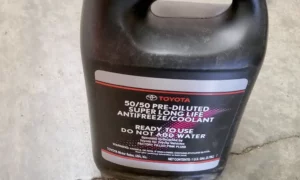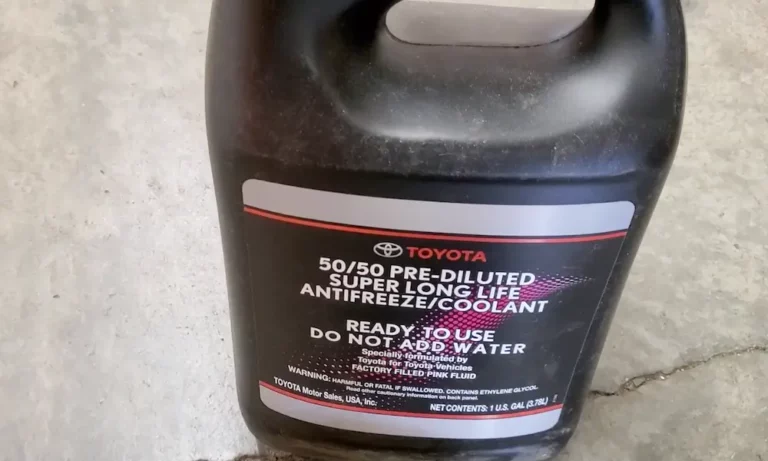
Your Toyota needs a very specific type of coolant — and grabbing the wrong one off the shelf can silently destroy your water pump, radiator, or heater core. Here’s exactly what works as a Toyota super long life coolant equivalent, why the chemistry matters more than the color, and how to avoid a costly mistake.
Why Toyota’s Pink Coolant Is So Specific
Toyota’s Super Long Life Coolant (SLLC) isn’t just pink water. It’s a Phosphate-enhanced Organic Acid Technology fluid — P-OAT for short. That means it’s built around phosphate inhibitors that rapidly protect aluminum components from corrosion.
Here’s what makes it unique — it contains none of the following:
- Silicates
- Borates
- Nitrites
- Amines
That list of exclusions isn’t an accident. Silicates, which you’ll find in many European coolants, are abrasive to the ceramic water pump seals Toyota uses. Phosphates protect aluminum faster than organic acids alone, which is critical in high-heat situations.
The factory fill lasts 100,000 miles or 10 years — that’s not marketing fluff, it’s real chemistry. The primary inhibitor, Sebacic Acid, gives the fluid its long-term stability. It doesn’t deplete nearly as fast as traditional inorganic salts.
| Feature | Toyota Pink SLLC | Toyota Red LLC |
|---|---|---|
| Base | Ethylene Glycol | Ethylene Glycol |
| Inhibitor Type | P-OAT (Phosphate + Organic Acid) | Inorganic Additive Technology |
| Silicates/Borates | None | Low/None |
| Service Life | 100,000 miles / 10 years | 30,000 miles / 2 years |
| Form | 50/50 Prediluted | 100% Concentrate |
The Best Toyota Super Long Life Coolant Equivalent Options
AISIN ACT002 — The Closest Match You Can Buy
If you want the most direct toyota super long life coolant equivalent, AISIN ACT002 is it. AISIN is part of the Toyota Group — they literally supply components to Toyota. The ACT002 is widely considered the same fluid Toyota sells under its own label, just packaged for the aftermarket.
It meets the TSK 2601G (Class G2) specification — Toyota’s own internal certification standard. Here’s how it stacks up side-by-side with the genuine article:
| Property | AISIN ACT002 | Toyota Genuine SLLC |
|---|---|---|
| Color | Pink | Pink |
| Concentration | 50/50 Prediluted | 50/50 Prediluted |
| pH Value | 7.5 – 9.0 | 7.5 – 9.0 |
| Standards | ASTM D3306, JIS K2234 | ASTM D3306, JIS K2234 |
You can find the full AISIN technical data sheet online — everything matches. It also explicitly provides water pump lubrication and scale prevention, which matters for maintaining radiator efficiency over time.
Valvoline Zerex Asian Vehicle Red/Pink
Zerex Asian Vehicle is a silicate-free P-HOAT fluid built specifically to replace Toyota SLLC. It’s widely available at AutoZone, Walmart, and online, which makes it a practical go-to for most people.
Key points:
- Compatible with the factory fill — safe to top off without draining first
- Claims up to 150,000 miles or 5 years service life
- Contains a high-quality defoamer to prevent aeration and cavitation
- Storage stable for up to five years
It meets both ASTM D3306 and JIS K2234, and it checks all the boxes for protecting Toyota’s aluminum-heavy cooling systems.
PEAK OET Asian Red/Pink
Old World Industries makes the PEAK Original Equipment Technology line, and their Asian variant is a direct P-OAT match for Toyota, Lexus, and Scion vehicles.
What sets PEAK apart from the others? It’s one of the few brands that offers both a 50/50 prediluted version (PARB53) and a concentrate (PAR0B3). If you’re doing a proper flush with distilled water, the concentrate lets you dial in the exact glycol-to-water ratio you want. PEAK guarantees 150,000 miles or 5 years of protection with a complete flush and fill.
Pentosin Pentofrost A4
Pentofrost A4 from Fuchs Lubricants is a phosphated OAT (classified as HOAT in the U.S.) that’s explicitly mixable with all other phosphated OATs. It meets ASTM D3306 and works across all water-cooled Toyota engines.
It’s a popular pick at European-specialist shops that also handle Asian imports. The brand carries serious credibility for OE-level chemistry, and it protects the aluminum radiators and heater cores that are most sensitive to coolant chemistry.
What Happens If You Use the Wrong Coolant
This is where DIYers and even some shops get into trouble.
Mixing Pink with Red — It’s Technically OK, But There’s a Catch
Toyota says Pink SLLC is backwards compatible with the older Red LLC. You can top off a Red system with Pink without disaster.
But here’s what nobody tells you: when you mix them, you lose the Super Long Life interval. The system immediately drops back to the Red LLC’s schedule — 30,000 miles or 2 years. The organic acids in the Pink fluid get diluted by the inorganic additives in the Red, cutting the overall stability of the mixture.
Don’t use Red to top off a Pink system if you want to maintain that long-change interval.
The Gelling Problem — Never Mix Asian and European Coolants
This one’s serious. When phosphates (Asian coolant) meet silicates (European coolant), you can get a gel-like chemical precipitate. That gel clogs radiator tubes and heater cores fast.
This is also why “Universal” coolants are risky. They claim to work with everything, but that compromise usually means a diluted chemical profile — not enough phosphate protection for Toyota’s aluminum, and potentially some silicate content that harms the water pump seals.
Checking Compliance: The Standards That Matter
Any real toyota super long life coolant equivalent needs to pass these benchmarks:
| Standard | What It Tests | Why It Matters for Toyota |
|---|---|---|
| ASTM D3306 | Comprehensive metal protection, cavitation resistance | Covers all engine metals and pump impeller safety |
| JIS K2234 | Silicate-free, phosphate effectiveness | Validates Asian-spec chemistry |
| TSK 2601G | Toyota’s internal certification | Direct OEM-level performance verification |
The ASTM D2809 water pump cavitation test is especially important for Toyotas — it directly measures a fluid’s ability to prevent pitting on aluminum water pump impellers.
Platform Exceptions Worth Knowing
Not every Toyota uses the Pink SLLC. A few models run different engines from other manufacturers, and that changes the coolant requirement entirely.
- Toyota Yaris iA / some Yaris hatchbacks — Built on a Mazda platform, these need Mazda FL22 Green coolant. Buying it from a Mazda dealer is often cheaper than the Toyota-labeled version.
- Toyota 86 / Scion FR-S — These use a Subaru boxer engine, so they need Subaru Blue Super Long Life Coolant.
- 2020+ Toyota Supra — BMW platform, BMW engine. Requires BMW HT-12 (Blue/Violet) or G11/G12 equivalent. Pentofrost is a solid option here.
If you own one of these, using the Pink SLLC is the wrong call — regardless of what the Toyota badge says.
How Often Should You Actually Change It?
Toyota says the factory fill lasts 100,000 miles. But a standard drain-and-fill only replaces about two-thirds of the system’s capacity. The rest stays trapped in the block and heater core, immediately diluting your fresh fluid with old, depleted coolant.
Toyota specialists, including those featured on The Car Care Nut YouTube channel, recommend changing the coolant every 50,000 miles or 5 years after the first interval — not waiting another 100,000.
Watch for These Warning Signs
| Observation | Likely Cause | What to Do |
|---|---|---|
| Brown or dirty fluid | Corrosion or head gasket issue | Flush and inspect immediately |
| Gel formation | Incompatible coolant mix | Full system cleaning and flush |
| Low reservoir level | Leak or evaporation | Pressure test, then top off |
| Pink fluid near battery or engine | Active coolant leak | Repair component right away |
Aging coolant also turns acidic over time. Acidic coolant conducts electricity, and that stray current accelerates corrosion from the inside out — especially in the radiator and heater core. It also degrades water pump seals, which leads to bearing failure. If the fluid looks brown or smells burnt, don’t wait for the mileage to catch up.
The Bottom Line on Price vs. Protection
The genuine Toyota SLLC costs more at the dealership, but the price gap narrows when you buy from Amazon or eBay. AISIN ACT002 sits just a few dollars below OEM pricing and delivers identical chemistry. Zerex and PEAK come in cheaper and still meet every required standard.
The real cost isn’t the coolant — it’s a failed radiator, a seized water pump, or a clogged heater core. Any of the verified P-OAT options above protect against that outcome. Stick to AISIN, Zerex, or PEAK, use the right change interval, and your cooling system will outlast most other things on the car.