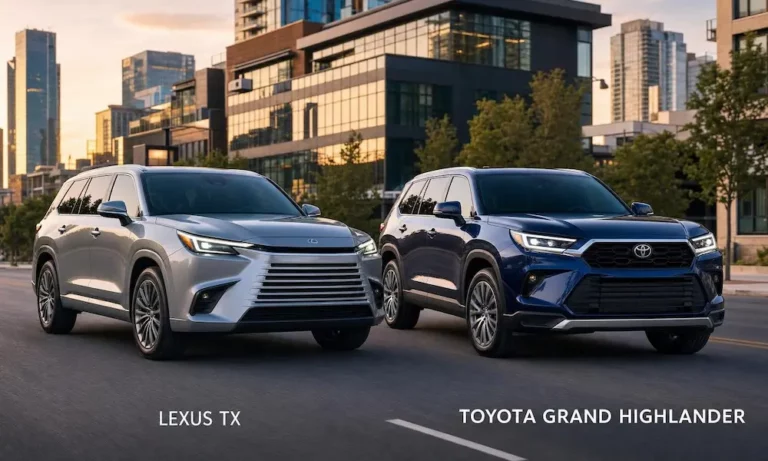
You’re staring at two nearly identical SUVs that share the same bones — but one costs $10,000 more. Is the Lexus TX worth it, or does the Toyota Grand Highlander give you everything you actually need? Let’s break it all down so you can stop second-guessing yourself.
They’re Basically Twins Under the Skin
Both the Lexus TX and the Toyota Grand Highlander ride on the same TNGA-K platform. Same wheelbase. Same width. Same height. But Lexus applies more structural adhesives and laser screw welding to stiffen things up — and you feel it behind the wheel.
That extra rigidity helps the TX deliver what Lexus calls its “Driving Signature” — linear steering, a planted feel, and a ride that doesn’t feel bouncy over highway expansion joints.
The Grand Highlander? It’s solid too. But it doesn’t have that same tuned, controlled feeling that justifies calling something a luxury vehicle.
Here’s a quick look at how close these two really are:
| Dimension | Lexus TX | Toyota Grand Highlander |
|---|---|---|
| Overall Length | 203.1 in | 201.4 in |
| Wheelbase | 116.1 in | 116.1 in |
| Overall Width | 78.3 in | 78.3 in |
| Rear Track Width | 67.4 in | 65.4 in |
| Ground Clearance | 7.9 in | 8.0 in |
Notice the rear track width. The TX is a full inch wider at the rear, which improves cornering stability and gives it a more aggressive visual stance.
How Quiet Is Your Commute Going To Be?
This is where the TX starts pulling ahead in a real, everyday way.
The Lexus TX uses acoustic laminated glass on the front side windows, high-density foam injected into structural cavities, and a more complex insulation package throughout. The Grand Highlander uses standard glass and conventional insulation.
In testing, the TX measured 51.7 decibels at 55 mph vs. 52.8 decibels for the Grand Highlander. That 1.1-decibel gap sounds tiny on paper, but your ears actually register it — especially on long highway trips.
If you do a lot of highway driving and hate road noise creeping into conversations or podcasts, the TX’s quieter cabin is a genuine upgrade, not just a marketing claim.
Engine Options: Efficiency vs. Performance
Both SUVs start with a 2.4-liter turbocharged four-cylinder, but Lexus squeezes out slightly more power — and asks you to use premium fuel to get it.
| Spec | Lexus TX 350 | Grand Highlander (Gas) |
|---|---|---|
| Horsepower | 275 hp | 265 hp |
| Torque | 317 lb-ft | 310 lb-ft |
| Fuel Required | Premium | Regular (87 octane) |
| 0-60 MPH | 7.1–7.8 sec | 7.2–7.5 sec |
The Grand Highlander’s lower curb weight means it occasionally beats the TX to 60 mph in some configurations — even with less horsepower. So don’t buy the TX expecting drag-strip dominance.
The Hybrid Story Changes Everything
Here’s where things get really interesting for the Lexus TX vs Grand Highlander decision.
Toyota’s advantage: The Grand Highlander offers a 2.5-liter hybrid that returns 36 mpg combined and 245 horsepower. This powertrain doesn’t exist in the Lexus lineup at all. If fuel economy is your top priority, the Grand Highlander wins this round cleanly.
Lexus’s advantage: The TX 550h+ is a plug-in hybrid with a 3.5-liter V6 and a combined system output of 404 to 406 horsepower. It delivers about 33 miles of pure electric range — enough for most daily commutes — and still pulls like a freight train when you need it on the highway.
For buyers who can charge at home, the TX 550h+ might actually cost less to run day-to-day than the Grand Highlander’s efficient hybrid.
The Performance Hybrid Head-to-Head
Both brands also offer a 2.4-liter turbocharged performance hybrid:
| Spec | Toyota Hybrid MAX | Lexus TX 500h |
|---|---|---|
| System Horsepower | 362 hp | 366 hp |
| System Torque | 400 lb-ft | 406–409 lb-ft |
| Combined MPG | 27 mpg | 27 mpg |
| AWD System | Standard | Direct4 (Dynamic) |
| 0-60 MPH | 5.6–6.1 sec | ~6.1 sec |
The Lexus TX 500h gets Adaptive Variable Suspension (AVS) and the Direct4 AWD system — both absent from the Toyota. Direct4 can dynamically shift torque between axles in milliseconds, reducing body pitch during hard acceleration and improving traction in tricky conditions.
How Many People Are You Moving?
This one matters a lot for families — and the Toyota wins here.
- Grand Highlander: Available in 8-passenger configuration with bench seats in both rows two and three
- Lexus TX: Maximum 7 passengers, and many popular trims cap at 6 due to standard captain’s chairs in the second row
Lexus prioritizes individual comfort over total headcount. That’s fine if you’re a family of five or six. But if you’re regularly hauling a full carpool, the Grand Highlander’s 8-seat configuration is genuinely useful.
Third-row legroom is identical at 33.5 inches — enough for adults on shorter trips. But the TX offers power-folding and power-reclining third-row seats. The Grand Highlander uses manual pull-straps.
Passenger Space by Row
| Dimension | Grand Highlander | Lexus TX |
|---|---|---|
| Front Headroom | 41.5 in | 41.4 in |
| 2nd Row Legroom | 39.5 in | 39.5 in |
| 3rd Row Legroom | 33.5 in | 33.5 in |
| 2nd Row Shoulder Room | 57.0 in | 57.0 in |
Interior volume is essentially shared between both models. The TX’s more airy cabin feel comes from the panoramic glass roof standard on higher trims — not more actual space.
Cargo Space: The Toyota Has a Tiny Edge
| Configuration | Grand Highlander | Lexus TX |
|---|---|---|
| Behind 3rd Row | 20.6 cu ft | 20.2 cu ft |
| Behind 2nd Row | 57.9 cu ft | 57.4 cu ft |
| Behind 1st Row | 97.5 cu ft | 97.0 cu ft |
The Grand Highlander’s boxier roofline gives it a small advantage in raw volume. Both offer a flat load floor when seats are folded. The TX actually fits more carry-on suitcases due to smarter interior panel shaping — so the numbers don’t tell the full story.
Inside the Cabin: Functionality vs. Hospitality
The Grand Highlander is built for durability. SofTex synthetic leather, large physical climate knobs, and a 12.3-inch touchscreen on most trims. It’s clean, functional, and easy to wipe down after your kid spills a juice box.
The Lexus TX brings semi-aniline leather, genuine wood trim, and a standard 14-inch touchscreen across all trims. The front seats offer 14-way power adjustment with power thigh extensions and four-way lumbar support. The Grand Highlander gives you 10-way adjustment.
The Lexus also brings the e-Latch electronic door handle system — a pressure sensor unlatches the door with a single smooth motion. It also integrates with the Blind Spot Monitor, preventing passengers from opening into the path of cyclists or passing cars.
Audio: JBL vs. Mark Levinson
- Grand Highlander: Optional 11-speaker JBL Premium Audio system with subwoofer
- Lexus TX: Optional 21-speaker Mark Levinson PurePlay Surround Sound with Clari-Fi compression restoration
If you care about audio quality, the Mark Levinson system is genuinely excellent — and it’s not even close to the JBL setup.
Safety Tech: Nearly Identical Where It Counts
Both vehicles come standard with Toyota Safety Sense 3.0 and Lexus Safety System+ 3.0 respectively. These systems are functionally identical:
- Pre-collision detection for pedestrians and cyclists
- Full-speed Dynamic Radar Cruise Control
- Lane Tracing Assist
- Road Sign Assist
- Automatic High Beams
- Traffic Jam Assist (below 25 mph, hands-free with eye monitoring)
Where Lexus pulls ahead:
- Digital rearview mirror — uses a camera feed so cargo doesn’t block your view
- Advanced Park — fully autonomous parallel and perpendicular parking with no driver steering input
- Adaptive Front-lighting System — headlights pivot into corners as you turn
Driving Feel: The TX Has a Secret Weapon
The TX 500h offers Dynamic Rear Steering — the rear wheels turn opposite the fronts at low speeds, making this large SUV feel surprisingly agile in tight parking lots. At highway speeds, they turn in the same direction to improve lane-change stability.
The Grand Highlander has no rear steering. In tight urban environments, you notice.
Combined with AVS adaptive dampers that adjust hundreds of times per second, the TX 500h is a genuinely fun vehicle to drive — something you wouldn’t say about most three-row family haulers.
Warranty and Ownership Costs
| Coverage | Grand Highlander | Lexus TX |
|---|---|---|
| Basic Warranty | 3 yr / 36,000 mi | 4 yr / 50,000 mi |
| Powertrain | 5 yr / 60,000 mi | 6 yr / 70,000 mi |
| Roadside Assistance | 2 yr / Unlimited | 4 yr / Unlimited |
| Hybrid Battery | 10 yr / 150,000 mi | 10 yr / 150,000 mi |
Lexus gives you an extra year of coverage across the board. That helps resale value too — a longer factory warranty is attractive to used car buyers.
Toyota includes ToyotaCare (2 years / 25,000 miles of free scheduled maintenance). Lexus only covers the first two service visits. But Lexus dealerships typically offer loaner vehicles, gourmet lounges, and a much more polished service experience.
Toyota also has five times more dealership locations nationwide — useful if you travel or live outside a major metro.
What Does It Actually Cost?
Toyota Grand Highlander starting prices:
- Gas LE: ~$40,860
- Hybrid XLE: ~$45,380
- Hybrid MAX Limited: ~$54,690
- Hybrid MAX Platinum: ~$58,775
Lexus TX starting prices:
- TX 350 Base: ~$55,050
- TX 350 Luxury: ~$61,200
- TX 500h F Sport: ~$69,350
- TX 550h+ Luxury: ~$78,050
The gap starts at roughly $10,000 and grows fast as you move up both ladders. Whether that gap makes sense depends entirely on what you’re actually buying it for.
So Which One Should You Actually Buy?
Buy the Grand Highlander if:
- You need 8 seats regularly
- Fuel economy is a top priority (that 36-mpg hybrid is genuinely excellent)
- You want to use regular 87-octane fuel
- You’d rather put the $10,000 savings toward something else
Buy the Lexus TX if:
- Road noise bothers you on long drives
- You want the plug-in hybrid’s EV range plus V6 punch
- Material quality and seat comfort matter to you daily
- You value Dynamic Rear Steering and adaptive suspension for city driving
- A longer warranty and premium service experience are worth paying for
The Lexus TX vs Grand Highlander decision isn’t really about which vehicle is better — it’s about which vehicle is better for you. They’re built on the same foundation, but they serve genuinely different buyers.