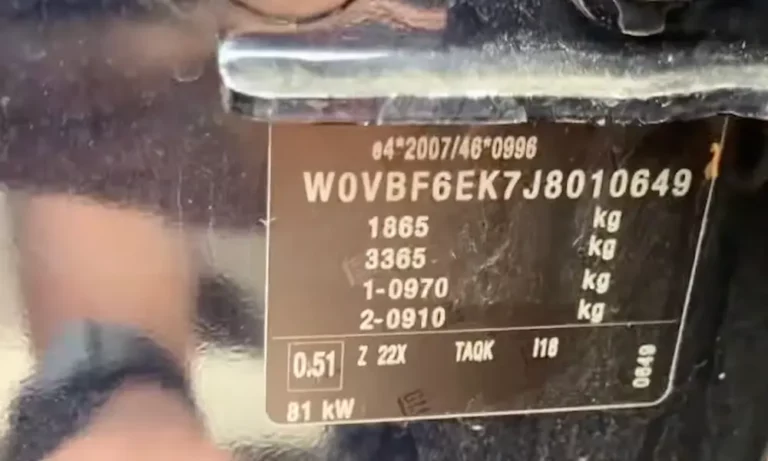
Got a scratch on your Vivaro and need the right paint code? Finding it sounds simple until you realize the label moves depending on which generation you own. This guide breaks down every Vivaro paint code location by platform, shows you how to read the label, and walks you through a basic touch-up repair. Stick around — the cross-reference color table at the end will save you serious time.
Why Your Vivaro’s Paint Code Location Depends on the Year
The Vivaro has had three distinct lives. It started as a Renault-GM joint venture, then became a Stellantis product. Each corporate changeover brought a new platform, new labeling standards, and a new place to stick the paint code.
Get this wrong and you’re ordering the wrong color. That’s an expensive mistake.
Here’s the short version:
- Vivaro A & B (2001–2019): Label on the passenger-side door frame (right-hand B-pillar)
- Vivaro C (2019–present): Label on the driver-side door frame (left-hand door jamb)
The sections below give you the exact spot for each generation.
Vivaro Paint Code Location by Generation
Vivaro A (X83 Platform, 2001–2014) and Vivaro B (X82 Platform, 2014–2019)
Open the front passenger-side door and look at the door frame — specifically the vertical pillar where the door latches shut. That’s the B-pillar. You’ll find a rectangular adhesive label mounted there.
According to the Vauxhall Vivaro X82 conversion guide, this label placement stays consistent regardless of whether the vehicle is left-hand or right-hand drive. So on US-spec left-hand drive vehicles, the passenger side is always where you look first.
Can’t find it there? Check these secondary spots:
- Under the hood on the upper suspension strut tower
- On the firewall between the engine bay and the cab
- Along the front slam panel (the metal frame behind the front grille)
Vivaro C (K0 Platform, 2019–Present)
The Vivaro C flips the script. Vauxhall’s official owners FAQ confirms the label now sits on the driver-side door frame — the left-hand door jamb on a US-configured vehicle.
If you don’t find it there, two backup locations exist:
- Inner lip of the hood (the underside, near the front edge)
- Inside the fuel filler door flap
| Generation | Platform | Years | Paint Code Label Location (US LHD) | Backup Locations |
|---|---|---|---|---|
| Vivaro A | X83 | 2001–2014 | Passenger-side B-pillar door frame | Hood strut tower, firewall, slam panel |
| Vivaro B | X82 | 2014–2019 | Passenger-side B-pillar door frame | Hood strut tower, firewall, slam panel |
| Vivaro C | K0 | 2019–Present | Driver-side door jamb | Hood inner lip, fuel filler door |
How to Read the Label Once You Find It
Finding the label is half the battle. Reading it correctly is the other half.
Renault-Era Labels (Vivaro A and B)
These labels use a 12-block grid layout — a format historically called the Renault Oval Plate. Don’t let the name confuse you. Modern versions are rectangular stickers, but they keep the same data grid.
Your paint code lives in Block 6. That’s the third row, far-left column.
The code usually looks something like TEKNG. Break it down like this:
- TE = Teinte Effet (Effect Paint finish type)
- KNG = The actual color formula code (Cassiopea Grey in this example)
Other common prefixes you’ll see:
- NV = Nacre Vernis (Pearlescent Clearcoat)
- TZ = Solid paint finish
When you order touch-up paint or take the code to a paint supplier, you only need the final three characters — KNG in the example above. The prefix describes the finish type, not the color formula.
Stellantis-Era Labels (Vivaro C)
The Vivaro C label is simpler. The paint code is a straight three-character alphanumeric string — for example, G20 (White Jade) or KCA (Carbon Grey).
You might see a single letter immediately before the code:
- Z = Dual-stage basecoat/clearcoat (metallic or pearlescent)
- Y = Single-stage solid gloss
As Touch Up Paint King explains, drop that leading letter when searching paint databases. Only the three characters after it matter for mixing the formula.
What If the Label Is Missing or Damaged?
Labels peel off. Previous owners repaint panels. Body shops remove stickers during repairs. It happens more than you’d think.
Use the VIN to Pull Factory Build Records
Your 17-character VIN doesn’t directly encode the paint color, but it unlocks the factory build record that does. Providing the full VIN to an authorized dealer’s parts department gives them access to the exact paint recipe your vehicle left the factory with.
Find your VIN in three places:
- Lower driver-side base of the windshield — visible from outside the vehicle
- The B-pillar label — same spot where the paint code label lives
- Your vehicle registration documents
On the Vivaro B specifically, there’s also a structural chassis number stamped directly into the metal frame. It’s hidden under a small plastic viewing window at the top of the passenger-side entry step. Use a flathead screwdriver to gently lift the window and read the number underneath.
Use a Spectrophotometer for Faded or Repainted Panels
If your van is older or has previously repainted panels, the original factory code might not match what’s actually on the bodywork anymore. UV exposure shifts metallic pigments over time.
In that situation, a digital spectrophotometer is your best tool. This device scans the paint directly from the panel, reads the light wavelength signatures, and builds a custom-adjusted formula that matches the current condition of your paint rather than the original specification.
Most professional body shops own one. It’s worth asking before committing to a bulk order of touch-up paint.
How to Apply Touch-Up Paint Correctly
Got your code? Got your paint? Here’s the process that actually works.
What you’ll need:
- Color-matched touch-up paint pen or aerosol
- Clear coat lacquer
- Polishing compound
- Microfibre buffing cloth
Step-by-step:
- Clean the area thoroughly. Wash and dry the damaged panel completely before touching anything.
- Apply polishing compound first. Work it over the scratch with your microfibre cloth. Minor surface scuffs often disappear here — no paint needed.
- Check for bare metal or primer. If you can see silver metal or grey primer, you need paint. If it’s just a surface scuff, you’re done after polishing.
- Apply the basecoat in thin layers. Don’t try to cover the damage in one thick coat. Thin layers prevent runs.
- Wait 10–25 minutes between coats. PaintNuts recommends this drying window to avoid texture buildup.
- Apply clear coat once the basecoat is dry. This seals the repair and restores the gloss.
- Let it cure for 24–48 hours. Don’t rush this step.
- Blend with polishing compound. After full cure, use a mild polish to blend the repair into the surrounding factory paint.
Note: Most modern metallic paints come as a ready-to-use single-component basecoat. You don’t need to add a chemical hardener.
Vivaro Paint Code Cross-Reference Table
The Vivaro was sold under multiple brand names — Opel, Vauxhall, Renault, and Nissan — so the same color often appears under different codes depending on the market. Use this table to cross-reference:
| Core Code | Variant Codes | Color Name | Generation | Finish | Notes |
|---|---|---|---|---|---|
| G20 | EWP | White Jade / Arktis Weiss | Gen C (2019–present) | Solid Gloss | Map to Stellantis/PSA White Jade files |
| KCA | 9808384280 | Carbon Grey | Gen C (2019–present) | Metallic | Map to Peugeot/Citroën grey codes |
| 92U | 298, 3AU, D68 | Midnight Black | Gen A & B (2001–2019) | Metallic | Map to GM/Opel black catalog codes |
| 82U | 147, TZ | Star Silver / Argent Etoile | Gen A & B (2001–2019) | Metallic | Map to Renault/Opel silver profiles |
| 389 | 93194150 | Ice White / Glacier White | Gen A (2001–2014) | Solid Gloss | Map to Renault Glacier White databases |
| 23U | 20P | Ink Blue / Tintenblau | Gen A (2001–2014) | Solid Gloss | Cross-reference Opel/Vauxhall Marine Blue |
| 547 | 79L, WK | Magma Red / Magmarot | Gen A, B & C (2001–present) | Solid Gloss | Map to GM/Opel Magma Red codes |
| 41Q | 10D | Iron Grey / Eisengrau | Gen B (2014–2019) | Metallic | Cross-reference Citroën/Peugeot Iron Grey |
| GQM | 95599190 | Boracay Blue | Gen B (2014–2019) | Metallic | Map to Vauxhall/Opel Boracay Blue |
| KRK | — | Blue Ingaro | Gen C (2019–present) | Solid Gloss | Map to Stellantis/PSA blue formulations |
| KVJ | — | Sand | Gen C (2019–present) | Metallic | Map to Stellantis/PSA sand metallic |
One last thing worth knowing: because Opel and Vauxhall are now under Stellantis, Opel’s paint database and Vauxhall’s overlap significantly for Gen C vehicles. If one source doesn’t have your code, try the other — they’re often identical formulas filed under different brand names.