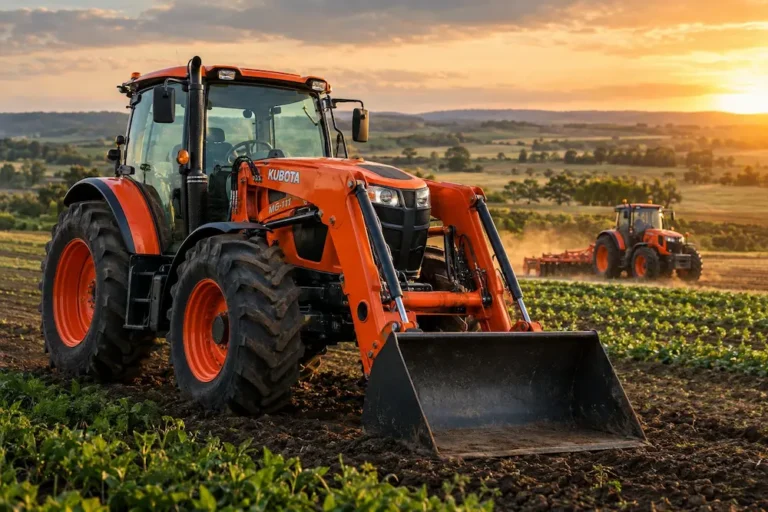
You’re standing on a dealer lot, looking at a Kubota in that famous orange, and wondering where it was actually put together. Good question. The paint hides a supply chain spread across four continents. Some of these tractors get assembled about an hour outside Atlanta. Others roll out of plants in Japan that have been casting iron since 1890. Below, you’ll find every major factory, which models come from each one, and why the answer shifts depending on the size of the machine. Stay to the end — a $2 million labeling fine says everything about how global this brand really is.
The Short Answer
Kubota builds tractors in Japan, the United States, Canada, France, India, and a handful of other Asian countries. No single plant makes everything. The company splits the work by tractor size and by where the tractor sells.
Here’s the fast version:
- Engines and transmissions: Japan, mainly the Sakai and Tsukuba plants
- Sub-compact and compact tractors: assembled in Gainesville and Jefferson, Georgia
- M7000 Series: Bierne, France
- M8 Series: Winnipeg, Manitoba, Canada
- Farmtrac and Powertrac brands: Faridabad, India
- Loaders, backhoes, mowers, and seeders: Kansas and Georgia
Roughly half of all Kubota-branded equipment sold in the US is built or assembled in Georgia. That’s the headline number most American buyers care about.
Why Kubota Builds Where It Sells
Kubota runs on a simple rule it calls local production for local consumption. In plain English: build the machine close to the people buying it.
That strategy solves several problems at once. It cuts shipping costs on heavy steel frames. It sidesteps import tariffs. It lets engineers tune a tractor for local soil, local emissions rules, and local operator habits. A rice farmer in Vietnam and a hay producer in Kansas don’t need the same machine, even if both want it painted orange.
But Kubota doesn’t scatter everything. It keeps the hard stuff — engines and complex drivetrains — concentrated in Japan, where the company can protect its proprietary designs and hold quality steady across every market. As Kubota’s tractor division puts it, designing the engine and the tractor body as one system is what delivers stable power and long-term durability.
So you get a hybrid model: core components made in a few tightly controlled plants, final assembly spread around the world.
Japan: The Engineering Core
Kubota started as a foundry, not a tractor company. In 1890, a 19-year-old named Gonshiro Ohde opened a small metal casting shop in Osaka, making parts for scales and household goods. When Japan needed sanitary water systems, the shop pivoted to cast iron pipes. Ohde later took the Kubota family name, and the business became Kubota Iron Works. You can trace the whole arc through Kubota’s official corporate history.
The company entered farm machinery in the 1940s and built Japan’s first domestically produced tractor by 1960. Over a century later, Japan still anchors the operation.
The Sakai Plant in Osaka
Sakai is the historical heart. Running since 1937, it employs more than 2,100 people and produces the diesel engines that power Kubota equipment — plus engines sold to other manufacturers around the globe. The Sakai Rinkai complex next door handles emissions research and development, which matters a lot when regulators keep tightening the rules.
The Tsukuba Plant in Ibaraki
Built in 1975, Tsukuba covers about 83 acres — roughly 63 American football fields, if that’s easier to picture. It’s Kubota’s automation showcase. About a third of the engine assembly line runs fully automated. Fifteen robots install crankcases, crank gears, pistons, and connecting rods. Sixteen CNC robots machine engine blocks, cutting human error and keeping tolerances tight.
Location helps too. Tsukuba is a planned science city with two major universities and hundreds of research labs, so the factory sits in a deep pool of engineering talent. An inside look at the Tsukuba factory shows just how far the automation goes.
What Japan Ships Out
Japan assembles premium compact tractors, rice transplanters, harvesters, and mini excavators. For US buyers, the practical takeaway: sub-compact and compact models often carry engines and drivetrain parts pulled straight from Sakai or Tsukuba, then assembled stateside.
The United States: Kubota’s Biggest Factory Floor
The US is Kubota’s largest equipment market, and the company backs that up with real factories. Almost half of the Kubota equipment sold here gets built in Georgia alone.
Georgia: Gainesville and Jefferson
It started in 1988 with Kubota Manufacturing of America, making backhoes and loaders. Decades later, it’s a sprawling campus. On January 1, 2024, Kubota folded Kubota Manufacturing of America and Kubota Industrial Equipment into one entity, as the company explained in its consolidation announcement. The combined operation now runs over 3 million square feet with about 3,500 workers.
Gainesville handles:
- BX Series sub-compact tractors, the go-to for residential landscaping and light farm work
- T, G, and GR series lawn tractors
- Z200 through ZD series zero-turn mowers, some of which ship to Europe and Australia
- RTV utility vehicles, painted in a dedicated state-of-the-art paint system
Jefferson handles:
- Heavy fabrication of loaders and backhoes, hundreds of thousands per year
- Final assembly of L, MX, and select M Series tractors
- The SSV65 skid steer loader
Here’s the nuance: engines and transmissions for those Georgia-assembled tractors usually arrive in crates from Japan. Workers in Jefferson marry the parts, install the cab, and finish the build. Fun wrinkle — the SSV65 is made in Georgia, but the bigger SSV75 ships in from Japan.
Quality systems in Georgia are no joke either. The team used enterprise quality software to centralize corrective actions, tracking defects per unit and cutting them from 2.3 down to 1.4. Camera-based inspection verifies parts and labels, which slashed return authorizations from mislabeling by half. Kubota also put $140 million into Gainesville expansion, adding 500 jobs and doubling loader capacity, plus an 85-acre research and development center backed by $85 million.
Kansas: Implements, Seeders, and Dirt Tools
Kubota bought Great Plains Manufacturing — founded in Salina, Kansas, in 1976 by Roy Applequist — to pair its tractors with implements that actually match. That acquisition brought 1.5 million square feet of factory space across eight Kansas towns and thousands of skilled workers, many of whom farm themselves. The current footprint is laid out on Great Plains’ facilities page.
- Salina: headquarters and R&D, with test tracks and prototypes
- Abilene East: mowers, rotary tillers, seeders, aerators, spreaders — robotic welders and powder paint lines
- Abilene West: construction loaders, ten robotic weld cells, laser cutters that load and unload themselves
- Lucas: the giant rotary cutters and drag scrapers
- Kipp and Tipton: rear blades, box scrapers, field cultivators, tillage tools
Abilene recently added a hay and forage assembly line with partner Kverneland, covered in this Farm Equipment report.
Illinois: Engine Distribution
Kubota Engine America in Lincolnshire, Illinois, doesn’t cast metal. It moves engines to the Georgia assembly lines and to outside manufacturers who buy Kubota powerplants for their own machines. It also runs supply chain due diligence on forced labor and child labor risks, detailed under Kubota Engine America’s governance pages.
Canada: Where the Big Horses Live
For years, Kubota meant compact and utility tractors. Breaking into row-crop farming meant building something much bigger, and fast.
So Kubota cut a deal with Buhler Industries in Winnipeg, Manitoba, the company behind the Versatile brand. That partnership produced the M8 Series, Kubota’s largest ag tractor ever, announced in this M8 launch release. Rather than pour concrete on a new plant, Kubota used Buhler’s existing Canadian factory.
The 190 and 210 horsepower M8 tractors run on 6.7-liter Cummins diesels — American engines, not Japanese — paired with ZF transmissions offering powershift and continuously variable options. Hydraulic flow runs 31.7 to 42.2 gallons per minute, enough to pull serious planting equipment. It’s a textbook case of teaming up to crack a market segment that takes decades to enter alone. Kubota’s own North American expansion notes spell out the strategy.
Europe: France and Germany Split the Work
European farms look different — smaller, more varied crops, tougher regulations. So Kubota built local factories rather than shipping machines across oceans.
France’s Bierne plant opened in 2014 to build the M7000 Series, tractors in the 130 to 170 horsepower range for upland farming and dairy work. That size class is huge in Europe. The plant shipped its 10,000th M7000 Series tractor in 2022, and those French-built machines also export to North America, Australia, and Japan.
France also hosts Kubota Research & Development Europe near Paris, focused on getting tractors and implements to talk to each other.
Germany handles construction. Kubota Baumaschinen GmbH in Zweibrücken has built compact and short-tail excavators since 1988, tuned for tight European streets and strict safety rules.
Asia and India: The Volume Play
Kubota also builds in Thailand, China, Indonesia, and Vietnam, mostly for regional markets — think wetland rice cultivation and cost-sensitive buyers.
The biggest story sits in India, the world’s largest tractor market by volume at roughly 1.5 million units a year. Kubota partnered with Escorts Limited, an Indian engineering firm dating back to 1944, then took a controlling stake to form Escorts Kubota Limited. From Faridabad in Haryana, the company builds Farmtrac and Powertrac tractors — simple, rugged, affordable machines for smallholder farms. Its R&D arm runs emissions labs and fluid dynamics test beds.
Those factories export to more than 60 countries. Existing capacity: 170,000 tractors and 10,000 construction units a year. And a new 154-acre greenfield plant in Uttar Pradesh, backed by roughly 20 billion rupees, will eventually source components for assembly plants in Japan and the US.
Which Kubota Model Comes From Where
| Tractor Series | Where It’s Built | Who It’s For |
|---|---|---|
| BX Series (sub-compact) | Gainesville, Georgia, USA | Homeowners, light landscaping |
| L and MX Series | Jefferson, Georgia, USA | Utility work, property maintenance |
| M7000 Series | Bierne, France | Upland farming, hay, dairy |
| M8 Series | Winnipeg, Manitoba, Canada | Row crop, large-scale ag |
| Farmtrac / Powertrac | Faridabad, Haryana, India | Emerging markets, smallholder farms |
The “Made in USA” Question
Can you call a Georgia-assembled Kubota “American made”? Legally, no. The Federal Trade Commission says a product must be all or virtually all made in the US to carry that label without conditions.
Georgia workers weld, paint, and bolt the frames. But the diesel engines and hydrostatic transmissions — the expensive parts — mostly arrive from Japan. So these tractors are assembled in America from domestic and imported components.
That distinction has teeth. In early 2024, Kubota’s North American arm paid a $2 million civil penalty after the FTC found it labeled thousands of replacement parts as made in the US when they were manufactured overseas. At the time, it was the largest penalty ever for Made in USA labeling fraud. The company acknowledged the settlement, cooperated, and tightened its supply chain auditing. Kubota caught a similar citation back in 1999 over lawn tractor claims.
The lesson for buyers: “assembled in the USA” and “made in the USA” are not the same sentence.
Emissions Rules Shape the Factory Floor
Regulation drives manufacturing decisions as much as labor costs do. Modern tractors must meet Tier 4 Final in the US and Stage IV in Europe — standards that nearly eliminate soot and cut nitrogen oxides by about 90% from earlier rules.
Kubota engineers tackled this in Japan. Smaller engines got internal fixes: high-pressure common rail injection, cooled exhaust gas recirculation, and Kubota’s Three Vortex Combustion System. Bigger engines needed hardware bolted onto the exhaust — diesel oxidation catalysts, particulate filters that trap soot and burn it off during regeneration, plus selective catalytic reduction that injects diesel exhaust fluid to turn nitrogen oxides into nitrogen and water. CK Power’s Tier 4 FAQ walks through how that aftertreatment works in practice.
Every engine family gets tested and certified by the EPA and California’s Air Resources Board before production starts. You can see the certification trail in Kubota’s emissions certificate library. Those systems changed engine dimensions, forced chassis redesigns on the Georgia line, and pushed dealers into new service training.
Chemical rules add another layer. Kubota even petitioned the EPA over fire-retardant substances regulated under the Toxic Substances Control Act, arguing that swapping them out of wiring and insulation takes years of testing — the filing is public record. One chemical ban can ripple across thousands of parts.
Final Thoughts
So where are Kubota tractors manufactured? Depends which one you buy. Japan still builds the engines and transmissions, the engineering crown jewels. Georgia assembles the sub-compacts and utility tractors most Americans own. Kansas forges the loaders, backhoes, and seeders that hang off them. Canada and France cover the big horsepower. India handles volume for developing markets.
That’s a deliberate design, not a scattered one. Centralized powertrains protect quality and secrets. Regional assembly keeps shipping costs sane and lets each factory tune machines for local fields. Acquired implement makers fill the gaps.
Next time you walk a dealer lot, check the model number. It tells you which continent built your tractor — and probably which ones built the parts inside it.