You’re thinking about 50% window tint, but you’re not sure how it’ll affect your night drives. Fair concern. This post breaks down exactly what happens to your visibility after dark, which film types perform best, and what the law says in your state. Stick around — the answer isn’t as simple as you’d think.
What “50% Window Tint” Actually Means
Here’s the thing most people get wrong. A 50% window tint doesn’t mean your window ends up at 50% light transmission. It means the film allows 50% of light through — but your factory glass already blocks some light on its own.
Most factory glass sits between 70% and 80% VLT (visible light transmission). When you layer a 50% film on top of that, the two work together. The result? You’re typically left with a net transmission of around 35% to 40% — not 50%.
That gap matters a lot at night.
| Component | Nominal VLT | Real-World Impact |
|---|---|---|
| Standard factory glass | 70–80% | Sets your baseline |
| 50% aftermarket film | 50% | Cuts remaining light in half |
| Combined assembly | ~35–40% | What your eyes actually receive |
| 5% limo tint | 5% | Dangerous after dark |
This is why law enforcement measures the full window assembly, not just the film. And it’s why understanding your net VLT matters before you commit to any tint level.
How Your Eyes Respond to 50% Tint at Night
Your eyes have two types of light receptors: cones for daytime detail and color, and rods for low-light conditions. When the sun sets, your eyes shift into rod-dominant “scotopic” vision. Rods are extremely sensitive but they can’t read color and they lose sharpness.
A 50% tint pushes you deeper into that rod-dependent mode earlier than clear glass would. Your pupils dilate more to compensate. That’s where the trade-off gets real.
Glare Recovery Takes Longer
Wider pupils are more vulnerable to sudden bright lights. When oncoming high beams hit your dilated eyes, recovery time increases. You’re temporarily blinded for a fraction longer — and at highway speed, that fraction counts.
Contrast Sensitivity Drops
Contrast sensitivity is your ability to distinguish an object from its background. Think: spotting a person in dark clothes against black asphalt. With fewer photons reaching your retina, your brain gets a weaker signal. You notice hazards later. You react later.
This isn’t theoretical. Federal Highway Administration research found that light transmission levels below 70% have a statistically significant impact on reaction times at night. A 50% net VLT window can reduce recognition distance for a pedestrian in dark clothing by up to 25% compared to clear glass.
| Target at Night | Detection Distance (No Tint) | Detection Distance (50% Tint) |
|---|---|---|
| Pedestrian in white clothing | ~800 feet | ~600 feet |
| Pedestrian in black clothing | ~200 feet | ~140 feet |
| Road debris (tire tread) | ~210 feet | ~160 feet |
| Wildlife (deer) | ~300 feet | ~225 feet |
Those aren’t small differences. At 60 mph, losing 60 feet of detection distance costs you nearly a full second of reaction time.
Which Film Type Matters Most for Night Driving
Not all 50% window tint performs the same after dark. The technology inside the film changes everything about how light passes through it.
Dyed Films: Budget Choice, Night Liability
Dyed films use colored layers to absorb light. They’re cheap and they do darken the glass. But dye particles scatter incoming light, creating a subtle haze. Streetlights look slightly blurry. Edges lose crispness.
Worse, dyed films fade. UV exposure breaks down the chemical bonds in the dye, turning it purplish or bluish over time. That discoloration doesn’t just look bad — it compromises the optical quality of the glass and makes night driving harder.
Metallic Films: Heat Yes, Clarity No
Metallic films reflect heat extremely well. But at night, those same metal particles act like tiny mirrors inside your cabin. Turn on an interior light or check a bright dashboard display and the film reflects it straight back into your eyes. That interior glare can seriously obscure your view of the road.
Metallic films also interfere with GPS, cellular signals, and radio — a real annoyance on modern vehicles loaded with electronics.
Ceramic Films: The Right Call for Night Drivers
Ceramic nano-particle films are the gold standard for 50% window tint at night. The ceramic particles block infrared heat and UV radiation without interfering with visible light clarity. They don’t scatter light. Streetlights and oncoming headlights appear sharp and focused rather than surrounded by halos.
Drivers consistently report that 50% ceramic tint delivers what installers call “optical purity” — the kind of clarity that makes you forget the film is even there. No signal interference. No fading. No internal reflections.
| Film Type | Optical Clarity at Night | Color Stability | Signal Interference |
|---|---|---|---|
| Dyed | Fair — scatters light | Low — fades purple | None |
| Metallic | Fair — reflective interior | High | High |
| Carbon | Good | High | None |
| Ceramic | Excellent | Superior | None |
If night driving is a regular part of your life, the price difference between dyed and ceramic is worth every dollar.
City Driving vs. Rural Roads: A Tale of Two Environments
Where you drive changes the entire equation for 50% window tint at night.
Urban Driving: The Tint Works for You
In the city, ambient light is everywhere. Streetlights, storefronts, billboard LEDs, and dense traffic all flood the environment with light. In this context, the 50% reduction actually helps.
Modern LED headlights and HID lamps are brutally bright. They wash out the visual field and cause real eye fatigue on long commutes. A 50% tint tones down those harsh light sources, reducing discomfort glare without making the road look dangerously dark. Urban drivers often call 50% tint the ideal “commuter’s tint” for exactly this reason.
Rural Driving: The Tint Works Against You
On unlit country roads, there’s no ambient glow helping your eyes. Your headlights do all the work. When 50% tint blocks half the returning light, peripheral detail disappears. You can’t catch the eye-shine of a deer standing on the shoulder. Movement in your side windows vanishes into black.
Rural drivers with tinted windows consistently report using high beams more frequently just to compensate. If you drive country backroads regularly, 50% tint demands extra attention and slower speeds after dark.
| Environment | Impact of 50% Tint at Night | Driver Experience |
|---|---|---|
| High ambient urban light | Minimal visibility loss | Reduced eye strain, more comfort |
| Modern LED headlights | Significant glare reduction | Less fatigue on long commutes |
| Rural backroads | Major peripheral detail loss | More anxiety, need for high beams |
| Unlit parking lots | Difficult rear-view maneuvers | Often need to roll down windows |
How Your Headlights Interact with 50% Tint
Your tint doesn’t work alone. The type of headlights on your vehicle dramatically affects how safe 50% window tint at night actually feels.
Halogen Bulbs Fall Short
Traditional halogen headlights output between 700 and 1,200 lumens. That’s already modest for safe night driving. When you add a 50% tint, halogen light through the film feels genuinely inadequate — as if you’ve lost a full headlight. The warm, yellowish spectrum also provides less contrast than white light, making distant objects harder to identify.
LED and HID Systems Compensate Better
Modern LED systems often exceed 3,000 lumens with a bright, white output. That white spectrum illuminates road signs and lane markers more effectively because they’re engineered to reflect it back. Many installers recommend upgrading to quality LED headlights if you plan to run 50% or darker tint on your front windows. The two improvements together deliver a much better net result than either one alone.
What the Law Says About 50% Window Tint at Night
Getting pulled over with illegal tint is frustrating. Getting denied an insurance claim because of it is worse. Know your state’s rules before you book an appointment.
States Where 50% Is Legal and Common
Sun Belt states like Arizona, Florida, and Texas allow front side windows as dark as 25–35% VLT. In those states, 50% tint is considered a conservative, “light” choice. Other states — Minnesota, Virginia, and Wisconsin among them — set 50% as the darkest legal option for front windows.
States Where 50% Is Illegal on Front Windows
New York, California, Pennsylvania, and several Northeast states require front side windows at 70% VLT or higher. Applying a 50% film in these states is illegal and can trigger fines during traffic stops. Drivers there often choose “clear” ceramic films — no visible darkening but the same heat rejection performance.
Windshields Are Almost Always Off-Limits
Virtually every state prohibits tinting the full front windshield to 50%. Most permit only a small strip along the top, ending at the AS-1 line — roughly five to six inches from the top edge. Don’t push this one.
Medical Exemptions Exist
If you have a diagnosed light sensitivity condition, most states offer a medical exemption process. You’ll need a physician’s affidavit submitted to your DMV and typically a certificate to display in the vehicle. Officers carry tint meters and check net VLT at traffic stops, so carry your documentation.
Installation Quality and Maintenance Change Everything
Even the best ceramic film fails if it’s poorly installed or badly maintained.
Why Proper Installation Matters
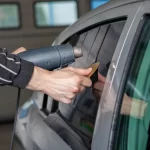
Dust trapped between the film and glass creates small air pockets. At night, those pockets catch streetlights and produce a “starburst” effect that distracts and irritates the driver. Incorrectly heat-shrunk film creases at the curves of the glass, distorting your view of the road. A skilled installer decontaminates the glass, heat-shrinks the film to the exact curvature, and cuts precisely to the edges to eliminate light gaps.
Keep the Film Clean
Tinted windows attract smudges and dust more than clear glass does. A dirty interior surface scatters light and causes it to bloom — especially at night. Clean your windows with a microfiber cloth and ammonia-free cleaner only. Ammonia breaks down the film’s coating, turning it cloudy or yellow over time. Inspect periodically for bubbles or peeling edges. If the film is failing, replace it before the degraded clarity becomes a safety problem.
The Smart Move: Adaptive Behavior for 50% Tint Drivers
If you already have 50% window tint or you’re committing to it, a few simple habits close the gap on the visibility trade-offs:
- Use high beams more on rural roads. They compensate for reduced peripheral light return.
- Upgrade to LED headlights if your vehicle still runs halogens. The extra lumen output counterbalances the tint’s reduction.
- Slow down in fog or heavy rain. Low-quality films develop a milky haze in wet conditions. Even premium films suffer from increased light refraction in heavy precipitation.
- Roll down your window when reversing in unlit parking lots. Rear windows are often darker than fronts, and backing blind is an easy way to hit something you never saw.
- Clean your tint monthly. Dirty film at night is dramatically worse than dirty clear glass.
50% window tint at night isn’t inherently dangerous — but it demands the right film technology, well-maintained glass, capable headlights, and a driver who understands where the limits are. Make those choices deliberately and the trade-off is entirely manageable.