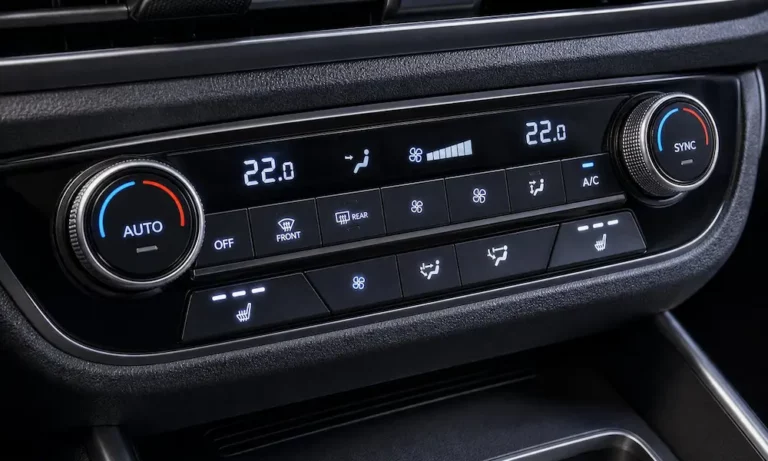
Staring at your car’s climate panel and guessing what half those buttons do? You’re probably using your AC wrong — and it’s costing you comfort, fuel, and maybe even a foggy windshield at the worst moment. This guide breaks down every air conditioner button in your car, explains what actually happens when you press them, and shows you how to use them smarter.
What Happens When You Press the AC Button
Before we get into individual buttons, here’s the quick version of how your car AC works.
Your AC doesn’t create cold air. It moves heat out of your car. A refrigerant loops through the system, shifting between liquid and gas states to absorb cabin heat and dump it outside. The compressor drives this whole cycle, pulling refrigerant in, pressurizing it, and pushing it through the condenser at the front of your car. Warm cabin air passes over cold evaporator coils behind your dashboard, and the cooled, dried air blows through your vents.
Every button on your climate panel triggers a specific part of this process. Now let’s go through them.
The Snowflake Button (AC On/Off)
This is the main air conditioner button in your car — the one with the snowflake icon. Pressing it energizes the compressor clutch, which physically connects the engine’s rotating pulley to the compressor shaft. That starts the refrigerant cycle.
Two things happen when the AC is on:
- Temperature drops — the evaporator pulls heat from cabin air
- Humidity drops — moisture condenses on the evaporator coils and drains outside
That second part matters more than most people realize. Running the AC in winter actually helps clear foggy windshields faster because it dries the air before it hits the glass.
Pro tip: The AC compressor can reduce fuel economy by more than 25% in hot conditions. That’s a real hit, especially on short trips.
The Recirculation Button (Curved Arrow Icon)
This button closes off the fresh air intake at the base of your windshield and loops cabin air back through the system instead. Here’s how it actually works: a motorized door blocks the outside air duct, and the blower just keeps recycling the air already inside.
When to use it:
- Stuck in traffic behind a diesel truck (blocks exhaust fumes)
- Cooling down a hot car fast (pre-cooled air cools faster than hot outside air)
- Driving through dusty or smoky areas
When to turn it off:
- Any time you’re defogging — recirculated air traps moisture from your breath and makes fogging worse
- On long drives — CO₂ builds up and makes you drowsy faster
The Auto Button
If your car has automatic climate control, the AUTO button is the one you should use most. Press it, set your target temperature, and the electronic control module takes over. It adjusts fan speed, vent direction, and compressor cycling automatically — no more fiddling with dials every few minutes.
Automatic systems use a network of sensors to do this:
- Interior thermistors — measure actual cabin air temperature
- Ambient sensors — monitor outside temperature (usually behind the front bumper)
- Solar load sensors — photodiodes on the dashboard that detect direct sunlight and compensate before the car heats up
- Humidity sensors — predict window fogging and activate the compressor or fresh air proactively
The result is lower driver distraction and more consistent comfort. It’s genuinely a set-and-forget system.
Every AC Button Explained: Quick Reference Table
| Button / Symbol | What It Triggers | What You Feel |
|---|---|---|
| ❄️ Snowflake (AC) | Engages the compressor clutch | Cooler, drier air from vents |
| 🔄 Recirculation | Closes fresh air intake door | Faster cooling, blocks outside odors |
| AUTO | ECM controls all variables | Steady cabin temp, no manual tweaking |
| MAX / Front Defrost | Max blower + windshield duct + AC on | Clears fog and condensation fast |
| Rear Defogger | Resistive grid in rear glass heats up | Melts ice and fog from rear window |
| SYNC | Syncs all climate zones to one setting | Same temperature front and rear |
| Fan Speed Dial | Adjusts blower motor resistance | More or less airflow volume |
| Temp Dial | Moves the blend door between hot and cold | Warmer or cooler mixed air |
The Front Defrost Button
This one’s often misunderstood. When you hit the front defrost button, three things happen at once:
- The blower goes to maximum speed
- The airflow redirects to the windshield vents
- The AC compressor turns on automatically
That last point surprises a lot of drivers. But it makes total sense — the AC dehumidifies the air before it’s heated and blown at the glass. Dry, warm air clears fog far faster than humid, warm air. The compressor acts as a dehumidifier here, not a cooler.
Don’t turn off the AC when using front defrost. You’ll slow the whole process down.
The Rear Defogger Button
The rear defogger is completely separate from the rest of your AC system. There’s no airflow involved at all. Instead, pressing this button completes a resistive electrical circuit through thin conductive lines embedded directly in the rear glass. Those lines heat up and melt frost or condensation from the inside out.
It draws a decent amount of power, so most cars automatically turn it off after 10–20 minutes. Don’t scrape the inside of your rear window — you’ll break those heating lines.
Fan Speed: More Than Just “Louder”
The fan dial controls the blower motor speed. Higher settings push more air across the evaporator coils, but they don’t make the refrigerant colder. The temperature of the air coming from your vents stays roughly the same — you just get more of it.
One smart feature on many newer vehicles: voice blower limiting. When you take a hands-free phone call, the system automatically drops the fan speed to reduce background noise. Once you hang up, it goes back to where it was.
Manual vs. Automatic Climate Control: Which Is Actually Better?
| What You’re Comparing | Manual Climate Control | Automatic Climate Control |
|---|---|---|
| How it works | You set it; it stays | Sets itself based on sensor data |
| Sensor use | None — you’re the sensor | Temperature, solar load, humidity sensors |
| Zoning | Single zone | Dual, triple, or individual seat zones |
| Driver distraction | Higher — constant adjustments | Lower — set once and done |
| Response time | Instant — doors move immediately | Slightly modulated — waits to reach target |
| Cost | Lower upfront | Higher upfront, more complex repairs |
Manual systems are simple and reliable. Turn the knob, get the result. But they require you to keep adjusting as outside conditions change.
Automatic systems self-regulate in a closed loop, which means less fiddling while you drive. The trade-off is complexity and cost.
How to Actually Defog Your Windshield Fast
Knowing your air conditioner buttons in your car really pays off here. Different fogging conditions need different button combinations.
Cold weather fog (inside the glass):
- Turn heat to maximum
- Turn AC on
- Turn recirculation off (fresh outside air is drier)
- Set fan to highest speed
- Crack a window slightly to help equalize humidity
Hot, humid weather fog (outside the glass):
- Raise the AC temperature slightly to warm the glass
- Turn recirculation off
- Use your windshield wipers to assist
- Avoid blasting cold AC when it’s muggy outside — it chills the glass below the dew point
Sub-freezing frost on the outside:
- Maximum heat, AC on, fresh air in, fan on high
- Spray a two-thirds isopropyl alcohol and one-third water mix directly on the frozen glass — it melts ice almost instantly
- A windshield cover overnight prevents the problem entirely
Passive moisture fix: Place crystal cat litter inside the car to absorb cabin humidity before it condenses on your windows. Cheap, simple, and it works.
Using Your AC Without Killing Your Fuel Economy
Running your AC hits your wallet in two ways — more fuel burned in gas cars, more battery drained in EVs. Here’s how to stay cool without wasting energy.
Speed matters for windows vs. AC:
- Under 45 mph → windows down is more efficient; the aerodynamic penalty is minimal
- Over 50 mph → windows up and AC on wins; drag increases exponentially at highway speeds
Smart habits that actually help:
- Vent the car first — open windows for two minutes after entering a hot car. Purging trapped hot air reduces the initial load and helps the AC cool the cabin faster
- Don’t idle to pre-cool — idling burns fuel while going nowhere; the AC works better once you’re moving because airflow hits the front condenser
- Pre-condition EVs while plugged in — cool the cabin on grid power before you leave; it preserves driving range
- Use Eco mode — it limits how often the compressor cycles and softens throttle response, reducing overall energy draw
- Keep tires inflated — proper pressure reduces rolling resistance and improves fuel economy by up to 3%
One often-overlooked fix: a bad oxygen sensor can tank fuel economy by up to 40%. If your car is running rough or your MPG has dropped, get it checked before blaming the AC.
The SYNC Button (Multi-Zone Vehicles)
If your car has dual or tri-zone climate control, each zone can be set independently. The SYNC button collapses all those zones into one setting — whatever the driver’s side is set to, every zone matches it. It’s useful when you want consistency and don’t need individual rear-seat adjustments.
Some vehicles also let the driver lock out rear passengers from adjusting their own zone via the infotainment screen. Handy if you’ve got kids who treat the rear controls like a toy.
Now that you know what every air conditioner button in your car actually does, you can stop guessing and start using your climate system the way it was designed. Cooler air, clearer windows, and fewer wasted miles — it all starts with knowing which button does what.