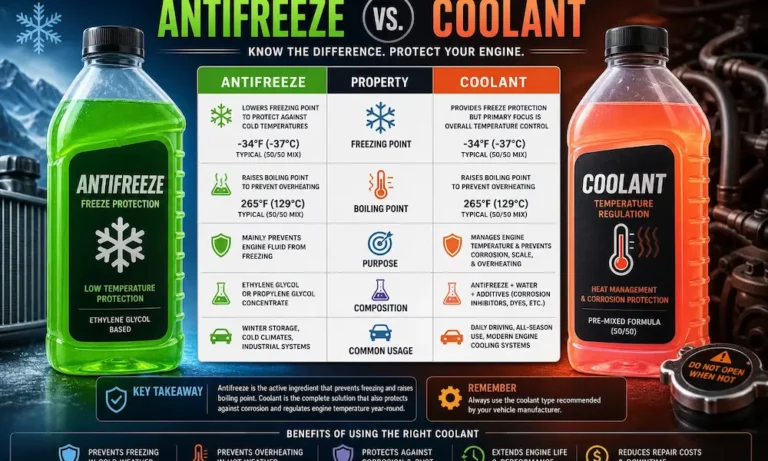
Confused about antifreeze vs coolant? You’re not the only one. Most people use the terms interchangeably—but they’re not the same thing. Using the wrong one, or mixing them incorrectly, can destroy your engine. This guide breaks down exactly what each fluid does, which type your car needs, and how to avoid costly mistakes. Read to the end—there’s a detail about mixing coolants that most people get completely wrong.
Antifreeze vs Coolant: The Core Difference
Here’s the short version: antifreeze and coolant aren’t the same fluid.
Antifreeze is the concentrated, undiluted chemical—mostly ethylene glycol or propylene glycol—straight from the bottle. It also contains corrosion inhibitors, anti-foam agents, and dye.
Coolant is what you actually put in your engine. It’s antifreeze mixed with water, typically in a 50/50 ratio.
Pour straight antifreeze into your engine without diluting it? Bad idea. Pure glycol has a lower heat capacity than water, so it can’t transfer heat efficiently. Your engine overheats. That’s a very expensive mistake.
The magic happens when you combine the two. Water handles heat transfer. Antifreeze prevents freezing, raises the boiling point, and protects metal parts from corrosion.
How Mixing Antifreeze and Water Actually Works
Pure water freezes at 32°F and boils at 212°F. Pure ethylene glycol freezes at 10°F and boils at 388°F. Mix them together, and something interesting happens—the water molecules can’t form ice crystals as easily. This creates what chemists call a eutectic mixture.
A standard 50/50 blend of water and ethylene glycol:
- Drops the freezing point to -34°F
- Raises the boiling point to 265°F (with a 15 psi radiator cap)
That’s the sweet spot for most drivers in the US.
The Right Ratio for Your Climate
Don’t guess your mix ratio. Your climate determines the right blend.
| Water/Antifreeze Ratio | Freezing Point | Best For |
|---|---|---|
| 70% water / 30% antifreeze | 7°F | Hot climates (US Southwest) |
| 50% water / 50% antifreeze | -34°F | Most of the US — standard blend |
| 40% water / 60% antifreeze | -63°F | Alaska, northern states |
| 100% antifreeze | 10°F | Never use — prohibited |
Two important limits to know:
- Never go below 30% antifreeze. Below that, corrosion inhibitors get too diluted. Your engine starts rusting from the inside.
- Never exceed 70% antifreeze. More glycol doesn’t mean more freeze protection. At 100% antifreeze, the freezing point actually rises back to 10°F—and pump strain increases.
One more thing: always use distilled or deionized water to mix your coolant. Tap water carries minerals like calcium and magnesium that drop out of solution under heat, forming scale on engine surfaces. That scale blocks heat transfer and causes hot spots. This is one of the most overlooked causes of cooling system damage.
The 5 Types of Coolant (And Which One Your Car Needs)
This is where most people get tripped up. Not all coolants work in all vehicles. Use the wrong type and you risk sludge, clogged radiators, and overheating.
| Coolant Type | Inhibitor Chemistry | Service Life | Typical Color | Compatible Vehicles |
|---|---|---|---|---|
| IAT (Inorganic Additive Technology) | Silicates, Phosphates | 2 yrs / 36k miles | Green | Older US models (pre-2001) |
| OAT (Organic Acid Technology) | Organic acids only | 5–7 yrs / 150k miles | Orange, Red, Pink | GM, VW, Honda, Toyota |
| HOAT (Hybrid OAT) | Organic acids + silicates or phosphates | 5 yrs / 150k miles | Yellow, Gold, Blue | Ford, Chrysler, select European |
| P-HOAT (Phosphated HOAT) | Organic acids + phosphates | 5–10 yrs / 150k+ miles | Pink, Blue, Red | Toyota, Honda, Hyundai, Kia, Nissan |
| Si-HOAT (Silicated HOAT) | Organic acids + silicates | 5 yrs / 150k+ miles | Purple, Violet, Green | BMW, Audi, Porsche, Mercedes |
IAT coolant depletes fast. The inorganic salts coat all metal surfaces—effective, but they break down quickly. After 2 years or 36,000 miles, the fluid turns acidic and starts corroding from the inside.
OAT coolant targets active corrosion sites specifically instead of coating everything. That precision makes it last much longer—up to 150,000 miles.
HOAT splits the difference. It combines organic acids with low doses of inorganic inhibitors for both quick protection and long-term durability.
Why European and Asian Cars Need Different Coolant
Here’s something most drivers don’t know: the reason European and Asian vehicles need different coolant formulations comes down to water chemistry.
European vehicles ban phosphates. Why? Hard water in Europe contains high levels of calcium and magnesium. Mix phosphate-based coolant with that hard water, and you get calcium phosphate deposits coating the inside of your engine. That scale insulates hot surfaces, blocks heat transfer, and causes head gasket failures. European manufacturers mandate phosphate-free, silicated HOAT formulas to prevent this.
Asian vehicles ban silicates. In regions with naturally soft water, phosphate scaling isn’t the problem. Instead, silicates act as an abrasive under high-velocity flow, wearing down water pump impellers and damaging shaft seals. Japanese and Korean manufacturers specify P-HOAT formulas—organic acids plus stable phosphates—to protect aluminum parts without the abrasion risk.
Using a European coolant in a Honda, or an Asian coolant in a BMW, isn’t a minor error. It’s a direct path to premature water pump failure.
Concentrate vs. Pre-Mixed: Which Should You Buy?
Both options work fine. The choice comes down to cost vs. convenience.
Concentrate is cheaper. A gallon of concentrated antifreeze costs around $9.88. Add $0.80 of distilled water and you get two gallons of 50/50 coolant for about $5.34 per gallon. Pre-mixed 50/50 coolant typically runs $7.88 per gallon. You’re essentially paying extra for water.
Pre-mixed is foolproof. No measuring, no mistakes. It also uses factory-deionized water, which eliminates the mineral contamination risk if you’re tempted to use tap water.
One warning: don’t confuse automotive coolant with RV or marine antifreeze. Those products are ethanol-based or pure propylene glycol with no heavy-duty corrosion inhibitors. They’re designed to protect idle water pipes from bursting—not to handle a running engine. Pouring RV antifreeze into your engine leads to rapid foaming and thermal failure.
Never Mix Incompatible Coolants
This deserves its own section because it’s a common and costly mistake.
Mixing traditional green IAT coolant with modern orange OAT coolant triggers a chemical reaction. The inorganic salts react with the organic acids, and the inhibitors drop out of solution. The result? A thick, jellylike sludge that clogs your radiator tubes, heater core, and water pump passages—followed by engine overheating.
Even mixing two different HOAT formulas can reduce corrosion protection and accelerate seal wear.
If your coolant looks cloudy, muddy brown, or discolored, don’t just top it off. That’s a sign the inhibitors have depleted and the fluid is already corroding your engine. Flush the entire system and refill with the manufacturer-specified coolant.
And always do a full system flush, not just a drain. Draining leaves spent, acidic fluid trapped in the engine block and heater core. A complete flush removes all degraded inhibitors, dissolved metals, and scale before fresh coolant goes in.
The Toxicity Problem With Antifreeze
Ethylene glycol—the base ingredient in most antifreeze—is highly toxic. It has a naturally sweet taste, which makes it dangerously attractive to children, dogs, and cats.
The numbers are alarming:
- Less than 7 tablespoons can kill an adult human
- Just 2 tablespoons can seriously harm a child
- 1 teaspoon can kill an average cat
- Less than 1 tablespoon is fatal to a 20-pound dog
When ingested, ethylene glycol metabolizes into glycolic and oxalic acid. Those acids form calcium oxalate crystals that deposit in the kidneys, causing acute renal failure.
Why All Major Brands Now Add a Bittering Agent
Oregon passed the first law in 1991 requiring manufacturers to add denatonium benzoate—the bitterest known chemical—to antifreeze. At just 30–50 parts per million, it makes the fluid intensely unpalatable, triggering an immediate spit reflex.
At least 17 states followed with their own mandates. In 2012, a voluntary nationwide agreement was reached, and today all major brands add denatonium benzoate to coolant sold in all 50 states. Lab testing confirms it has zero effect on cooling system performance or corrosion protection.
How to Dispose of Used Coolant Legally
Don’t pour used coolant down the drain, into a storm sewer, or onto the ground. It’s illegal—and genuinely harmful to the environment. Glycol in waterways strips dissolved oxygen, suffocating aquatic life.
As coolant circulates through an engine, it picks up heavy metals—lead from solder, cadmium, chromium, and copper. Under EPA Resource Conservation and Recovery Act guidelines, used coolant containing these metals at or above federal thresholds is classified as hazardous waste.
How to dispose of it properly:
- Store in a leak-proof, sealed container labeled “Hazardous Waste”
- Take it to an auto parts store (AutoZone, O’Reilly, and others accept used coolant)
- Use a certified recycling facility
Recycled coolant gets filtered, re-stabilized, and re-charged with inhibitors to meet ASTM D3306 standards. It performs just as well as new fluid.
The scale of improper disposal is staggering. Globally, over 400 million gallons of antifreeze concentrate are sold every year. Studies estimate that roughly 50% gets dumped directly onto the ground or into storm sewers—only about 5% gets properly recycled.
What ASTM Standards Actually Mean for Your Coolant
In the US, engine coolants must meet standards set by the American Society for Testing and Materials. For passenger cars and light trucks, that’s ASTM D3306.
Key requirements include:
- pH between 7.5 and 11.0 — below 7.5, the fluid is breaking down into corrosive acids; above 11.0, it attacks aluminum
- Chloride limit: 25 ppm max — prevents pitting corrosion in aluminum
- Sulfate limit: 50 ppm max — prevents scale and galvanic corrosion
- Foam volume: 150 mL max — prevents vapor locks and cavitation damage
Heavy-duty diesel engines follow ASTM D6210, which adds mandatory protection for wet sleeve cylinder liners against cavitation pitting caused by engine vibration.
When you buy a coolant that meets these specs, you know it’s been tested against a standardized set of metals—copper, brass, solder, steel, cast iron, and aluminum—for corrosion rates within safe limits.
The One Rule That Covers Everything
Check your owner’s manual. Every vehicle manufacturer specifies the exact coolant type your engine needs. That specification exists because your engine’s metallurgy, water pump design, and regional water chemistry all factor into the formula.
Using the right coolant, at the right ratio, with distilled water, and flushing it on schedule—that’s how you keep a cooling system running for 150,000+ miles without issues. The wrong fluid, or the right fluid at the wrong concentration, costs far more than the extra five minutes it takes to get it right.