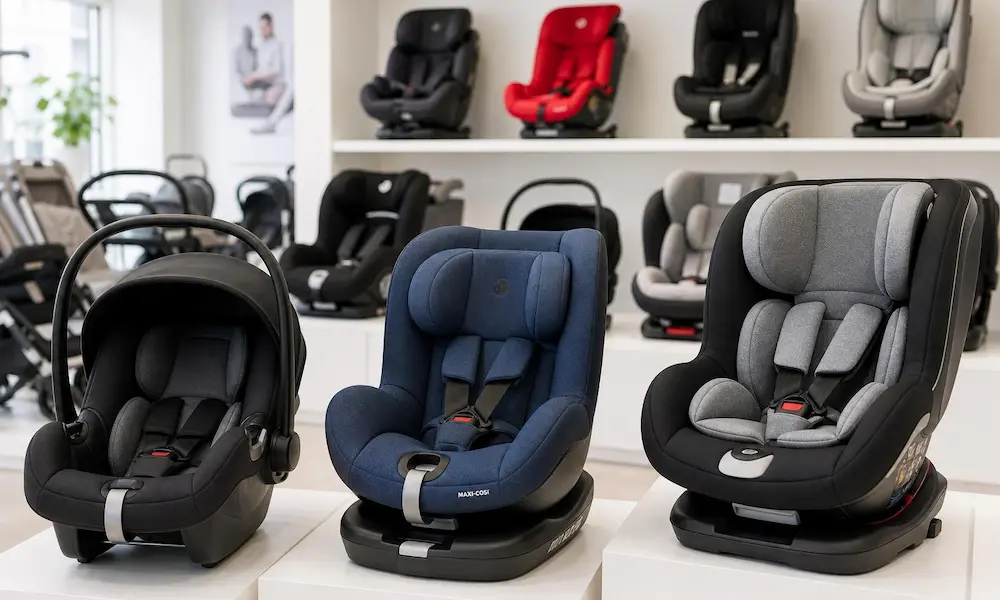
You’ve seen rotating car seats at baby stores with their hefty price tags and wondered if they’re just another overhyped baby product. The short answer: it depends on your situation. Let’s break down what you’re actually paying for and whether it’s worth the investment for your family.
What Makes Rotating Car Seats Different
Rotating car seats swivel 180 to 360 degrees on their base, letting you turn the seat toward the car door. You squeeze a handle or press a button, and the seat rotates for easy access.
These seats pack all the safety features of traditional convertible seats but add that swivel mechanism. They’ve been popular in Europe for years and are now catching on in the U.S. market.
Here’s the important part: rotating seats must pass the same rigorous federal safety testing as traditional car seats. We’re talking crash tests that are more severe than 95% of real-world crashes. So you’re not trading safety for convenience.
The two-piece design includes a base that stays installed and a seat shell that clicks in and rotates. Once you’ve got the base secured, you can switch from rear-facing to forward-facing without reinstalling everything.
The Real Benefits You’ll Notice
Your Back Will Thank You
The biggest win? No more contorting yourself into weird positions to buckle a squirmy toddler.
Michelle Pratt, a Nationally Certified Passenger Safety Technician and founder of Safe in the Seat, puts it plainly: “the rotation feature on car seats can be transformative for parents dealing with back pain, limited mobility, or tight vehicle spaces.”
Parents who’ve made the switch say it’s life-changing. One parent with a 25-pound 10-month-old described how the rotating seat eliminated the awkward hold-and-buckle dance that was wrecking their back.
If you’re recovering from a C-section, dealing with back problems, or have mobility issues, this convenience factor becomes a legitimate health consideration. You’re not just paying for easier buckling; you’re protecting your body from daily strain.
Keeping Kids Rear-Facing Longer
Here’s where rotating seats shine from a safety perspective. The American Academy of Pediatrics recommends keeping kids rear-facing until at least age 2, preferably longer.
But let’s be honest: loading a rear-facing toddler into a traditional seat is a pain. Many parents flip their kids forward-facing early just to avoid the hassle.
Rotating seats remove that temptation. It’s just as easy to buckle a child rear-facing as forward-facing. This convenience can prevent serious spinal injuries in crashes by helping you stick to extended rear-facing goals.
Install Once, Rotate Forever
Most rotating seats let you switch from rear-facing to forward-facing without touching the installation. The base stays put, and you just rotate the seat when it’s time to change orientations.
No need to wrestle with LATCH anchors or seat belts again. For parents who dread car seat installation (which is most parents), this is a genuine advantage.
The Downsides Nobody Mentions at the Store
The Price Will Make You Wince
Rotating car seats run $300 to $750. Compare that to $100-400 for quality traditional convertible seats.
Dr. Alisa Baer, a pediatrician and co-founder of The Seat Lady, notes that “currently, the least expensive rotating seats cost at least $300.” That’s a substantial chunk of change for many families.
You’ve got to ask yourself: is the convenience worth potentially double or triple the cost? For some families, absolutely. For others, that money could go toward other baby essentials.
They’re Heavy and Bulky
Rotating seats typically weigh 28-30 pounds compared to 19 pounds for regular convertible seats. That extra weight comes from the rotating mechanism and reinforced base.
This bulk creates real problems:
- Your front passenger will need to scoot way forward
- Forget about fitting three across in most vehicles
- They’re too heavy for practical airplane travel
- Most aren’t even FAA-approved for air travel
If you’ve got a compact car or need multiple seats across the back, a rotating seat might not physically work for you.
Installation Gets Complicated
Despite what manufacturers claim, rotating car seats can be trickier to install than traditional seats. The two-piece design adds complexity and more potential failure points.
Expert reviewers note that these seats “are more complex, less straightforward to install, and have more things that can go wrong than conventional models.”
Nearly half of all car seats are installed incorrectly, and the complexity of rotating seats doesn’t help. Some models loosen over time when installed with seat belts, requiring regular checks.
Safety: What You Need to Know
They Pass the Tests
All rotating car seats sold in the U.S. must meet federal safety standards. Sam from The Car Mom states that “rotating car seats and every car seat sold in the U.S. must pass stringent federal safety testing.”
Consumer Reports found that top-performing rotating seats achieve safety ratings comparable to traditional convertible seats. The Graco Turn2Me and Baby Jogger City Turn received the best safety ratings among rotating options.
But Some Models Have Issues
The rotating car seat category has faced scrutiny. The NHTSA is investigating the popular Evenflo Revolve360 series after reports of the seat shell separating from the base during crashes.
At least six incidents have been reported where the Revolve360’s shell detached from its base during collisions. The investigation is ongoing with no definitive conclusions yet.
Evenflo also recently recalled approximately 324,000 Revolve360 Slim seats due to headrest foam posing a choking hazard.
These issues don’t condemn the entire category, but they highlight why you need to stay informed about recalls and follow manufacturer instructions exactly.
Which Models Actually Deliver
Top Performers Worth Considering
Chicco Fit360: Multiple testing organizations rate this as the best rotating car seat overall. It’s got straightforward installation, smooth rotation, and a magnetic chest clip that’s actually helpful. You can buy separate bases for multiple vehicles.
Baby Jogger City Turn: This seat offers smooth rotation and solid safety ratings. One quirk: it pushes the seat outward during rotation, so you’ll need to close the door carefully.
Graco Turn2Me: Good value and crash test performance, but here’s the catch: it only rotates in rear-facing mode. Once you flip it forward-facing, the rotation feature stops working.
Models to Approach Cautiously
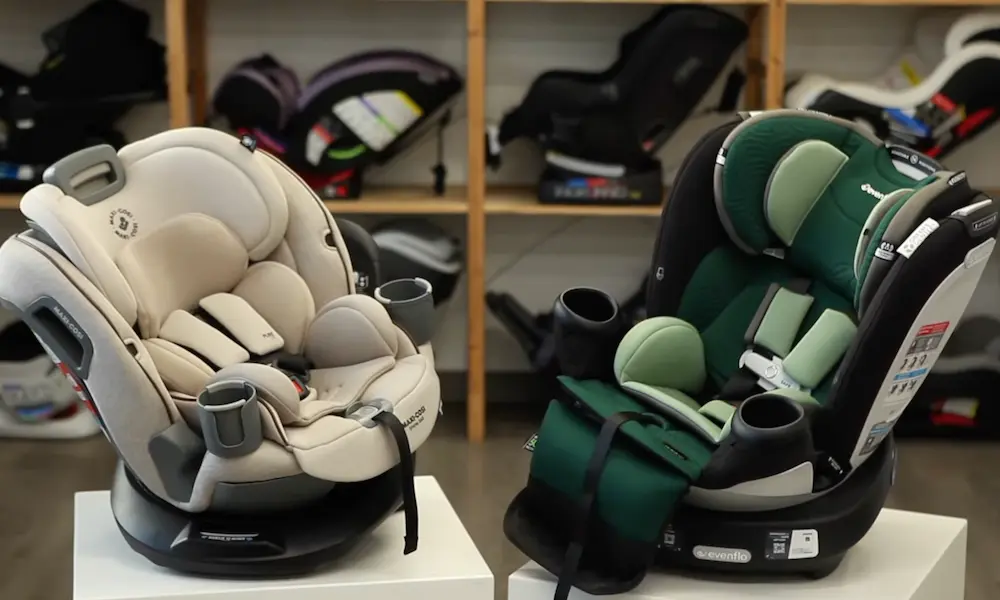
The Evenflo Revolve360 series, despite being popular, has faced the most scrutiny with ongoing investigations and multiple recalls.
The Cybex Sirona S gets mixed reviews due to its sliding mechanism that some parents find challenging to operate smoothly.
Who Should Actually Buy One
You’re a Good Candidate If:
- You’ve got back pain or mobility issues that make traditional seats painful to use
- You’re committed to extended rear-facing and want convenience to help you stick with it
- You live in a city with tight parking where the swivel feature helps in cramped spaces
- You buckle and unbuckle your kid multiple times daily
Skip It If:
- You’re shopping on a tight budget and can’t justify the premium
- You drive a small car where the bulk will overwhelm your space
- You travel frequently by airplane
- You need to fit three car seats across your back seat
Breaking Down the Investment
Most rotating seats are convertible, transitioning from rear-facing (4-50 pounds) to forward-facing (22-65 pounds). Some extend to booster mode (40-120 pounds). This longevity can justify the premium if you plan to use the seat for several years.
The convenience factor becomes more valuable with frequent use. Parents who buckle and unbuckle children multiple times daily report that the time savings and reduced physical strain make the investment worthwhile.
Here’s a simple comparison of what you’re getting:
| Feature | Rotating Seat | Traditional Seat |
|---|---|---|
| Price Range | $300-$750 | $100-$400 |
| Weight | 28-30 lbs | 19 lbs |
| Installation Changes | One-time base install | Reinstall for orientation change |
| Ease of Buckling | High (rotates to door) | Moderate (reach into car) |
| Space Requirements | High (wider, longer) | Moderate |
| Three-Across Fit | Usually no | Often yes |
As more manufacturers enter the market, prices should become more competitive. Budget options like the Joie Chili Spin 360 start around $300, while premium models can exceed $700.
What Experts Actually Recommend
Child passenger safety experts generally view rotating car seats favorably when properly used. Michelle Pratt emphasizes that “correct usage is crucial” and “caregivers must adhere to the manufacturer’s guidelines for both the car seat and the vehicle.”
Dr. Lyndsey Garbi, pediatrician and Chief Medical Officer at Blueberry Pediatrics, states that “I believe rotating car seats are safe when utilized properly.” She notes that improper installation and failure to lock the seat after rotation are the most common mistakes.
Smart Shopping Tips
When you’re choosing a rotating car seat, do this:
- Test the rotation mechanism in-store before buying
- Measure your vehicle to confirm you’ve got adequate space
- Consider professional installation help due to the complexity
- Prioritize models with strong safety ratings from Consumer Reports
Making Your Decision
Rotating car seats work brilliantly for some families and are complete overkill for others.
If you’ve got back problems, you’re committed to extended rear-facing, or you use the car seat frequently throughout the day, the convenience and ergonomic benefits can justify the cost.
But if you’re budget-conscious, drive a small car, or travel frequently by air, traditional convertible seats offer excellent safety and value without the drawbacks.
The key is honest self-assessment: if the convenience features address real pain points in your daily routine and the budget allows, rotating car seats can significantly improve the car seat experience for both you and your child. But if you’re shopping primarily on price or have space constraints, traditional convertible seats continue to deliver safety without the premium price tag.
As the technology matures and more manufacturers enter the market, rotating car seats will likely become more accessible and refined. For now, they’re worth it for specific families with specific needs, not necessarily everyone.