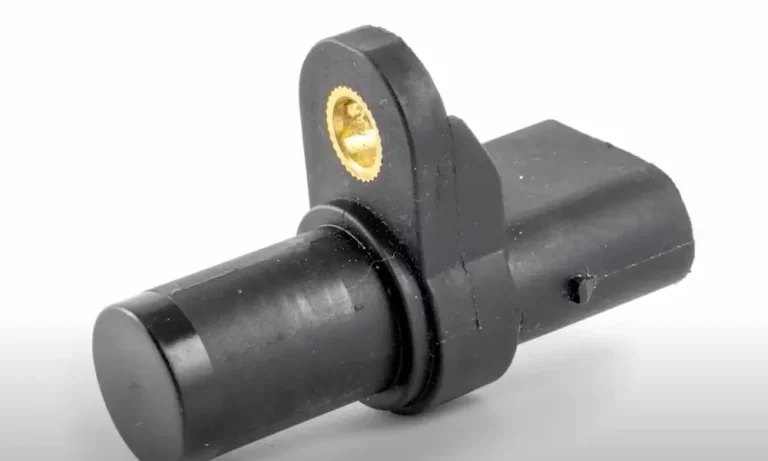
Your car’s acting weird — stalling, shaking, or just refusing to start. Sound familiar? A bad crankshaft sensor might be the culprit. This guide breaks down every symptom, what causes them, and how to confirm the diagnosis before you spend a dime.
What Does a Crankshaft Position Sensor Actually Do?
Think of the crankshaft position sensor (CKP) as your engine’s timekeeper. It tracks the crankshaft’s exact position and rotation speed, then feeds that data to the engine control unit (ECU). The ECU uses this info to fire the spark plugs and inject fuel at precisely the right moment.
No signal? The ECU goes blind. It can’t determine when a piston reaches Top Dead Center, so it can’t trigger combustion. The engine either runs terribly or doesn’t run at all.
The CKP sensor is one of the most critical inputs in the entire engine management system. Lose it, and everything downstream falls apart.
The 7 Most Common Bad Crankshaft Sensor Symptoms
1. Engine Cranks But Won’t Start
This is the most obvious of all bad crankshaft sensor symptoms. You turn the key, the starter motor spins, but the engine never fires.
Here’s the thing — people usually blame the fuel pump first. But Identifix explains that a dead CKP sensor cuts off both spark and fuel injection simultaneously. A fuel pump failure usually kills one without the other.
Here’s a quick trick: watch the tachometer while cranking. A healthy CKP signal makes the needle bounce between 100–300 RPM. If it stays pinned at zero while the starter is clearly running, the sensor is your prime suspect.
2. Sudden Engine Stalling — Especially at Highway Speed
The engine dies without warning. No sputtering, no coughing. Just off — like someone flipped a switch.
That’s because the ECU loses its timing reference mid-operation and shuts down all ignition and fuel events instantly as a protection measure. eBay Motors describes this as the engine going from normal operation to complete shutdown in a fraction of a second.
The sneaky part? These stalls often happen only when the engine is fully warmed up. The car may restart perfectly after sitting for 20–30 minutes. This is the “heat soak” failure mode at work (more on that below).
3. Engine Misfires and Shaking
When the CKP sensor sends erratic data instead of no data at all, the ECU miscalculates spark timing. The result is incomplete combustion, which you feel as jerking, shuddering, or a “stumbling” sensation — especially under load.
Urb’s Garage notes that a bad CKP sensor frequently triggers P0300-series misfire codes even when the spark plugs and injectors are fine. That’s because the ECU monitors tiny changes in crankshaft speed after each spark event to detect misfires. A corrupted signal throws off that entire monitoring system.
4. Hesitation and Poor Acceleration
Press the gas and nothing happens for a beat. Then the car lurches forward. That lag is the ECU struggling to calculate correct ignition advance with a lagging or erratic signal.
AutoZone describes this as one of the more frustrating symptoms because it’s subtle at first. It feels like a transmission issue or a dirty throttle body. But if your acceleration hesitation comes with other symptoms on this list, the CKP sensor is worth checking first.
5. Rough or Unstable Idle
At low RPM, a degraded sensor causes the ECU to constantly hunt for the correct fuel mixture and idle speed. The engine shakes at stops, the RPM needle bounces, and the whole car feels like it might stall any second.
Think Robotics points out that this symptom often worsens as the engine warms up — another hint that thermal stress is degrading the sensor’s internal components.
6. Check Engine Light with Specific Fault Codes
A failing crankshaft position sensor almost always trips the Check Engine Light. Plug in an OBD-II scanner and you’ll likely find one of these codes:
| Code | What It Means |
|---|---|
| P0335 | Total signal loss — dead sensor or broken wiring |
| P0336 | Signal present but noisy or out of range |
| P0337 | Signal voltage too low — possible short to ground |
| P0338 | Signal voltage too high — possible open circuit |
| P0339 | Intermittent dropout — often heat or vibration related |
| P0016 | Crank/cam timing mismatch — check timing chain too |
AutoZone’s P0335 guide is a solid starting point if that code pops up.
A flashing Check Engine Light is more urgent. It means active, catalyst-damaging misfires are happening right now. Pull over. Unburned fuel hitting the catalytic converter’s hot substrate can melt it — and that’s an expensive secondary repair.
7. Fuel Economy Drops Noticeably
With a corrupted timing signal, the ECU falls back on conservative “safe mode” fuel maps. It runs the engine rich and retards ignition timing to avoid knock. You burn more fuel for less power.
Wagner Brake explains that fuel-saving features like variable valve timing (VVT) and cylinder deactivation also require accurate CKP data to function. A bad sensor disables them entirely, pushing your MPG down even further.
Why Does a Crankshaft Sensor Fail?
Heat Soak — The Sneaky One
This failure mode fools a lot of people. The sensor works fine when cold, but after 20–30 minutes of driving, internal thermal expansion pulls apart a microscopic crack in the sensor’s copper windings. The engine stalls. You wait. It cools. It restarts.
Wikipedia’s crankshaft position sensor entry describes this pattern well — intermittent failures that often leave no permanent fault code, making them genuinely difficult to catch without the right tools.
Vibration and Air Gap Problems
Every CKP sensor needs a precise gap between its tip and the reluctor wheel. Too wide and the magnetic signal weakens. Too narrow and the sensor physically strikes the wheel — instant destruction.
Loose mounting hardware or worn brackets cause this gap to drift over time. Heavy vibration from larger engines accelerates the problem.
Oil Leaks and Metal Contamination
CKP sensors are magnetic. They attract metal shavings from normal engine wear. A layer of metallic fuzz on the sensor tip distorts the signal badly.
Five Star Ford also notes that oil leaks from the front main seal can saturate the sensor harness, degrading insulation and causing shorts — even if the sensor body itself is intact.
How to Tell It’s the Crankshaft Sensor (Not Something Else)
CKP vs. Camshaft Sensor Failure
People mix these up constantly. Here’s the quick version:
- CKP fails → Engine dies immediately and won’t restart
- CMP fails → Car usually still starts but takes 5–10 seconds of cranking first
Urb’s Garage breaks this down cleanly — the CKP is the master clock. The CMP is a supporting reference. Lose the master, you lose the engine.
CKP vs. Fuel Pump Failure
A dying fuel pump typically sputters and struggles before dying, especially under heavy load like towing or climbing hills.
A CKP failure is more binary — the engine either runs or it doesn’t. Technicians sometimes spray starting fluid into the intake: if the engine briefly fires on the fluid, ignition timing is probably fine, pointing the finger at fuel delivery instead.
How to Confirm a Bad Crankshaft Sensor
Check Live OBD-II Data
Connect a scanner and watch the Engine RPM parameter while cranking. If the RPM reading jumps erratically or drops to zero while the starter is clearly spinning, the sensor or its wiring is dropping out.
Test with a Multimeter
For a two-wire inductive sensor, disconnect the connector and measure resistance across the terminals:
- Healthy range: 200–1,000 ohms
- Zero ohms: Internal short
- Infinite (OL): Open circuit — the sensor’s dead
CarParts.com has a detailed walkthrough for both inductive and Hall Effect sensors if you want step-by-step guidance.
Read the Oscilloscope Waveform
This is the gold standard. A lab scope shows the actual signal in real time. Here’s what different waveform problems mean:
| Waveform Issue | Likely Cause |
|---|---|
| Missing pulses | Damaged or missing reluctor wheel teeth |
| Varying signal height | Eccentric or wobbly reluctor wheel |
| Electrical noise/spikes | EMI from alternator or spark plug wires |
| Incomplete voltage drop | Bad ground circuit (Hall Effect sensors) |
TechRoute66’s testing guide covers waveform interpretation in solid detail if you’re heading down that path.
Don’t Forget the Mechanical Side
Sometimes the sensor is fine — it’s what the sensor watches that’s broken.
- Bent or chipped reluctor wheel teeth cause rhythmic misfires at specific RPMs
- Harmonic balancer slippage shifts the timing reference mechanically, even with a clean sensor signal
- Stretched timing chain throws a P0016 code — the CKP and camshaft sensor are both working, but they’re now out of sync with each other
The Diesel Store covers crankshaft failure symptoms including these mechanical causes if you want to dig deeper on the P0016 side.
A bad crankshaft sensor doesn’t always mean a bad sensor. Run through the mechanical checklist before you swap parts — your wallet will thank you.