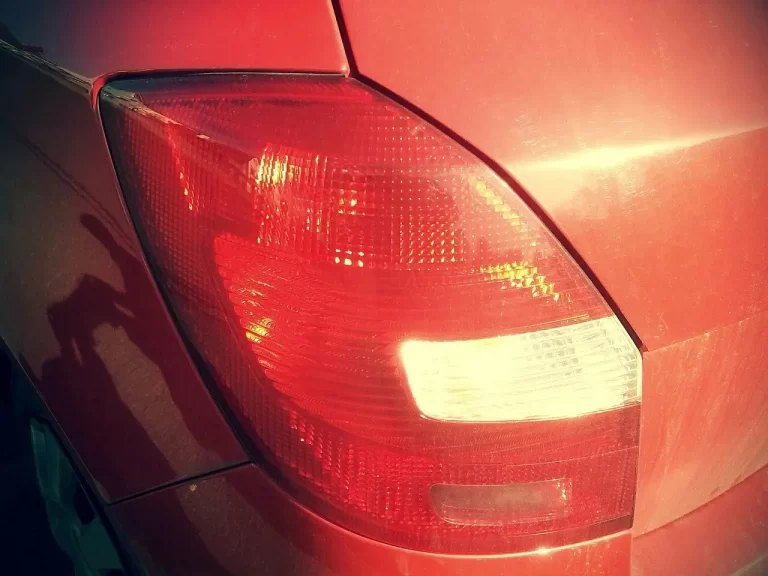
Your car brake lights stay on even after you’ve parked and walked away. That’s a dead battery waiting to happen — and possibly a ticket. This post breaks down every real cause, how to test it yourself, and what to do right now.
Why Do Car Brake Lights Stay On?
There’s no single answer. Your brake lights connect to mechanical parts, electrical wiring, and computer modules. When any one of those fails, the lights fail to signal actual braking events to drivers behind you — and they stay on constantly instead.
The fix ranges from a $5 rubber bumper to a wiring job. Let’s find your problem first.
The Most Common Culprit: A Missing Brake Pedal Stopper
This tiny part causes the majority of stuck brake light problems. Most people have never heard of it.
Here’s how it works. Your brake light switch sits on a bracket above the pedal arm. When your foot is off the pedal, the pedal arm physically pushes the switch plunger inward — and that opens the circuit, turning the lights off. A small rubber or plastic bumper called the brake pedal stopper cushions that contact point.
When that stopper dries out, cracks, and falls apart, the plunger drops into an empty hole on the pedal arm. The switch never gets pushed in. The circuit stays closed. Your brake lights glow 24/7.
How to check: Look under your dash at the brake pedal arm. Find the bracket above it with the switch attached. Look for a small rubber nub pressed against the switch plunger. If you see a hole, plastic crumbs on the floor mat, or nothing at all — that’s your problem.
Good news: Replacement stoppers cost under $11 and take ten minutes to install without any tools.
Other Mechanical Reasons Car Brake Lights Stay On
Weak or Broken Pedal Return Spring
Your pedal needs spring tension to snap back to its resting position after you release it. If the return spring weakens or breaks, the pedal hangs slightly down. It never travels far enough back to press the switch plunger in. Lights stay on.
Rust and dirt buildup at the pedal pivot hinge can cause the same lazy return. A quick spray of penetrating lubricant at the pivot point tells you if that’s the issue.
Hydraulic Binding in the Master Cylinder
This one’s more serious. Certain 2023–2025 Honda Odyssey, Passport, and Ridgeline models have a documented manufacturing variance where the hydraulic master cylinder and vacuum booster bind internally. The pedal can’t return to its full resting position. The brake light switch stays open. Lights stay on.
Worse, this drags the brakes while driving, overheats the rotors, and triggers the car’s brake-throttle override — which cuts engine power and leaves you crawling. This is a dealer-level repair, not a DIY job.
Electrical Causes of Stuck Brake Lights
If your pedal stopper is intact and the pedal returns normally, the problem lives in the electrical system.
The Switch Itself Has Failed Internally
Every time you press the brake pedal, tiny metal contacts inside the switch close together. After thousands of presses, those contacts can fuse together from heat and electrical arcing. The switch stays closed permanently. Doesn’t matter where the pedal sits — the lights stay on.
A Short Circuit in the Wiring
Wires routed near the steering column or chassis can rub through their insulation over time. If a bare wire touches a power source directly, it bypasses the switch entirely. Moisture in the tail light assembly or fuse box can create conductive bridging across terminals, keeping the circuit powered with no switch input at all.
Aftermarket Electronics Backfeeding the Circuit
Remote starters, security alarms, and trailer wiring adapters are common offenders. If they’re wired or grounded incorrectly, they push current backward into your brake light circuit. The physical switch becomes irrelevant — the lights stay on regardless.
Body Control Module Fault
Modern cars don’t always run direct battery power through the brake switch. The switch sends a low-voltage signal to a Body Control Module (BCM), which then controls the lights. If the BCM experiences a software lockup or an internal driver fails in a closed state, it keeps the brake lights energized continuously — even if the physical switch and pedal are perfectly fine.
How to Diagnose the Problem Yourself
Work through these steps in order. Each one rules out a category.
Step 1: Visual Inspection
Look at the pedal stopper hole. Check for rubber debris on the floor. That alone solves roughly half of all cases.
Step 2: The Disconnect Test
Unplug the electrical connector from the brake light switch.
- Lights go off? The fault is the switch itself or its mechanical alignment.
- Lights stay on? Power is reaching the circuit from somewhere else — a short, stuck relay, or backfeeding accessory.
Step 3: Scan Tool Live Data
Connect an OBD2 scanner and pull up live data. Check the brake pedal position sensor status. If the scanner shows the pedal as active while your foot is completely off it, the BCM is receiving a continuous signal. Watch for these codes:
| Code | Tool Needed | Normal State | Fault State | What It Breaks |
|---|---|---|---|---|
| P0571 | OBD2 Scanner | Circuit OFF | Circuit ON | Cruise control, engine power cut |
| C0044 | OBD2 Scanner | Pedal at rest | Pedal shows applied | ABS and stability control warnings |
| Switch Continuity | Multimeter | No beep when plunger depressed | Continuous beep | Lights stay on permanently |
| Supply Voltage | Voltmeter/Test Light | 12V with ignition on | Under 10V or zero | Intermittent or dead circuit |
| Ground Resistance | Multimeter | Under 0.5 ohms | High or open | Backfeed current into adjacent circuits |
Step 4: Multimeter Continuity Test on the Switch
Unplug the switch and touch your multimeter probes to its terminals in continuity mode.
- Plunger extended: meter should beep (circuit closed — brake applied).
- Plunger pushed in: meter should go silent (circuit open — brake released).
If it beeps continuously regardless of plunger position, the internal contacts are fused. Replace the switch.
One important note: Don’t rely on a digital multimeter alone to verify power. Multimeters draw almost no current and can register 12 volts on a wire held together by a single copper strand — what’s called ghost voltage. Use a load-bearing test light to confirm the wire can actually deliver real current.
Quick Fixes If You’re Stuck Right Now
These are temporary measures only — don’t drive with them in place.
The coin method: Tape a quarter or penny directly over the empty stopper hole on the pedal arm. The coin surface presses the switch plunger in and turns the lights off. Works in a pinch.
Trim clip substitution: A plastic push-pin or automotive trim clip inserted through the hole acts as a substitute stopper pad and holds the plunger open.
Pull the fuse: Find the stop light fuse in your fuse box and remove it. This kills the circuit and stops the battery drain. Only do this while parked. Driving without brake lights is illegal in every US state and genuinely dangerous.
Permanent Repairs and Replacement Parts
Replacing the Brake Pedal Stopper
Depress the pedal slightly to create clearance. Pry out any remaining rubber fragments with a flathead screwdriver. Press the new stopper into the mounting hole until the retaining tab seats flush. Done in under ten minutes.
Here are the most common replacement parts in the US:
| Part Number | Brand | Fits | Material | Est. Price |
|---|---|---|---|---|
| 90541-06036 | Toyota OEM | Toyota, Lexus, Scion | High-density rubber | $5.49 |
| 46505-SA5-000 | Honda OEM | Civic, Accord, CR-V, Acura | Thermoplastic elastomer | $5.08 |
| 74015 | Dorman HELP! | Honda, Acura, Nissan | Thermoplastic rubber | $10.69–$10.99 |
| 74025 | Dorman HELP! | Universal multi-make | Color-coded elastomer | $10.49 |
| 74035 | Dorman HELP! | Hyundai, Kia, Subaru | Hard plastic polymer | $5.99 |
Replacing and Adjusting the Brake Light Switch
Disconnect the negative battery terminal first. Unplug the wiring harness. Unclip or unscrew the switch from its bracket. Install the new switch and adjust it correctly — this part matters.
Threaded switches: Screw the switch into the bracket until the plunger contacts the stopper pad. The standard clearance gap between the switch housing and pedal bracket is 0.5 to 2.4 millimeters. Tighten the locknut behind the bracket to lock that position.
Self-adjusting switches: Pull the plunger fully out to its maximum extension. Slide back the locking sleeve. With the pedal fully returned, push the switch into the bracket and rotate it a quarter-turn to lock. The plunger automatically retracts to the correct depth. Press the locking sleeve in to set it permanently.
Run a final functional test. Lights on when you press the pedal, off when you release it. That’s the only acceptable result.
What Happens If You Ignore This
Your Battery Dies Overnight
A pair of brake lights draws roughly 20–24 watts continuously — about 2 amps from your 12-volt system. Overnight, that drains 16–20 amp-hours from a standard battery. That’s a 20–30% discharge, often enough to leave you with a dead battery by morning. Worse, repeatedly deep-discharging a starting battery causes sulfation on the lead plates and permanently shortens its life.
Your Car’s Safety Systems Start Acting Up
A brake light switch that’s stuck in the “on” position disrupts multiple vehicle systems simultaneously:
- Cruise control won’t engage or cancels mid-highway
- Automatic transmission shift lock may disengage without your foot on the brake — creating a rollaway risk
- ABS and stability control receive false brake input and disable themselves
- Brake-throttle override cuts engine power if the computer thinks you’re pressing both pedals at once
You Can Get Pulled Over
Operating a vehicle with constantly illuminated brake lights violates state traffic law across the US. Virginia Code Section 46.2-1014 is a good example — it requires brake lights to activate only when the brake is applied, visible from 500 feet. Constant illumination means drivers behind you can’t tell when you’re actually slowing down. That’s a rear-end collision waiting to happen, and a cop will see it immediately.
Check If Your Car Has an Active Safety Recall
This problem is serious enough that NHTSA has overseen multiple major recalls. Three of the largest:
| Recall ID | Manufacturer | Vehicles Affected | Root Cause | Units Recalled |
|---|---|---|---|---|
| 13V114000 | Hyundai / Kia | 2007–2011 Accent, Elantra, Sonata, Santa Fe, Genesis Coupe, Sportage, Soul, Optima + more | Switch contacts fail prematurely — lights stuck on or disabled | 1,683,482 |
| 19V149000 | Subaru | 2008–2017 Crosstrek, Forester, Impreza, WRX | Silicone gas deposits insulate contacts, causing conductivity loss | 1,303,530 |
| Nissan Campaign | Nissan | 2013–2018 Sentra | Contaminant buildup on switch contacts | 807,376 |
If your car is a Hyundai, Kia, Subaru, or Nissan from any of those model years, check your VIN on the NHTSA recall database right now. If there’s an active recall on your vehicle, a dealership will replace the faulty switch at no cost to you.