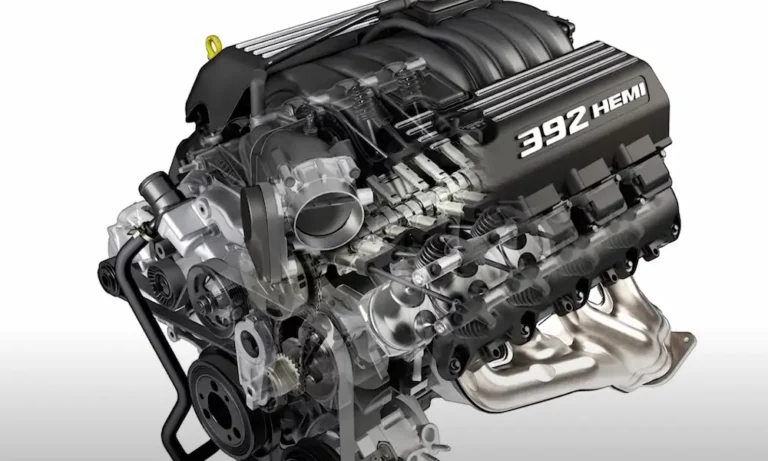
Your 5.7 Hemi already makes solid power from the factory. But you know it can do more. This guide walks you through every meaningful 5.7 Hemi performance upgrade — from simple bolt-ons to full forced induction builds — so you spend money on parts that actually move the needle.
First, Know Which 5.7 Hemi You Have
Not all 5.7 Hemis are the same. There are two distinct generations, and the differences matter when you’re buying parts.
- Pre-Eagle (2003–2008): Older cylinder head design, no Variable Valve Timing (VVT), smaller valves
- Eagle (2009–present): Revised port shape, larger valves, VVT added
The Eagle heads flow significantly better than the older castings. If you’re building a Pre-Eagle engine, you can swap Eagle heads onto it — but you’ll need a matching intake manifold, custom pushrods, and thicker head gaskets to keep your compression ratio in check.
Knowing your generation saves you from buying the wrong cam, the wrong intake manifold, and wasting a weekend.
Start Here: The Bolt-On Foundation
These upgrades work on any 5.7 Hemi. They’re affordable, straightforward, and set up everything that comes after.
Cold Air Intake
Cooler air is denser air. Denser air holds more oxygen. More oxygen means more fuel can burn — and more power gets made. That’s the whole idea behind a cold air intake system.
Quality systems from brands like aFe Power or S&B relocate the filter outside the hot engine bay and replace the factory’s restrictive, baffled tubing with smooth-walled composite or carbon fiber pipes. On their own, you’re looking at 10–15 rear-wheel horsepower. That’s not massive, but a cold air intake prevents the engine from choking once you add cams and headers later.
180-Degree Thermostat
The factory thermostat keeps the engine at roughly 203–205°F for emissions reasons. That’s too hot for performance. Installing a 180-degree thermostat drops operating temperature and reduces heat soak in the intake manifold, which lets the PCM run slightly more aggressive timing.
There’s a catch: you need a tune to adjust when your cooling fans kick on. Without it, the fans won’t activate early enough, and you’ll lose the benefit entirely. On pre-2009 engines, cooler operation also helps prevent the dropped valve seat issue that plagues high-mileage units.
Oil Catch Can
The Hemi’s PCV system recirculates crankcase gases back into the intake. Those gases carry oil vapor that coats your intake valves with carbon sludge over time. Worse, oil vapor lowers the octane rating of your air-fuel mixture, which forces the PCM to pull ignition timing and costs you power.
An oil catch can intercepts that vapor before it reaches the intake, condensing it into a small reservoir you drain at oil changes. It’s a cheap, effective fix that keeps the engine cleaner and making consistent power.
Headers: The Exhaust Upgrade That Actually Works
The factory cast-iron exhaust manifolds are restrictive and notoriously prone to warping. Sheared mounting bolts and exhaust leaks are common on high-mileage Hemis. Replacing them with headers fixes both problems at once.
Shorty vs. Long-Tube: Which Should You Buy?
| Header Type | HP Gain | Install Difficulty | Best For |
|---|---|---|---|
| Shorty | 10–15 WHP | Moderate | Towing trucks, daily drivers |
| Long-Tube | 25–30 WHP | High | Street/strip builds, max power |
| Factory Manifold | 0 | N/A | Quiet, emissions compliant |
Shorty headers bolt directly where the factory manifolds sat and preserve the factory mid-pipes and cats. They’re ideal for Ram 1500 trucks where low-RPM torque between 1,500–3,000 RPM matters more than peak power.
Long-tube headers use longer primary tubes — typically 1¾” or 1⅞” diameter — that merge much further downstream. That extra length improves exhaust scavenging, where fast-moving exhaust gas creates a vacuum that pulls the next pulse out more efficiently. You’ll pick up 25–30 wheel horsepower, but you’ll need a custom tune since the factory catalytic converters get relocated or removed.
Installation heads-up: The driver’s side is tight. The steering shaft and oil dipstick tube will interfere with the tubes. On long-tube setups, the headers also run very close to the starter motor. Wrap the starter in a heat shield and use Grade 8 hardware with Mopar MLS gaskets. Skip this step and you’ll deal with hot-start failures later.
The 6.4L Apache Intake Manifold Swap
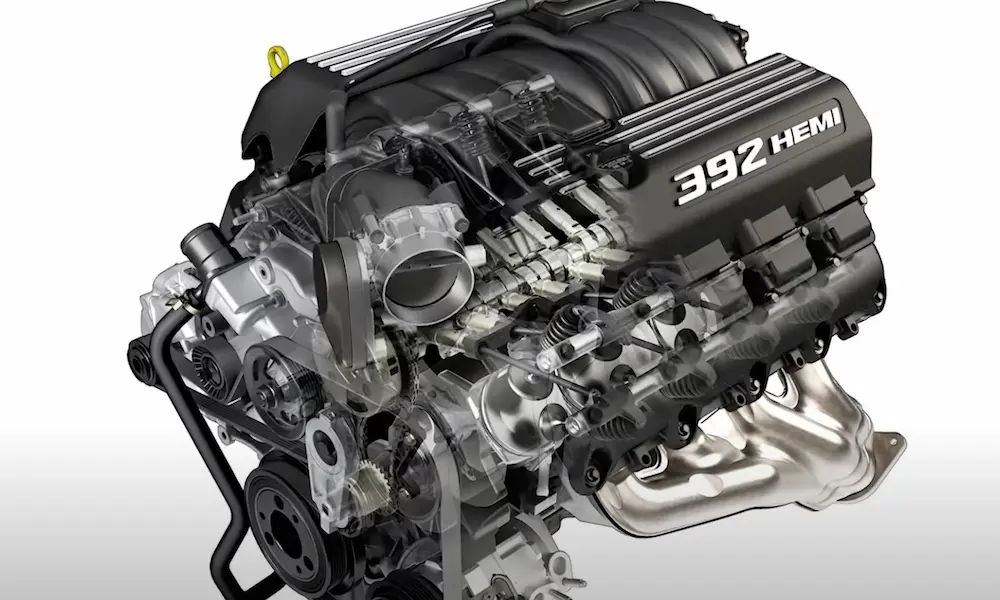
This is one of the best bang-for-buck 5.7 Hemi performance upgrades available. The factory 5.7L intake uses fixed-length runners — a compromise between low-end torque and top-end power. The 6.4L “Apache” manifold found on SRT 392 engines and heavy-duty 2500/3500 trucks fixes that with an active runner system.
Here’s how it works: A Short Runner Valve (SRV) actuator switches between long and short runner paths based on engine demand. At low RPM, long runners maximize torque through Helmholtz resonance — the timing of air pulses helps pack more air into the cylinder as the intake valve closes. At around 4,800–5,000 RPM, the SRV flips to short runners for high-velocity airflow and peak horsepower.
The result? 25–30 horsepower and torque gains at the wheels. You’ll need a specialized SRV controller and wiring harness extension to make it work with 5.7L electronics, but the swap is well worth it.
Camshaft Upgrades and MDS Delete
The camshaft is where serious 5.7 Hemi performance upgrades live. Get this right and the engine transforms. Get it wrong and you’ll be pulling the engine back apart.
Delete the MDS First
The Multi-Displacement System deactivates four cylinders during light cruising to save fuel. It does this through collapsing solenoid-controlled lifters. The problem: those lifters are heavier than standard units, prone to failure at higher RPMs, and physically can’t handle the travel required by a performance cam.
MDS delete kits replace the collapsing lifters with solid Hellcat or 6.1L non-MDS lifters and include matching lifter trays. This modification is non-negotiable before installing any aggressive cam. It also eliminates the infamous “Hemi Tick” caused by failing lifter needle bearings.
Choosing Your Cam Stage
| Camshaft | Duration @.050″ | Spring Requirement | HP Gain | Drivability |
|---|---|---|---|---|
| TSP Stage 1 Low-Lift | ~212/218 | Stock / PAC 1218 | 30–35 HP | Near-OEM |
| TSP Stage 2 | ~218/226 | PAC 1218 / PSI 1511 | 40–42 HP | Slight Lope |
| Chopacabra | ~22X/23X | PAC 1218 / PSI 1511 | 43–45 HP | Heavy Chop |
| Stage 3 Boost | Aggressive | Dual Springs | 50+ HP | Track-Focused |
The TSP Stage 1 Low-Lift cam is the sweet spot for street builds. It adds 30–35 horsepower, stays compatible with factory valve springs on fresh engines, and doesn’t sacrifice drivability. For something more aggressive with real idle lope, the TSP “Chopacabra” and Stage 2/3 grinds push 40–50 horsepower gains but require upgraded beehive or dual valve springs like the PAC 1218 or PSI 1511 to prevent valve float.
One more thing: aggressive cams reduce piston-to-valve clearance. If you’re running VVT, install a phaser limiter or lockout kit to restrict how far the cam can advance or retard. Without it, you risk a mechanical collision between the valve and piston.
Cylinder Head Work: CNC Porting and Aftermarket Castings
The 2009+ Eagle heads are solid castings from the factory, but they still leave power on the table. CNC porting uses computer-controlled machinery to smooth out casting imperfections and optimize port shape for maximum airflow.
Companies like Arrington Performance and Thitek offer high-end ported heads that support cams with up to .645 inches of lift. Thitek’s “Bear” cylinder heads take it further — they’re 100% aftermarket castings made from A356-T6 aluminum, which offers nearly double the strength of the factory material. Thitek Bear heads feature reinforced rocker arm stands, thicker decks to resist head gasket failure under boost, and port walls thick enough to handle extreme porting programs. Gains can exceed 50 rear-wheel horsepower and often make the difference in breaking into the 10-second quarter-mile on naturally aspirated builds.
ECU Tuning: Your Modifications Mean Nothing Without It
The PCM controls ignition timing, fuel delivery, and throttle sensitivity. The factory calibration is conservative — it prioritizes emissions and fuel economy, not power. Every significant modification on this list requires a matching tune to extract what you paid for.
The 2015+ PCM Lock Problem
Starting in 2015, Chrysler locked the PCM to block third-party tuning through the OBDII port. To tune a 2015 or newer Hemi, you either send the PCM to DiabloSport or HP Tuners for an unlock procedure (expect about a week of downtime) or swap in a pre-unlocked unit. Vehicles from 2018 onward also need a Security Gateway Bypass cable before any tuning hardware can communicate with the car.
Handheld Tuner vs. Custom Tune
| Tuning Tool | Best Use Case | PCM Unlock Needed? | Monitoring |
|---|---|---|---|
| Superchips F5 | Basic mods, trucks | Yes (2015+) | Basic |
| DiabloSport inTune i3 | Mild street builds | Yes (2015+) | Diagnostic |
| DiabloSport Trinity 2 | Advanced street/track | Yes (2015+) | Full gauges |
| HP Tuners MPVI3 | Cam/boost builds | Yes (2015+) | Comprehensive |
Handheld programmers with preloaded “canned” tunes work well for adjusting tire size, gear ratios, or disabling MDS. But for any engine with a cam, ported heads, or forced induction, you need custom remote tuning. Tuners like Jay Greene or HemiFever send you a base file, you record data logs using HP Tuners MPVI3, and they dial in your specific air-fuel ratio and ignition advance. It finds more power and better drivability than any generic tune can.
Supercharging: The Fastest Path to Big Numbers
Forced induction adds 40–50% more power over stock. The 5.7L handles boost well, but its 10.5:1 compression ratio means you need a precise tune and quality fuel to stay out of detonation.
Centrifugal vs. Positive Displacement
ProCharger’s centrifugal systems are belt-driven and build boost linearly with RPM. They’re self-contained with their own oiling system and mount away from engine heat — a real advantage for thermal management. The ProCharger HO kit adds around +160 WHP at 7 PSI.
Whipple and Magnuson positive displacement superchargers replace the entire intake manifold with a twin-screw or Roots-style blower. They build boost from idle, so you feel it immediately off the line. The Whipple Gen 6 3.0L uses a dual-core intercooler to keep intake temps controlled under sustained load and adds +187–195 WHP.
Regardless of which kit you choose, drop to NGK LFR6AIX spark plugs (one heat range colder) before you make a boosted pull. The increased combustion heat will melt standard tip plugs.
Drivetrain: Don’t Let the Power Die at the Wheels
A 400+ wheel-horsepower 5.7 Hemi will quickly overwhelm the stock drivetrain. The transmission and axles need attention before you make the big pull.
The ZF 8HP70 8-speed is capable but can suffer cracked drums at extreme power levels. SunCoast and Spool Performance offer rebuild kits using 7075-T6 billet aluminum drums and increased clutch counts to support over 1,200 horsepower.
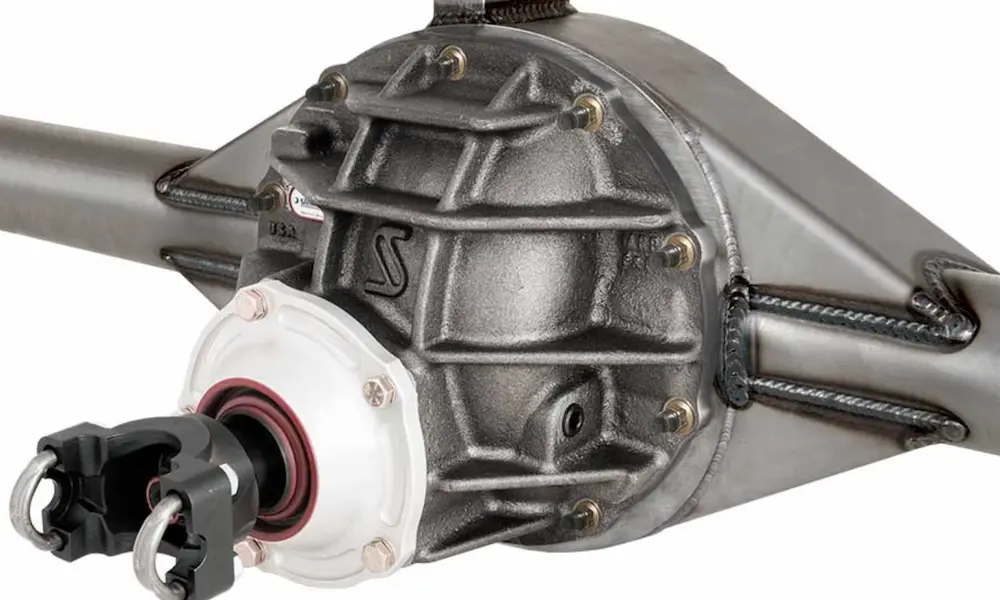
For the Charger and Challenger R/T, the Hellcat axle swap replaces the R/T’s 215mm rear differential with the Hellcat’s 230mm unit and 32-spline axles. Pair that with a 3.09 limited-slip differential and a 3,200-stall billet torque converter, and your Hemi actually launches the way the engine’s power deserves.
The Build Path That Makes Sense
Here’s how to think about your 5.7 Hemi performance upgrades based on your goals:
Entry-Level Bolt-Ons (~$800–$1,500): Cold air intake + 180-degree thermostat + oil catch can + handheld tuner. Better throttle response, cleaner engine, smarter calibration. No drama.
Naturally Aspirated Street Build (~$3,000–$6,000): Long-tube headers + MDS delete + Stage 1 or Stage 2 cam + 6.4L intake manifold + custom tune. This combination pushes a 5.7L toward 425–450 wheel horsepower without forced induction.
Supercharged Build ($5,000–$10,000+): ProCharger or Whipple kit + forged internals (if targeting 500+ WHP) + upgraded fuel system + custom tune + drivetrain fortification. The highest power-per-dollar ratio available, but requires committed supporting work to stay reliable.
The 5.7 Hemi rewards a systematic approach. Build your foundation first, tune at every stage, and don’t skip the drivetrain when the power climbs past 400 wheel horsepower.