That ticking sound from your Charger’s engine? It’s not just annoying — it could mean your lifters are failing. Dodge Charger lifter replacement is one of the most common (and costly) repairs Hemi owners face. This guide breaks down why it happens, how to spot it early, and exactly what the repair involves — so you can make a smart decision before it turns into a full engine replacement.
What Is the Hemi Tick and Why Does It Happen?
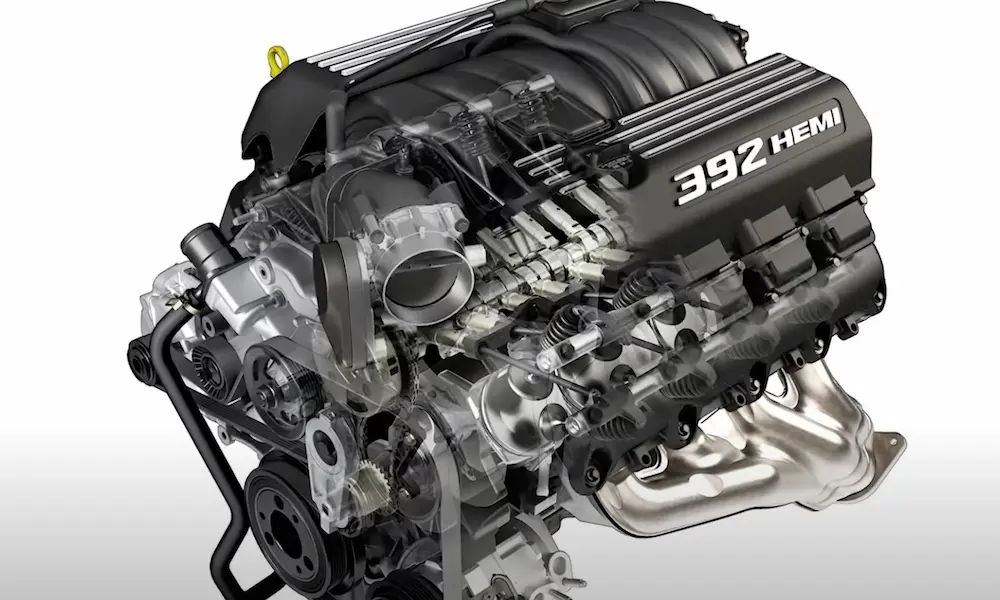
The “Hemi Tick” is the nickname for a rhythmic metallic clicking that comes from a failing hydraulic roller lifter in the 5.7L or 6.4L Hemi engine.
Here’s the core problem: the Hemi’s oiling system is designed in a way that sends oil to the lifters last. Oil travels from the block deck, through a restrictor in the head gasket, up through the cylinder head, into the rocker shaft, down the pushrod, and finally into the lifter itself. That’s a long trip — and at low RPM or idle, oil pressure often isn’t strong enough to properly protect the lifter’s internal needle bearings.
When those bearings fail, the roller wheel stops spinning and starts skidding across the camshaft lobe. That metal-on-metal grinding wears through the cam’s hardened surface layer (usually just 0.050 to 0.100 inches deep), and once the softer core is exposed, wear accelerates fast.
The result? A wiped cam lobe, collapsed valve lift, and eventually a misfire.
Which Dodge Charger Models Are Most Affected?
All Gen 3 Hemi-powered Chargers can experience this issue, but some years are worse than others.
| Engine | Production Years | VVT | MDS | Oil Spec |
|---|---|---|---|---|
| 5.7L Hemi (Pre-Eagle) | 2003–2008 | No | Yes (Auto) | 5W-20 |
| 5.7L Hemi (Eagle) | 2009–Present | Yes | Yes (Auto) | 5W-20 |
| 6.1L SRT Hemi | 2006–2010 | No | No | 0W-40 |
| 6.4L 392 Hemi | 2011–Present | Yes | Yes (Auto) | 0W-40 |
The 2009 redesign added variable valve timing and higher compression, but it didn’t fix the lubrication path. That’s exactly why lifter failures show up across nearly two decades of production.
How to Diagnose a Failing Lifter
Not every tick is a lifter. Before you panic — or pay — you need to confirm the actual source.
Step 1: Listen Carefully
Pay attention to when the noise appears and whether it changes with temperature.
- Exhaust manifold leak → Sharp, loud tap on cold start that fades as the engine warms up. Often caused by broken manifold bolts on cylinders 7 or 8.
- Failing lifter → Rhythmic metallic click tied to engine speed. Gets louder or more distinct as the engine warms up and oil thins out. Advanced cases sound like chirping or squeaking.
- Fuel injector click → High-pitched ticking you can isolate by placing a stethoscope on the fuel rail. This is normal.
- Rod knock → Deep, heavy thudding from the bottom of the engine. That’s a different (worse) problem entirely.
Step 2: Run Diagnostic Tests
| Diagnostic Test | What to Do | What a Bad Lifter Looks Like |
|---|---|---|
| Scan Tool | Check for P0300–P0308 codes | Persistent misfire on one cylinder despite new plugs or coils |
| Valve Lift Check | Remove valve covers, measure rocker arm travel while cranking | Visibly reduced travel on one valve vs. its neighbors |
| Oil Analysis | Send a sample to Blackstone Labs | Elevated iron particles indicating metal-on-metal wear |
| Oil Control Valve Screen | Pull the OCV from the engine block | Metallic “glitter” or shavings = cam damage already done |
| Stethoscope | Probe valve covers and intake manifold | Sound localizes to the valvetrain, not accessories or exhaust |
One important note: early-stage lifter failure often won’t trigger a check engine light. The misfire threshold hasn’t been reached yet. You might only notice a subtle shudder at idle or a small drop in fuel economy. Don’t wait for a code before investigating.
Understanding the MDS System and Its Role
The Multi-Displacement System (MDS) deactivates cylinders 1, 4, 6, and 7 under light load to save fuel. It uses specialized “collapsible” lifters with internal locking pins that disengage the pushrod from the cam when triggered by oil pressure through solenoids in the engine valley.
The problem? Those locking pins are tiny and extremely sensitive to oil quality. Sludge or varnish from extended oil change intervals can cause pins to stick — either leaving a cylinder permanently active or permanently dead. A stuck-dead cylinder means a serious misfire.
Here’s the debate though: even manual-transmission Chargers and Challengers without MDS still experience the Hemi Tick. That confirms the root issue is the needle bearing lubrication circuit — not the cylinder deactivation system itself. MDS just adds another layer of mechanical complexity that can fail alongside it.
Tools You’ll Need for Dodge Charger Lifter Replacement
This isn’t a spark plug swap. Dodge Charger lifter replacement requires pulling the intake manifold, valve covers, rocker assemblies, and cylinder heads. Here’s what you’ll need on the bench:
| Component | Fastener Size | Tool Needed |
|---|---|---|
| Intake Manifold Bolts | 8mm | 1/4″ or 3/8″ drive with long extension |
| Valve Cover Bolts | 8mm / 10mm | 1/4″ drive ratchet |
| Rocker Arm Shaft Bolts | 10mm | 3/8″ drive ratchet |
| Primary Head Bolts (M12) | 15mm | 1/2″ drive deep socket + breaker bar |
| Small Head Bolts (M8) | 10mm | 3/8″ drive socket |
| Timing Cover Bolts | 10mm / 13mm | 3/8″ drive ratchet |
| Crankshaft Damper Bolt | 21mm | 1/2″ drive impact or large breaker bar |
Beyond sockets, you’ll also need:
- Torque-to-yield (TTY) bolt set — the old head bolts must be discarded and replaced. They’re one-use only.
- Harmonic balancer puller — a dedicated Chrysler-style puller protects the damper. Skip the three-jaw generic.
- Crankshaft socket — a specialty socket lets you manually rotate the engine for timing alignment.
- Torque angle gauge — mandatory for TTY bolt sequences.
- Cooling system vacuum refiller — prevents air pockets that cause overheating after reassembly.
How to Inspect the Lifters and Camshaft
Once you’ve pulled the heads and extracted the lifters from their plastic guides, every single one needs a careful inspection.
Lifter Inspection
- Roller surface: It should look mirror-smooth. Pitting, frosting, or scaling means the bearing metal has started to fatigue.
- Spin test: Hold the lifter body and spin the roller with your finger. Smooth and silent = good. Gritty, notchy, or rough = the needle bearings are gone.
- Side-to-side play: Wiggle the roller wheel laterally. Excessive play means the axle or needles have worn down.
Camshaft Lobe Inspection
Run your fingernail across every lobe. If you can feel a groove, the cam is damaged.
| Lobe Condition | What It Means | Severity |
|---|---|---|
| Mirror finish | Normal wear | Fine — keep it |
| Scoring (horizontal lines) | Skidding roller contact | High — replace cam |
| Pitting (craters on lobe nose) | Catastrophic failure starting | High — replace immediately |
| Wiped lobe (flattened peak) | Valve lift already reduced | Critical — cam must go |
| Blue or purple discoloration | Extreme friction heat | High — indicates severe damage |
Critical rule: If you install new lifters on a damaged cam, you’ll be back doing this job again within a few thousand miles. The rough cam surface destroys the new roller immediately. Always replace both together.
Should You Do an MDS Delete at the Same Time?
If you’re already this deep into the engine, many experienced Hemi mechanics recommend deleting the MDS system entirely during the repair. Here’s what that conversion requires:
- Non-MDS lifters (16 total) — Hellcat or 6.1L lifters work well. No internal locking pins, more robust design.
- Non-MDS camshaft — MDS and non-MDS cam lobes have different profiles. Using non-MDS lifters on an MDS cam causes rough idle and imbalance.
- MDS solenoid plugs — Remove the four valley solenoids and plug the ports to maintain proper oil pressure in the main galleries.
- Full gasket set + new TTY head bolts — You’re pulling the heads anyway, so this is non-negotiable.
Don’t Skip the Tune
This is where most DIY MDS deletes go wrong. The ECM expects manifold pressure and timing changes when it commands MDS. If the hardware is gone but the software still tries to activate it, you’ll get misfire codes and possibly limp mode.
A custom tune through HP Tuners or DiabloSport disables the MDS in the ECM. You’ll lose 1 to 3 MPG on the highway, but you gain a simpler, more reliable valvetrain.
Torque Specs for Reassembly
Torque accuracy here isn’t optional — a loose head gasket or improperly torqued rocker shaft can undo everything.
Cylinder head bolt sequence (M12 bolts, primary 10):
- Tighten to 25 ft-lbs in the specified circular pattern
- Tighten to 40 ft-lbs in the same pattern
- Rotate an additional 90 degrees (one quarter turn)
Small head bolts (M8):
- 15 ft-lbs
- 25 ft-lbs
| Component | Torque Value | Notes |
|---|---|---|
| Rocker Arm Bolts | 195 in-lbs | Single pass |
| Intake Manifold Bolts | 9 ft-lbs | Criss-cross pattern |
| Valve Cover Bolts | 80 in-lbs | Center outward |
| Timing Cover Bolts | 21 ft-lbs | Single pass |
| Harmonic Balancer Bolt | 130 ft-lbs | Standard 5.7L |
One more thing before you torque anything: chase the head bolt holes with a thread cleaner and vacuum them out. Oil or coolant trapped at the bottom of a bolt hole can hydrolock during torquing and crack the block.
How Much Does Dodge Charger Lifter Replacement Cost?
Costs vary a lot depending on how far the damage has spread and where you take it.
| Repair Level | What’s Included | Labor Hours | Independent Shop | Dealership |
|---|---|---|---|---|
| Lifter swap only | Lifters, yokes, gaskets | 15–18 hrs | $2,500–$3,500 | $4,500–$5,500 |
| Full cam + lifters | Cam, lifters, timing set, gaskets | 26–30 hrs | $4,000–$5,500 | $7,000–$9,000 |
| Remanufactured long block | Complete rebuilt engine | 16–20 hrs | $6,000–$8,500 | $10,000–$14,000 |
Dealerships regularly quote $7,000 to $9,000 for cam and lifter replacement — and some go higher in high-cost-of-living states.
When a Full Engine Makes More Sense
If you pull the oil control valve screen and find metallic glitter or shavings, that debris has likely already circulated through the crankshaft bearings and oil pump. Replacing just the top end in that situation is risky — contaminated passages can destroy new lifters within weeks.
For Chargers with 150,000+ miles and confirmed metal contamination in the oil, a remanufactured long block often makes more financial sense. These typically carry a 3-year/100,000-mile warranty — longer coverage than most shop repairs.
How to Prevent Lifter Failure After the Repair
Once the engine is back together, your oil routine is your best defense.
Oil viscosity: Many Hemi engine builders recommend moving to 5W-30 or 0W-40 full synthetic instead of the factory 5W-20. The thicker film provides better cushioning at operating temperature — especially for the lifter rollers.
Oil change intervals: Don’t stretch to 10,000 miles. A 5,000-mile interval is the professional standard for the Hemi platform to prevent varnish buildup that clogs lifter ports.
Anti-drainback filter: Use a quality oil filter with a strong anti-drainback valve. It keeps oil in the upper galleries when the car sits, cutting down dry-start time significantly.
Limit extended idling: Fleet and patrol vehicles with high idle hours show disproportionately high lifter failure rates. If your Charger idles a lot, a slight idle speed increase to 700–750 RPM through a custom tune delivers meaningfully better oil pressure to the valvetrain.
Molybdenum-based oil additives: Products containing moly or ZDDP coat metal surfaces during cold starts, protecting bearings before full oil pressure reaches the top of the engine.
The Hemi is a strong engine with a specific weakness — and that weakness is almost entirely manageable with the right maintenance habits and the right repair approach.