Picking the wrong coolant for your Dodge, Jeep, RAM, or Chrysler can turn a $15 top-off into a $10,000 engine repair. That’s not an exaggeration. The right Mopar OAT coolant equivalent keeps your engine alive for a decade. The wrong one creates a gelatinous sludge that destroys heater cores and warps cylinder heads. Read this before you touch that coolant cap.
What Is Mopar OAT Coolant, Exactly?
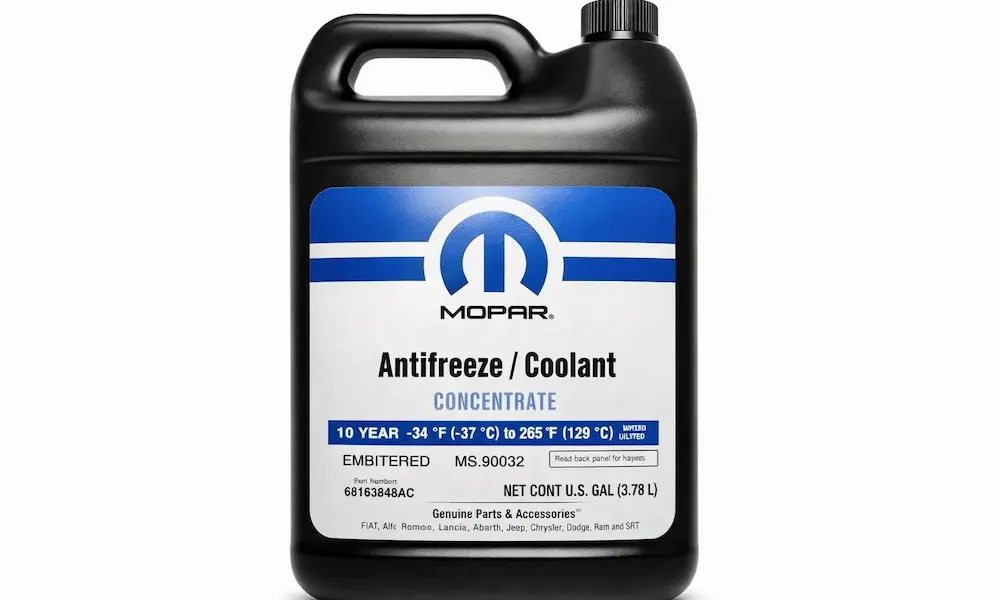
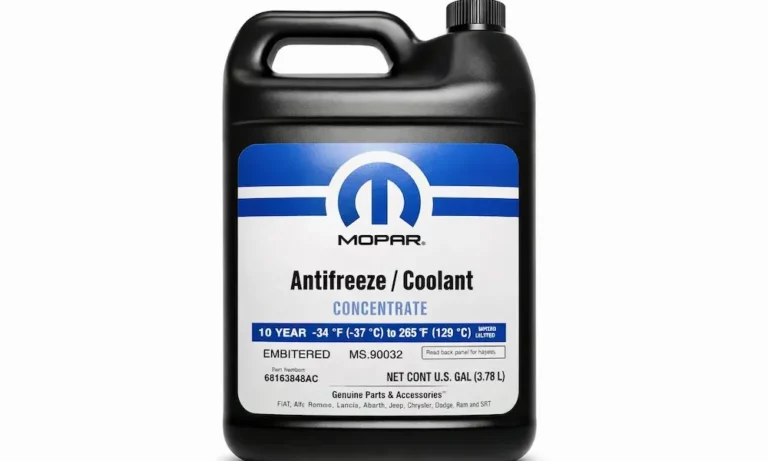
Starting with the 2013 model year, Stellantis (then Chrysler) switched to a pure Organic Additive Technology coolant called MS-90032. This purple fluid replaced the older orange/yellow HOAT formula (MS-9769) that Chrysler used throughout the 2000s.
Here’s the quick version of the coolant timeline:
| Era | Fluid Type | Standard | Service Life |
|---|---|---|---|
| Pre-2000s | Inorganic (IAT) | Traditional Green | 2 yrs / 30K miles |
| 2000–2012 | Hybrid OAT (HOAT) | MS-9769 (Orange) | 5 yrs / 100K miles |
| 2013–Present | Pure OAT | MS-90032 (Purple) | 10 yrs / 150K miles |
The MS-90032 formula is a concentrated ethylene glycol coolant that contains zero silicates, phosphates, borates, nitrites, or amines. That’s not an accident — removing those inorganic inhibitors is exactly what makes it last a decade.
Why the Formula Changed
Modern Chrysler engines like the Pentastar V6, Hemi V8, and EcoDiesel use thin-wall aluminum castings, plastic thermostat housings, and complex elastomer seals. Older silicate-based coolants are abrasive to these materials. Silicates can also “drop out” of solution and form gritty sludge that destroys water pump impellers and clogs heater cores.
OAT chemistry works differently. It deposits a molecularly thin protective film on metal surfaces. This film only reacts at active corrosion sites, which is why it lasts so much longer than older formulas.
MS-90032 vs MS-12106: Are They the Same?
You’ll see both numbers thrown around, and it creates real confusion. Here’s the short answer: they’re chemically identical.
- MS-90032 = concentrated formula (mix with distilled water)
- MS-12106 = pre-diluted 50/50 version (ready to pour)
Same OAT chemistry, same purple color, same 10-year service life. Modern documentation mostly uses MS-90032 for both. When you’re shopping for an equivalent, a product that meets either standard works.
| Property | Concentrated MS-90032 | 50/50 Pre-Diluted |
|---|---|---|
| Base | Ethylene Glycol | Ethylene Glycol + Water |
| Color | Purple / Violet | Purple / Violet |
| Freeze Point (50/50) | -34°F | -34°F |
| Boil Point (at 15 psi) | +268°F | +265°F |
| pH | 8.0–8.6 | 8.1–8.6 |
| Service Life | 10 yrs / 150K miles | 10 yrs / 150K miles |
The Best Mopar OAT Coolant Equivalents
Not every “universal” coolant cuts it here. These four aftermarket products genuinely meet the MS-90032 specification.
Valvoline Zerex G30
Zerex G30 is widely considered the closest aftermarket match to the factory Mopar fluid. It’s a pure carboxylate-based OAT with no silicates, phosphates, borates, or nitrites. It shares the same purple/violet color.
The reason G30 aligns so well with MS-90032 comes down to history. When Chrysler merged with Fiat, their fluid standards shifted toward European norms. Zerex G30 was already designed for those same phosphate-free European standards — it explicitly meets MS-12106 and MS-90032.
One critical warning: don’t confuse G30 with Zerex G05. The G05 is a hybrid OAT formula. Mixing it into an MS-90032 system risks the gelling reaction described below. Stick specifically to G30.
Peak OET North American Purple
Peak’s “North American Purple” coolant is designed specifically for Stellantis vehicles from 2013 onward — RAM, Jeep, Dodge, and Chrysler all covered.
The technical standout here is that Peak formulates this product to be 2-EHA free. Some OAT fluids (including GM’s Dex-Cool) use 2-ethylhexanoic acid, which can soften rubber gaskets and seals in certain older applications. Peak’s version skips that acid entirely, making it gentler on the seals used in modern Chrysler engines.
Peak also rates this product for 15 years or 350,000 miles on a full flush-and-fill — significantly more than the factory 10-year requirement.
Prestone MAX American Vehicles Purple
Prestone’s MAX American Vehicles Purple uses their “Cor-Guard” OAT inhibitor package, engineered for instant protection against rust and corrosion on aluminum and other metals.
Prestone notes this product works as a top-off for older Chrysler vehicles from 2000 and newer, though a complete flush is always the right call when changing coolant types. You’ll find this one at just about every auto parts store, which makes it a convenient choice for a roadside top-off.
Ravenol LTC
For a premium European option, Ravenol’s LTC series explicitly lists MS-90032 and MS-12106 in its specification profile. It’s based on 1,2-ethanediol and is formulated as an eco-friendly option that performs well across extreme temperature ranges.
| Brand | Product | Technology | Meets Standard |
|---|---|---|---|
| Valvoline | Zerex G30 | OAT | MS-12106 / MS-90032 |
| Peak | OET North American Purple | OAT | MS-12106 / MS-90032 |
| Prestone | MAX American Vehicles Purple | OAT | Chrysler 2000+ |
| Ravenol | LTC Protect C12++ | OAT | MS-90032 |
| Mopar | 10 Year / 150,000 Mile | OAT | MS-90032 (OEM) |
Why Mixing the Wrong Coolant Destroys Engines
This section isn’t meant to scare you — it’s meant to keep you from making a very expensive mistake.
Mixing OAT (MS-90032) with HOAT (MS-9769) triggers a chemical reaction between the organic acids and the silicates/phosphates. The inhibitors fall out of solution and form a thick gelatinous sludge — like mud or jelly circulating through your cooling system.
This sludge has zero thermal conductivity. It doesn’t carry heat. It accumulates in the slowest-moving parts of the system:
- Heater core (tiny passages, clogs easily → no cabin heat)
- Radiator tubes (reduced flow → overheating)
- Engine water jackets (localized hot spots → warped heads)
Modern aluminum engines have almost no tolerance for overheating. A single severe episode can warp cylinder heads or blow a head gasket. Repairs can exceed $10,000.
If you’ve accidentally mixed fluid types, don’t wait. Drain the system immediately, flush thoroughly with distilled water until the runoff is crystal clear, and refill with the correct OAT fluid.
The Purple Color Problem (It’s Not Reliable)
Here’s something that trips up both owners and technicians: the purple dye in MS-90032 isn’t chemically stable over 10 years. Heat cycles and exposure to oxygen cause it to shift toward red, pink, or even orange.
That orange color makes people think the vehicle was filled with the older HOAT coolant. They “correct” it with HOAT fluid. Now they’ve caused the exact gelling problem they were trying to avoid.
Two additional complicating factors:
- Semi-translucent reservoirs change how the fluid looks. Purple coolant can appear dark red or brownish through the plastic tank. Draw it into a clear syringe before judging the color.
- Stickers and manuals sometimes conflict on which standard applies. Always default to the model year (2013+) and the owner’s manual specification rather than the fluid’s appearance.
The rule: Verify the fluid by standard (MS-90032), not by color.
Mixing Ratios, Water Quality, and Filling Correctly
Always Use Distilled or Deionized Water
Tap water contains calcium, magnesium, and chlorides. These minerals react with the organic acids in OAT coolant, neutralizing the corrosion inhibitors years ahead of schedule. They also build scale deposits that act as insulators inside the radiator, reducing heat transfer.
Using tap water is one of the most common causes of premature water pump failure in modern Chrysler engines. If you don’t have reliable access to distilled water, just buy pre-mixed 50/50 fluid — it’s blended with deionized water in a controlled environment.
The Right Concentration
- Standard ratio: 50% concentrate, 50% distilled water → freeze protection to -34°F
- Cold climates: Up to 70% concentrate is acceptable → lowers the freeze point further
- Never exceed 70% concentrate — pure ethylene glycol actually freezes at a higher temperature than a water-glycol mix, and it’s far less efficient at transferring heat
Dealing With Air Pockets
RAM trucks and Jeep Wranglers in particular have complex cooling circuits with multiple high points where air traps. Trapped air causes:
- Gurgling sounds from the dashboard
- Inconsistent heater output
- Localized overheating in the engine block
Many Stellantis vehicles require a vacuum-filling tool to evacuate all air before adding new coolant. This tool pulls a deep vacuum on the entire system so the fluid fills every passage completely. Skipping this step can cause damage that doesn’t show up for several thousand miles.
What MS-90032 Protects (And How)
Understanding what this fluid actually does helps explain why the right equivalent matters so much.
| Component | Threat Prevented | How OAT Helps |
|---|---|---|
| Water pump impeller | Cavitation and erosion | Stable thin film prevents pitting |
| Radiator core | Scale and mineral buildup | Phosphate-free formula |
| Gaskets and seals | Chemical softening | Silicate-free and 2-EHA-free |
| Cylinder heads | Localized hot spots | Thin film preserves heat transfer |
| Engine block | Galvanic corrosion | Controlled conductivity and pH stability |
The galvanic corrosion protection is worth understanding. When different metals (aluminum, steel, cast iron) sit in the same fluid, they create a weak electrochemical reaction — basically a tiny battery. The organic acid inhibitors in MS-90032 maintain a controlled pH level that suppresses this reaction. As the fluid ages, its pH drifts and this protection fades — which is why the 10-year service interval isn’t just a guideline.
Cross-Reference Standards: Finding More Equivalents
MS-90032 intersects with several broader specifications. If you’re searching for a product not listed above, look for these standards on the label:
| Standard | What It Covers | Relationship to MS-90032 |
|---|---|---|
| ASTM D3306 | General North American coolant performance | Baseline requirement |
| SAE J1034 | Chemical stability and freeze protection | Met by all MS-90032 fluids |
| VW TL 774-F (G12+) | European silicate-free OAT | Chemically analogous |
| MS-12106 | Chrysler pre-mixed OAT | Pre-diluted version of MS-90032 |
| MS-9769 | Older Chrysler HOAT | Strictly incompatible |
This European connection explains why Zerex G30 and Ravenol LTC work so well — they were built for G12+ European standards before being adapted for the North American Stellantis fleet. Same chemistry, different label.
The single most important line in this chart: MS-9769 is not an alternative. It’s the chemistry that turns your cooling system into a gel factory.