Confused by ceramic coating prices ranging from $200 to $3,500+? You’re not imagining things — the gap is real, and it matters. This guide breaks down exactly what drives ceramic coating cost, what separates a great job from a disaster, and whether DIY is actually worth your weekend.
What’s Really Driving Ceramic Coating Cost?
Here’s the thing most shops won’t tell you upfront: you’re not paying for a tiny bottle of liquid. That vial of professional-grade ceramic costs an installer roughly $100–$200 wholesale. The raw materials for a full job — applicator pads, prep chemicals, leveling towels — typically run $225–$350 total.
So why does the final bill land between $600 and $3,500?
Labor accounts for 60–70% of the total service cost. A proper installation demands 15–20 hours of meticulous, hands-on work. Professional detailing studios charge $75–$150 per hour. Do the math — it adds up fast.
Why Cheap Quotes Are a Red Flag
You’ve probably seen $199 “ceramic coating” deals advertised online. Seasoned detailing professionals universally flag these as a serious warning sign.
A shop charging under $500 for a full exterior coating simply can’t afford to do the job correctly. Here’s what those budget installs actually involve:
- No paint correction — they wash the car and spray straight over damaged paint
- Consumer-grade spray sealants, not true liquid ceramic
- Weak molecular bonds that fail within a few months
- Locked-in defects permanently trapped under a thin layer of product
That’s not a ceramic coating. That’s an expensive car wash.
Surface Preparation: The Real Cost Engine
Before a single drop of ceramic touches your paint, the surface must be completely clean, decontaminated, and corrected. Why? Because ceramic coatings bond permanently to your clear coat — every swirl mark, scratch, and water spot gets locked in forever if the paint isn’t fixed first.
This preparation process alone typically adds $100–$1,500+ to your bill.
The Decontamination Phase
The prep starts long before any polishing. Technicians work through several critical steps:
- pH-neutral hand wash — strips loose dirt without scratching
- Chemical iron fallout treatment — dissolves embedded brake dust and industrial particles
- Clay bar decontamination — physically removes tar, sap, and stubborn debris
- Isopropyl alcohol panel wipe — strips all wax residue for a clean bond surface
Skip any of these steps, and the coating fails early. This phase alone typically adds $100–$300 to your bill.
Paint Correction Stages and Their Costs
Once the surface is clean, technicians use machine polishers to physically level the clear coat and eliminate visible defects. The worse the paint condition, the more stages required — and the higher the cost.
| Correction Stage | Defect Removal | Best For | Added Cost |
|---|---|---|---|
| No Correction | 0% | Not recommended by professionals | Base rate |
| Single-Stage | 50–65% | New cars, minor wash swirls | $300–$600 |
| Two-Stage | 75–85% | Moderate swirl marks, light scratches | $500–$1,000 |
| Three-Stage | 90–95% | Older vehicles, oxidation, deep scratches | $800–$1,500+ |
| Show-Quality | Near perfection | Exotics, collector cars, showroom prep | $1,000–$3,000+ |
Dark colors like black or deep navy push costs toward the top of each tier. Fine scratches show vividly on dark paint, so technicians spend significantly more time per panel. Soft European clear coats also require completely different compounds and techniques than harder Japanese finishes — that complexity costs money.
Ceramic Coating Cost by Vehicle Size
Larger vehicles mean more surface area, more ceramic product, and far more labor hours. A full-size truck can have 70–90 square feet of paintable surface compared to 40–50 square feet on a compact sedan.
| Vehicle Type | Entry-Level (1 Layer) | Premium Multi-Layer Package |
|---|---|---|
| Compact Sedan / Coupe | $500–$900 | $1,200–$2,800 |
| Mid-Size Sedan / Crossover | $800–$1,200 | $1,400–$3,000 |
| Full-Size SUV / Minivan | $900–$1,200 | $1,600–$3,400 |
| Full-Size Pickup Truck | $1,000–$1,300 | $1,700–$3,500 |
| Luxury / Exotic Vehicle | $1,000+ | $3,000–$4,000+ |
Trucks cost the most for standard consumer vehicles. The tall body lines, complex panel gaps, and physical fatigue for technicians all push labor up significantly. Aftermarket lift kits or body mods add custom surcharges on top.
Add-On Surfaces That Boost Your Total Cost
Most base quotes only cover the painted body panels. Your car has plenty of other surfaces that need protection — and each one requires a specialized formula.
Glass and Windshield Coating
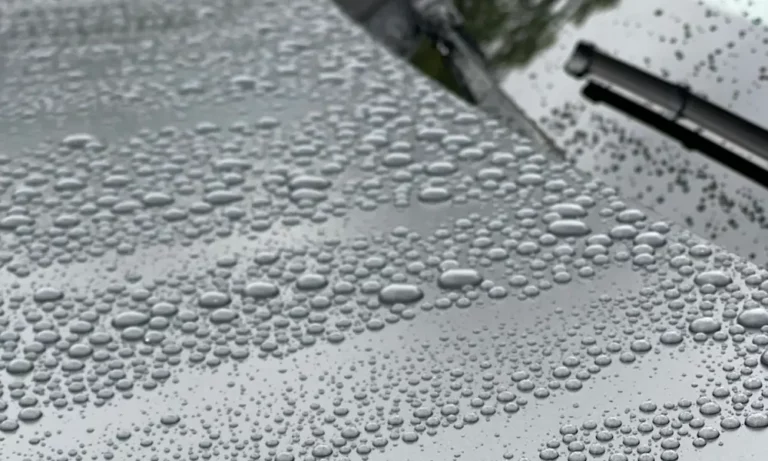
Ceramic glass coatings fill microscopic pits in the surface, creating a hydrophobic barrier that sends rain sheeting off at highway speed. It’s a genuine safety upgrade, not just cosmetic.
- Front windshield only: $75–$150
- All exterior glass and panoramic roof: $200–$350
Wheel and Brake Caliper Coating
Standard waxes melt off hot wheels instantly. Specialized high-temperature ceramic wheel coatings withstand temperatures over 2,000°F, stopping brake dust from pitting the metal.
- Wheel faces only: ~$200
- Full wheels-off service (inner barrels + calipers): $400–$500+
Plastic Trim and Interior Protection
Unpainted plastic trim fades from rich black to chalky gray without UV protection. Dedicated trim coatings stop that degradation cold.
- Exterior plastic trim: $150–$200 added
- Interior leather and dashboard protection: $400–$600 added
DIY vs. Professional Ceramic Coating: Real Cost Comparison
The DIY route looks tempting on the surface. But the true cost — and true risk — goes deeper than the kit price.
What DIY Actually Costs You
A consumer-grade ceramic kit runs $50–$300. But to do it right, you also need:
- Iron decontamination chemicals
- Clay bars and lubricant
- Quality microfiber towels (multiple packs)
- A dual-action machine polisher
- Abrasive compounds and multiple pad types
That equipment adds $100–$300 to the project. Realistic out-of-pocket DIY cost: $200–$600. Plus 10–20 hours of your own labor on a single weekend.
| Metric | DIY Application | Professional Installation |
|---|---|---|
| Total Cost | $200–$600 (tools included) | $600–$3,500+ |
| Expected Durability | 6–18 months | 3–10+ years |
| Chemical Concentration | Low to moderate (diluted) | Industrial grade |
| Paint Correction Quality | Variable, limited by skill | Multi-stage machine polishing |
| Warranty | None | Manufacturer-backed (2 years to lifetime) |
| Risk of Errors | High | Minimal |
Why Professional Results Last Longer
Consumer kits are deliberately diluted to give beginners a longer working window. That makes them easier to apply — but it also means the coating degrades and fails within 6–18 months. Then you do the whole thing again next year.
Professional-grade coatings use high-concentration silica formulas that crosslink permanently with the clear coat. The result genuinely lasts 3–10 years.
Then there’s the “high spot” problem. Ceramic coating starts hardening the moment it contacts air. If you don’t wipe the excess at exactly the right moment, it cures into a raised optical distortion on your paint. Fixing it requires aggressive compounding — which can damage the clear coat. Professionals catch these under specialized inspection lighting before they cure. You won’t.
How Location Affects What You Pay
Where you live directly affects your ceramic coating cost — sometimes by $200–$400.
Studios in dense metro areas like Miami, Las Vegas, Denver, and Charlotte carry higher overhead costs: commercial rent, utilities, competitive wages. Those costs pass directly to you.
Your local environment matters too:
- Northern salt-belt states: Road salts and de-icers embed deeply into clear coats. Technicians spend significantly more time on decontamination — adding $100–$300 to prep costs
- Sun-belt states: Less salt contamination, but intense UV exposure causes severe clear coat oxidation requiring aggressive compounding to fix
- Coastal areas: Salt air accelerates surface contamination year-round
Brand-by-Brand Ceramic Coating Cost Breakdown
Not all ceramic coatings are the same chemistry. Here’s what the major certified brands actually charge.
Ceramic Pro
Ceramic Pro structures pricing around the number of layers applied, with each tier carrying a longer warranty:
- Sport Package (spray sealant): $399–$600 | 6–12 months
- Bronze Package (1 coat): $600–$1,000 | 2-year warranty
- Silver Package (base coat + top coat): $1,000–$1,500 | 5-year warranty
- Gold Package (4 coats + top coat): $2,000–$2,500+ | Lifetime warranty
Gtechniq Crystal Serum Ultra
Gtechniq uses a dual-nanoparticle formula that separates into two layers as it cures — a flexible bottom layer to absorb impacts, and an ultra-hard top layer to resist chemicals. Full application runs $800–$1,000+ for compact cars, scaling up with vehicle size.
Opti-Coat
Opti-Coat uses silicon carbide instead of standard silica dioxide, bonding more permanently with the factory clear coat:
- Opti-Coat Pro (single layer): $900–$1,200 | 5-year warranty
- Opti-Coat Pro Plus (dual layer): $1,400–$1,600 | 7-year warranty
- Opti-Coat Pro3 (4 layers): $2,499+ | Lifetime warranty
Modesta
Japan’s premium boutique brand uses nano-grade titanium and pure glass resins for what detailers consistently describe as unmatched gloss. Their Private Label system offers up to 10 years of protection and starts at $2,500, reaching $4,000+ for full multi-surface coverage.
Ceramic Coating vs. Other Paint Protection Options
How does ceramic coating cost stack up against your other options?
| Protection Type | Professional Cost | Durability | Chemical Resistance | Hydrophobic Effect |
|---|---|---|---|---|
| Carnauba Wax | $50–$150 per application | 1–3 months | None | Low–Moderate |
| Synthetic Sealant | $100–$200 per application | 6–12 months | Low | Moderate |
| Ceramic Coating | $600–$3,500+ (one-time) | 3–10+ years | High | Extreme |
| Paint Protection Film | $2,000–$7,000+ | 7–10 years | Supreme (stops rock chips) | Moderate |
A professional wax applied four times per year costs $400 annually. Over five years, that’s $2,000 — with zero structural protection against acid rain, bird droppings, or automated car wash scratches.
A mid-range ceramic coating at $1,500 outperforms wax in every measurable way and lasts the full five years. Paint Protection Film stops physical rock chips that ceramics can’t, but costs thousands more and lacks extreme hydrophobic performance. Ceramic coatings hit the sweet spot between protection and cost.
Ongoing Maintenance Costs After Installation
Ceramic coatings aren’t maintenance-free — they’re just far less work than traditional products.
To keep your warranty valid and your coating performing properly, you’ll need:
- pH-neutral or ceramic-specific shampoo for all washes — avoid automated friction car washes entirely
- Annual inspection and decontamination service: $180–$300 per year at your certified installer
- Silica booster spray applied during annual visits to rejuvenate the hydrophobic top layer
Skip the annual maintenance and you’ll typically void your warranty — cutting the coating’s effective life in half.
Does Ceramic Coating Actually Protect Your Car’s Resale Value?
This is where the math gets interesting. Professionally coated vehicles consistently command 5–15% higher trade-in and private sale prices than identical uncoated vehicles.
On a $20,000 car, that’s an extra $1,000–$3,000 at point of sale.
Here’s why it works. A ceramic-coated car arrives at appraisal with deep, reflective, showroom-quality paint. That visual immediately signals careful ownership to appraisers — and often leads to the assumption that mechanical maintenance was equally thorough.
Uncoated vehicles show up with oxidized paint, heavy swirl marks, and cloudy headlights. Dealerships mentally subtract reconditioning costs immediately — costs that come straight out of your trade-in offer.
Vehicles protected with ceramic coatings retain approximately 80% of their original factory paint quality after five years. Waxed-only vehicles retain about 50%. That 30% difference in paint condition has a direct, measurable impact on your car’s dollar value.
For luxury vehicles and exotics, the math often means the coating pays for itself entirely at resale — and then some.
The bottom line on ceramic coating cost? You’re not spending money on a product. You’re investing in preserved equity that pays you back when it matters most.