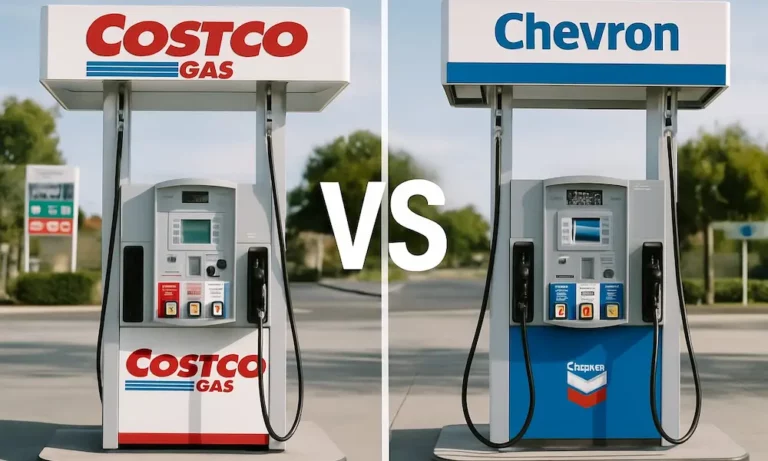
Ever pulled up to a gas station and wondered if premium fuel brands like Chevron are actually worth the extra money? Or if warehouse clubs like Costco truly offer the same quality at lower prices? You’re about to discover exactly how Costco gas compares to Chevron across price, quality, and convenience – helping you make smarter decisions at the pump that could save you hundreds each year.
The Price Gap: How Much Can You Actually Save?
Let’s cut to the chase – Costco gas is significantly cheaper than Chevron in virtually every market. Recent data shows price differences that might surprise you:
- In New Jersey, Costco’s regular unleaded averages $2.72-$3.05 per gallon compared to Chevron’s $3.05-$3.15
- Nevada markets show some of the widest gaps, with Chevron charging up to $0.92 more per gallon than Costco
- Even in states with smaller differentials like Colorado, Costco still maintains a $0.20-$0.30 per gallon advantage
For a typical 14-gallon fill-up, this means saving $2.80-$12.88 each time you fuel up at Costco. For a family with two vehicles getting weekly fill-ups, annual savings can exceed $1,300 compared to consistently using Chevron.
This price difference exists primarily because Costco operates on a different business model. They use gasoline as a membership driver rather than a profit center. With minimal markup strategies and massive bulk purchasing power, they can undercut traditional gas retailers while maintaining profitability through membership fees.
Fuel Quality: Is Cheaper Gas Actually Inferior?
The biggest misconception about discount gas is that it’s somehow lower quality. This simply isn’t true when comparing Costco and Chevron.
Both Costco’s Kirkland Signature gasoline and Chevron with Techron® are TOP TIER™ certified, meaning they exceed basic EPA requirements for detergent additives. This certification is endorsed by major automakers including BMW, Toyota, and General Motors as providing optimal engine protection.
Here’s what makes both fuels premium quality:
- Both contain detergent levels 2-5 times higher than EPA minimums
- Both effectively prevent carbon deposits on fuel injectors and intake valves
- Both help maintain engine performance and fuel efficiency over time
- Costco’s detergent levels exceed EPA requirements by 500%
Independent testing shows no statistically significant difference in engine performance between the two brands over extended use. The Costco Fuel Promise guarantees high-quality gasoline with deposit control additives that keep critical engine parts clean.
One Costco member who switched from exclusive Chevron use reported: “After six months of using only Costco fuel, my 2018 Toyota still runs perfectly. I’ve noticed no difference in performance but a huge difference in my budget.”
The Membership Factor: Is Costco Worth The Fee?
The most obvious barrier to Costco’s gas savings is the membership requirement. At $60-$120 annually, is it actually worth it just for gas?
The math is compelling:
| Scenario | Savings Calculation | Annual Benefit |
|---|---|---|
| Average driver (12,000 miles, 25 MPG) | 480 gallons × $0.30 savings | $144 |
| High-mileage driver (20,000 miles, 25 MPG) | 800 gallons × $0.30 savings | $240 |
| With Costco Visa (2% cashback on gas) | $144 base savings + $28.80 cashback | $172.80 |
| Executive Member with Costco Visa | $240 base savings + $48 cashback | $288 |
For many drivers, the gas savings alone cover the membership fee. If you fill up weekly, you could offset a $60 basic membership within just five weeks based on typical savings.
The value proposition becomes even stronger when considering that Costco members also gain access to:
- Discounted prices on tires and automotive services
- Additional savings on groceries and household items
- Special pricing on travel and other services
Convenience and Accessibility: The Chevron Advantage
Where Chevron clearly outshines Costco is in accessibility and convenience. With approximately 8,000 U.S. stations compared to Costco’s roughly 900 worldwide locations, Chevron offers far greater availability.
This network difference matters in several key scenarios:
- Rural areas often have Chevron stations but no nearby Costco
- Emergency refueling is easier with Chevron’s widespread presence
- Long road trips may require planning around Costco locations
Costco’s gas stations also come with operational limitations:
- Hours typically limited to 6 a.m.–10 p.m.
- Often lengthy lines during peak times
- Exclusive access for members only
One survey of 500 drivers found that convenience was the top factor for 32% of respondents when choosing a gas station, while price was most important for 56%.
Regional Differences That Matter
Your location significantly impacts the Costco vs. Chevron equation. The price gap varies widely by region due to:
- State gas tax differences
- Transportation costs to deliver fuel
- Local market competition
- Environmental regulations
California shows some of the most dramatic differentials, with Costco gas averaging $4.11-$4.39 per gallon compared to Chevron’s $4.40-$4.90. This larger gap is partly due to California’s stringent environmental standards, which Chevron factors into its premium pricing.
Meanwhile, states with lower overall gas taxes like Texas show smaller but still significant differences between the two brands.
Long-Term Vehicle Impact: What Mechanics Say
Professional mechanics generally agree that consistent use of either Costco or Chevron gasoline maintains engine health equally well, thanks to their TOP TIER™ status.
“What damages engines is inconsistent fuel quality or using the cheapest gas available regardless of detergent content,” explains Tom Anderson, a master mechanic with 25 years of experience. “Both Costco and Chevron provide excellent detergent packages that keep fuel systems clean.”
The key differences appear in:
- Carbon deposit prevention: Both fuels perform similarly well
- Fuel economy: Tests show a statistically insignificant 0-1% difference
- Cold-weather performance: Both contain seasonal additives appropriate for local climate
- Engine longevity: No documented difference in long-term engine health
Who Should Choose Costco Gas?
Costco gas makes the most financial sense for:
- Families with multiple vehicles who fuel up frequently
- Budget-conscious drivers who plan their refueling
- Those who already have Costco memberships for other reasons
- Drivers with flexible schedules who can avoid peak times
- High-mileage commuters who quickly recoup membership costs
One satisfied customer reported: “I drive about 25,000 miles annually for work. Switching to Costco gas saved me approximately $450 last year compared to using Chevron exclusively.”
Who Should Stick With Chevron?
Chevron remains the smarter choice for:
- Drivers who value maximum convenience and station availability
- Travelers and road warriors who need predictable access nationwide
- Those living far from Costco locations
- People who strongly prefer avoiding warehouse club membership fees
- Drivers with tight schedules who can’t accommodate potential wait times
“I tried Costco gas but went back to Chevron,” says Michael Liu from San Francisco. “The 45-minute wait times during my commute hours weren’t worth the savings. I need to refuel quickly and get home to my family.”
The True Cost of Convenience
To understand your personal value equation, try this approach:
- Calculate your annual gas consumption (miles driven ÷ MPG)
- Multiply by the average price difference in your area
- Subtract the $60 Costco membership fee
- Factor in the time value of waiting in lines (your hourly wage × estimated annual wait time)
For example:
- 15,000 miles ÷ 25 MPG = 600 gallons annually
- 600 gallons × $0.30 savings = $180 potential savings
- $180 – $60 membership = $120 net savings
- If you wait an average of 10 minutes extra per fill-up (40 fill-ups annually), that’s 6.7 hours
- At $30/hour value of time, that’s $201 in “convenience cost”
In this scenario, the time cost actually exceeds the net savings, making Chevron potentially a better overall value despite the higher price.
Making The Switch: What To Expect
If you’re considering switching from Chevron to Costco, here’s what to expect:
- No noticeable change in vehicle performance or fuel economy
- Potentially longer refueling times due to station congestion
- Need to plan refueling around Costco locations and hours
- Significant savings that accumulate over time
Many drivers find a hybrid approach works best – using Costco for regular refueling when convenient, but keeping Chevron as a backup option when needed.
Environmental Considerations
Both fuels help reduce emissions by keeping engines running efficiently. TOP TIER™ gasoline from either retailer reduces tailpipe emissions by minimizing engine deposits, which can impair fuel efficiency by up to 4%.
In controlled tests, both Costco’s Kirkland Signature gasoline and Chevron with Techron® demonstrated a 2-3% improvement in miles per gallon compared to minimum-standard gasoline. This efficiency gain translates to marginally lower carbon emissions over time.
The Bottom Line: Value vs. Convenience
The Costco vs. Chevron decision ultimately comes down to prioritizing either maximum savings or maximum convenience. For most drivers, the choice isn’t actually exclusive – many use Costco when convenient and Chevron when necessary.
With potential savings of $0.30-$0.90 per gallon and identical fuel quality standards, Costco gas delivers better pure value. However, Chevron’s widespread availability, shorter lines, and open access without membership fees provide tangible benefits worth considering.
Your personal driving patterns, proximity to stations, and how you value your time will determine which option makes more sense for your situation. The good news? Both provide high-quality fuel that will keep your engine running smoothly for years to come.