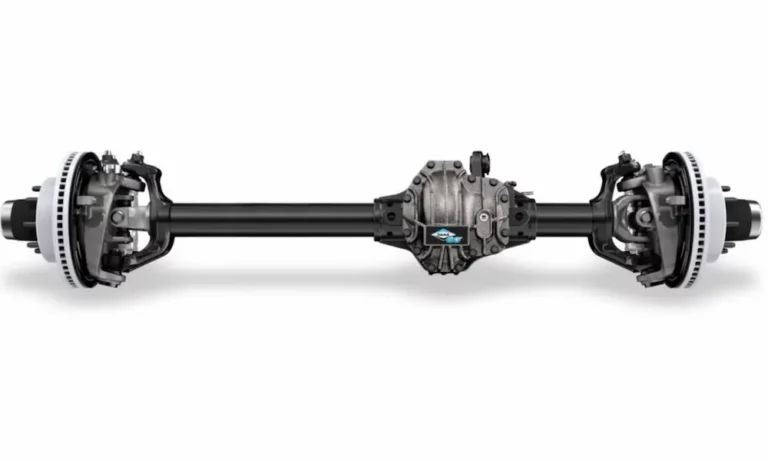
Staring at a mystery axle with no idea what you’re looking at? Dana axle identification doesn’t have to feel like cracking a secret code. Whether you’re rebuilding a trail rig, ordering parts for a fleet truck, or swapping gears, knowing exactly what axle you have saves you time, money, and a lot of frustration. This guide walks you through every method — from BOM tags to cover bolt counts — so you get the right answer fast.
Start Here: The Bill of Material Number Is Your Best Friend
Before you eyeball the differential cover or count ring gear teeth, check for the Bill of Material (BOM) number. This alphanumeric code is Dana’s version of an axle fingerprint. It tells you the exact model, gear ratio, carrier type, and every internal component used during factory assembly.
Think of it as the axle’s birth certificate.
How the BOM Number Works
The traditional BOM format is a six-digit number starting with 60 or 61, followed by a dash and a one- or two-digit suffix. A tag reading 610320-1 points to one specific build configuration.
The suffix matters — it identifies gear ratio variations and whether the unit includes a limited-slip or locking differential.
Here’s a common trap: some stamped tags drop the 60 or 61 prefix due to space constraints. If you see something like 3994-1, add 60 to the front and search for 603994-1 in Dana’s parts database. Post-2000 axles often use a seven-digit BOM starting with 200, and those are rarely truncated.
Once you have the BOM, cross-reference it through the Dana Aftermarket Media Library to pull rebuild specs and exact part numbers.
Where to Find the BOM on the Axle
Dana stamps or tags BOM numbers in multiple spots. Here’s where to look:
- Solid rear axles: Stamped on the rearward-facing side of the right (passenger-side) axle tube
- Solid front axles: Stamped on the forward-facing side of the left or right long tube
- Differential cover tags: Metal tags bolted under two cover bolts, introduced around 1965
- Gear ratio tags: A secondary single-bolt tag that states the ratio — if it includes an “L,” the unit has a limited-slip differential
- IFS axles: Stamped on the right support arm tag, left support arm opposite the camber adjuster, or cast into the carrier housing nose
- Late-model Super Duty trucks: A white data decal on the right axle beam with full build details including assembly date
Paint and road grime love to hide tube stamps. Scrape gently with a non-marring tool. Aggressive wire wheeling destroys shallow impressions permanently.
GM Vehicles: Check the RPO Codes First
If you’re working on a General Motors truck, skip the crawling around and check the Regular Production Option (RPO) code tag in the glovebox or driver’s side door jamb. On 2018 and newer GM vehicles, scan the matrix barcode on the driver-side door pillar. Axle-related codes usually carry F, G, or H prefixes.
One caveat: RPO codes only reflect the original factory build. If a previous owner swapped axles, the codes won’t match what’s under the truck.
Visual Dana Axle Identification: Reading the Differential Cover
When tags are missing, painted over, or corroded beyond reading, visual identification becomes your fallback. The differential cover’s shape, bolt count, and size give you a fast field ID for integral-housing Dana axles.
Axle Housing Architecture: Two Types
Before you focus on cover details, identify the housing style:
- Integral housing: Axle tubes are welded into the cast center section. Internal components are accessed through a removable rear cover. Most light-duty and heavy-duty Dana axles use this design.
- Dropout housing: A solid steel weldment without a removable rear cover. The entire differential carrier — ring gear, pinion, and all — bolts to the front face of the housing as a self-contained unit. Common in Dana’s commercial S-Series line, this design lets fleet techs swap a failed third member in the field without setting gear backlash roadside.
Semi-Floating vs. Full-Floating Axles
This distinction matters for both identification and safety:
- Semi-floating axles carry vehicle weight AND transmit torque through the same shaft. The wheel bolts directly to a flange forged into the shaft end. Common in light-duty applications like the Dana 35 and base Dana 44.
- Full-floating axles isolate the shaft from vehicle weight entirely. The hub rides on dedicated bearings over a spindle. The shaft only transmits torque, bolting to the outer hub face. This design defines heavy-duty models like the Dana 60, 70, 80, and commercial S-Series.
Cover Shape and Bolt Count Quick Reference
This table gives you the fastest visual ID method for integral Dana axles:
| Axle Model | Cover Bolt Count | Cover Profile | Ring Gear Diameter |
|---|---|---|---|
| Dana 25, 27, 28 | 10 | Small symmetrical round | 7.125 in |
| Dana 30 | 10 | Symmetrical rounded square | 7.125 in |
| Dana 35 | 10 | Symmetrical horizontal oval | 7.560 in |
| Dana 44 | 10 | Asymmetrical hexagon, flat sides, wide top | 8.500 in |
| Dana 50 | 10 | Asymmetrical, scaled-down Dana 60 shape | 9.000 in |
| Dana 60 / 70 | 10 | D-shape lying on its side | 9.750 / 10.500 in |
| Dana 80 | 10 | Tall, massive, pronounced rounded bottom | 11.250 in |
| Dana M275 | 14 | Large round with flat bottom edge | 10.800 in |
| Dana M300 | 14 | Massive round with flat bottom edge | 11.800 in |
Light-Duty and Heritage Axle Platforms
Dana 25, 27, and 28
These early axles powered original military and civilian Jeep platforms starting in 1941. Small ring gears, closed-knuckle steering, and limited torque capacity define this group. The Dana 28 appeared later as an IFS unit in early Ford compact trucks. Historically important, but too weak for modern performance builds.
Dana 30
The Dana 30 is almost always a front axle. You’ll find it in Jeep CJ, YJ, TJ, JK, and JL models, plus early Ford Broncos. Its 10-bolt rounded square cover and 7.125-inch ring gear make it one of the easier axles to spot visually. Factory shafts run 27 splines at 1.13 inches in diameter.
The weak point? Under oversized tires, the Dana 30 housing flexes and bends. Tube sleeves, external trusses, or a full housing swap are common fixes for trail rigs running anything larger than factory tire sizes.
Dana 35
The Dana 35 served as the rear axle on Jeep YJ, TJ, and early JK Wranglers through roughly 2007. Spot it by the 10-bolt oval cover, roughly 10.625 inches wide. It uses a 7.56-inch ring gear and 27-spline shafts.
The real problem with the Dana 35 isn’t the gears — it’s the C-clip shaft retention. The axle shafts are held inside the housing by small C-shaped clips seated inside the differential carrier. When a shaft fractures inboard of the wheel bearing, there’s nothing stopping the wheel from separating from the vehicle entirely. That’s not a minor inconvenience — it’s a serious safety hazard.
A C-clip eliminator kit or a full Dana 44 swap is strongly recommended for any build running lockers, larger tires, or aggressive terrain.
Dana 44
The Dana 44 is arguably the most significant axle in light-truck history. Jeep, Ford, Dodge, Chevy, Nissan, and International Harvester have all used it since the 1940s. Its 10-bolt asymmetrical hexagon cover — flat sides with a wider top — is one of the most recognized shapes in off-road circles.
Internal specs: 8.5-inch ring gear, 1.375-inch pinion shaft (upgraded to 1.625-inch on modern variants), and factory 30-spline shafts at 1.31 inches in diameter. That’s a meaningful strength jump over the Dana 30 and 35.
The Dana 44 has appeared in more configurations than almost any other axle — solid front and rear in trucks, Twin Traction Beam IFS in Ford F-150s and Broncos, and even as an independent rear in C4 Corvettes with manual transmissions.
Jeep Rubicon “Super 44” note: The Rubicon variant uses a thicker housing, unequal shaft lengths, and factory electronic lockers. JK front Super 44 axles carry an unusual 30/32 spline split between inner and outer shafts. The rear runs 32-spline throughout.
Dana 44 HD Aluminum warning: The aluminum-cased Dana 44 found in the rear of Jeep Grand Cherokee WJ models doesn’t swap parts with standard cast-iron Dana 44s. Different carrier bearings, unique mounting, and proprietary geometry — keep those parts separate.
Heavy-Duty Truck Platforms
Dana 50
The Dana 50 falls between the 44 and 60 in strength. Ford used it heavily in TTB IFS systems and early solid-front Super Duty trucks. Here’s the identification trap: the Dana 50 and Dana 60 share the exact same differential cover gasket. The covers look nearly identical. You have to check the ring gear diameter (9.0 inches vs. 9.75 inches) or measure the housing flange width to tell them apart reliably. The Dana 50 pinion shaft is also smaller, making it the weaker of the two.
Dana 60 and Dana 70
The Dana 60 is the benchmark heavy-duty axle for performance trucks and off-road builds. Its horizontal D-shaped 10-bolt cover is one of the most distinctive in the segment. It runs a 9.75-inch ring gear with 30- or 35-spline full-floating shafts.
The Dana 70 shares the same cover bolt pattern as the Dana 60 — another common misidentification in salvage yards. The Dana 70 houses a larger 10.5-inch ring gear, and its casting numbers plus cover flange width measurements are the most reliable ways to separate the two without pulling it apart.
Ford Dana Super 60 (M256): Introduced on 2005+ Ford F-250, F-350, F-450, and F-550 Super Duty 4×4 trucks, the Super 60 is a major evolution over legacy designs. Its cover measures exactly 12 inches high by 11.0625 inches wide. It uses 3.5-inch axle tubes, unitized wheel hubs, oversized knuckles, and a driver-side differential offset — all sized to handle modern forced-induction diesel torque.
Dana 80
The Dana 80 handles the heaviest Ford and Dodge pickup duty. Its cover is unmistakable — taller than a Dana 60 or 70, up to 13 inches high with a sweeping curved bottom. Inside: an 11.25-inch ring gear, near-4-inch OD axle tubes, and standard 35-spline shafts.
The Dana 80’s main vulnerability is thermal failure under heavy towing. Overloaded pinion bearings overheat, pit, and spall. Watch for gear whine, increased backlash, heat discoloration, and metallic debris in the gear oil. Synthetic oil, strict change intervals, and correct bearing preload torque are non-negotiable for longevity on these units.
The AdvanTEK Generation: Metric Naming, Modern Engineering
Dana’s AdvanTEK axle series uses High Power Density gearing to deliver equal or greater torque capacity in a smaller, lighter package. The naming system switches to millimeter-based ring gear designations.
- M186 / M200: Replace the Dana 30 and 35 on standard Jeep JL Wrangler and Gladiator models
- M210 / M220: Rubicon-tier front and rear axles. The M220 uses a 220mm ring gear — slightly smaller than the old 226mm Dana 44 — yet matches its 8,200 N·m torque capacity through optimized hypoid geometry
- M275: 2017+ Ford F-250 heavy towing and single-rear-wheel F-350 trucks. Instantly identified by its 14-bolt cover — a sharp break from every traditional Dana heavy-duty axle. Features a 10.8-inch ring gear and 4-inch OD tubes
- M300: Dual-rear-wheel Ford Super Duty application. Also 14 bolts, scaled up to an 11.8-inch ring gear — one of the largest ring gears in light-truck production history
Commercial S-Series Axles: The Dropout Architecture
Class 4 and Class 5 trucks — Ford F-450/F-550, Chevy Kodiak C4500/C5500, Dodge Ram 4500/5500 — use the Dana S-Series commercial axles. This lineup includes the S110, S111, S130, S132, S135, S140, and S150.
The defining feature: a dropout third-member design. The housing is a welded steel enclosure with a flat bottom and welded rear cover — no removable inspection cover. The entire differential assembly bolts to the front face of the housing. When something fails internally, you pull the axle shafts, unbolt the third member, and swap in a pre-built unit. No gear backlash setup in a parking lot.
Key specifications:
- S110/S111: 12.25-inch ring gear, 34-spline shafts, 14,706 lb gross axle weight rating. Supersedes the Dana 80 in many applications starting around 2005
- S135/S140/S150: 14.25-inch ring gear, 34- or 39-spline pinion options, capacity ranging from 16,000 to 21,000 lbs depending on configuration
The S-Series Spicer Trac-Lok limited-slip operates entirely on gear separation forces — no pneumatic lines, no friction modifier additives, no driver input required. It delivers a 3:1 torque bias automatically.
Understanding Carrier Breaks and Setup Tolerances
What Is a Carrier Break?
Changing gear ratios isn’t as simple as swapping ring and pinion sets. As ratios go numerically higher (3.54 to 4.10 to 4.56), the pinion gear shrinks physically. A smaller pinion must sit closer to the ring gear centerline to maintain proper mesh. Dana addresses this by offering two carrier case heights — a low-ratio case and a high-ratio case — for each axle model.
Example: Upgrading a Dana 44 from 3.54 to 3.73 uses the same carrier case. Jumping to 4.09 or higher? You need the high-ratio carrier case or the ring gear physically can’t mesh correctly.
Setup Torque Quick Reference
These are general setup ranges for standard-generation axles. AdvanTEK and S-Series units require BOM-specific data:
| Axle Model | Pinion Preload (New Bearings) | Backlash Tolerance | Ring Gear Bolt Torque |
|---|---|---|---|
| Dana 25, 27, 28 | 10–15 in-lbs | 0.005–0.007 in | 55 ft-lbs |
| Dana 30 | 12–15 in-lbs | 0.006–0.010 in | 55 ft-lbs |
| Dana 44 | 14–19 in-lbs | 0.006–0.010 in | 55 ft-lbs |
| Dana 50 | 14–19 in-lbs | 0.006–0.010 in | 65 ft-lbs |
| Dana 60 | 17–30 in-lbs | 0.005–0.009 in | 110 ft-lbs |
| Dana 80 | 25–35 in-lbs | 0.005–0.008 in | 200+ ft-lbs |
Get these wrong and you’re not just looking at a noisy differential — you’re accelerating bearing failure. Use quality synthetic gear oil, maintain your change intervals, and reference the exact BOM for anything outside these standard platforms.
Dana axle identification is a structured process — start with the BOM number, verify with casting numbers and visual cues, then confirm ring gear dimensions and shaft spline counts when needed. Get that identification right first, and everything else — parts ordering, gear setup, upgrades — becomes straightforward from there.