Staring at a mystery carburetor with no idea what it is? You’re probably holding a Rochester Quadrajet — and this guide will tell you exactly what you’ve got. From decoding stamped numbers to spotting the difference between a 750 and 800 CFM casting, everything you need is right here. Read to the end — the date code section alone will save you from a very expensive mistake.
What Makes the Quadrajet Different From Every Other Four-Barrel
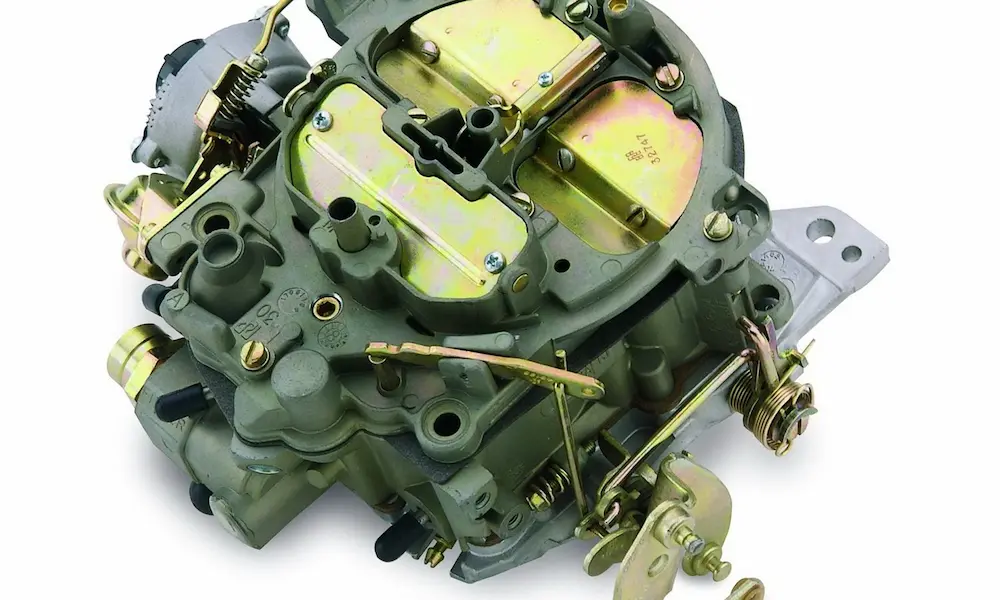
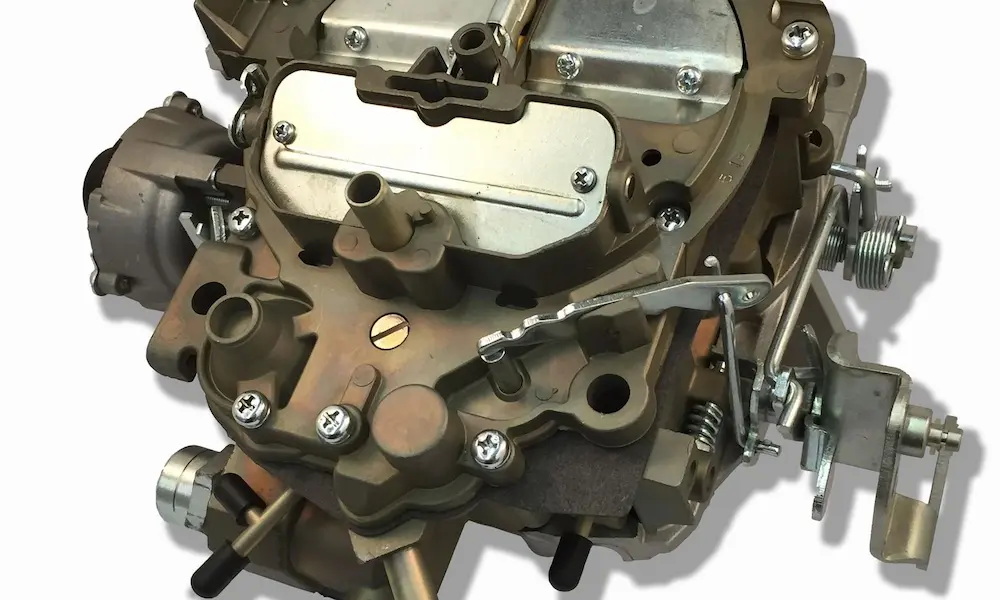
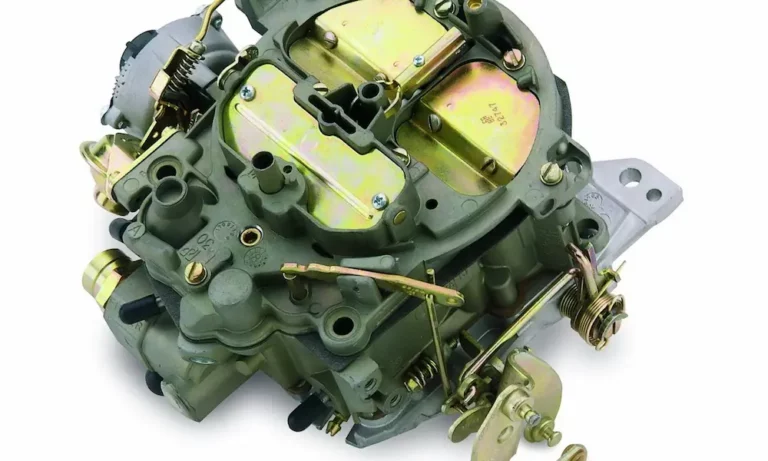
The Rochester Quadrajet isn’t your typical square-bore carburetor. Every other four-barrel design uses four roughly equal-sized bores. The Quadrajet uses tiny primary bores paired with massive secondary bores — a layout called spread-bore.
Here’s why that matters:
- Small primaries = high air velocity = crisp throttle response and great fuel economy
- Massive secondaries = maximum airflow when you actually need it
- Vacuum-controlled secondary air doors = no bog, no hesitation, no drama
This design made the Quadrajet incredibly adaptable, fitting everything from a 327 small-block to a 454 big-block without major recalibration. No other carburetor of the era pulled that off as cleanly.
Quadrajet Model Families: How to Know What You Have
Before you decode any numbers, you need to know which model you’re looking at. The letter designations tell the whole story.
Early Series (1965–1974): 4M, 4MC, and 4MV
These three models share the same internal casting. The only difference is how the choke works.
- 4M — Manual choke via a cable to the dashboard. Rare. Mostly industrial or marine use.
- 4MC — Integral choke mounted directly on the carburetor body, heated by exhaust air through a metal tube.
- 4MV — “Divorced” choke. The thermostatic coil lives in a well in the intake manifold, connected to the carb by a linkage rod.
Modified Series (1975–1980): M4MC and M4ME
The “M” prefix means these carburetors were redesigned to meet tighter emissions rules. They’re tighter internally and run dual vacuum choke pull-offs.
The M4ME added an electrically heated choke coil — 12 volts straight from the ignition. No more waiting for exhaust heat to warm the spring. This made cold starts dramatically faster and more consistent. These even showed up on 1985–1988 Dodge trucks and late-1980s police package vehicles.
Electronic Era (1981–late 1980s): E4ME and E4MC
The “E” prefix means the carburetor talks to a computer. A solenoid inside the primary fuel bowl cycles up and down, adjusting the air-fuel ratio in real time based on O2 sensor feedback.
These carburetors don’t work without the factory computer and sensor harness. Don’t try to swap one onto an older engine unless you’re keeping the whole system.
750 CFM vs. 800 CFM: Here’s How to Tell Them Apart
This is one of the most misunderstood topics in the Quadrajet world. The Quadrajet only came in two airflow ratings for mechanical versions:
| Rating | Production Years | Primary Bore Size |
|---|---|---|
| 750 CFM | 1965–1972 | 1-3/8 inches |
| 800 CFM | 1973–onward | 1-17/32 inches |
You can’t tell them apart from the outside — the bolt patterns and dimensions are identical. You have to look up through the primary throttle bores from the bottom of the carb with the throttle blades held open.
- 750 CFM — Smooth, uniform venturi walls. No bumps, no protrusions.
- 800 CFM — A visible bulge on each primary venturi wall at roughly the 4 o’clock and 8 o’clock positions. Rochester added those to prevent the slightly enlarged bores from breaking through into internal vacuum passages.
The secondary bores are identical on both. The entire 50 CFM difference comes from those larger primaries.
One more thing: The E4ME and E4MC carburetors are mechanically limited to 600 CFM by a mechanical stop on the secondary air valves — not smaller bores. The computer couldn’t handle the fuel mapping above that. Performance builders remove the stop, but it requires proper recalibration.
Where to Find the Identification Number
Location depends on when the carburetor was made.
1965–1968: Look for a small round metal tag pressed into a recess on the driver’s side of the float bowl, just behind the primary throttle arm. These tags were color-coded by application to help assembly line workers match carbs to engines quickly.
The problem? Decades of heat, vibration, and carburetor dip destroy those tags. If yours is missing or blank, the carburetor’s identity is basically gone without a full teardown.
1968-onward: Rochester switched to roll-stamping the number directly into the metal on the driver’s side of the main body casting. This stamp survives chemical dipping and abrasive blasting. This is your reliable identification source for the vast majority of Quadrajets you’ll encounter.
Decoding Seven-Digit Numbers (1965–1975)
If your carburetor has a seven-digit number starting with “70,” here’s how to read it position by position.
Digits 1–3: The Prefix
| Prefix | What It Means |
|---|---|
| 702 | 1960s production, standard |
| 703 | 1960s production, A.I.R. emissions equipped |
| 704 | 1970–1975 production |
Digit 4: Year of Production
Read this in context with the prefix. With a “704” prefix, a “5” in position four means 1975. With “702,” a “9” means 1969.
Digit 5: Model and Emissions Standard
- 2 = Quadrajet, Federal emissions standards
- 5 = Quadrajet, California emissions standards
If you see a 2 or 5 here, you’ve confirmed it’s a genuine Quadrajet.
Digit 6: GM Division
| Digit | Division | Notes |
|---|---|---|
| 0, 1, 2 | Chevrolet | 90-degree fuel inlet, passenger side |
| 3 | Chevy/GMC Truck | Unique throttle linkage |
| 4 | Buick | Straight front-facing fuel inlet |
| 5 | Oldsmobile | Forward-facing fuel inlet |
| 6, 7 | Pontiac | Forward-facing inlet, unique choke lever |
| 8 | Holden | Australian export, rare in the U.S. |
Cadillac is the wild card — it ignored this system entirely. Cross-reference with a parts catalog for any Cadillac unit.
Digit 7: Transmission
- Even number = Automatic transmission calibration
- Odd number = Manual transmission calibration
Decoding Eight-Digit Numbers (1976–1980s)
In 1976, GM dropped the “70” prefix and moved to “170,” creating an eight-digit number.
- 1705xxx = Late 1970s (1976–1979)
- 1708xxx = 1980s
The fifth digit is still the production year. With a “1705” prefix, digit five “6” = 1976. With “1708,” digit five “1” = 1981.
The last three digits follow the old model/division/transmission logic through the late 1970s. By the 1980s, they’re essentially sequential internal codes — use a reference manual for those.
The 1968–1969 Five-Digit Stamping Problem
During the transition to roll-stamping, operators frequently skipped the “70” prefix. So if you find a five-digit stamp like 28219, add “70” to the front. The real part number is 7028219.
Don’t confuse this with Carter aftermarket numbers, which are four digits followed by a letter — like 4675S. A number ending in “S” is an aftermarket replacement, not an O.E. unit.
How to Read Date Codes
Rochester Julian Format (Most Quadrajets)
Four digits: JJJY
- First three digits = day of the year (001–365)
- Fourth digit = last digit of the year
Example: 0828 = 82nd day of 1968 = late March 1968. A stamp of 3668 = December 31, 1968 (a leap year).
Carter Alphanumeric Format
A letter followed by a number means Carter built it. The letter is the month — but the sequence skips “I” to avoid confusion with the number 1.
| Letter | Month | Letter | Month |
|---|---|---|---|
| A | January | G | July |
| B | February | H | August |
| C | March | J | September |
| D | April | K | October |
| E | May | L | November |
| F | June | M | December |
Example: A8 = January 1968. Any trailing letters after the year digit are Carter internal shift codes — ignore them for identification purposes.
Carter-Built Quadrajets: What You Need to Know
Carter manufactured Quadrajets under license from GM starting in 1966, when Rochester’s plant couldn’t keep up with demand. Carter-built O.E. units carry standard GM seven-digit part numbers but use Carter-style date codes and sometimes have “Carter” cast into the driver’s side of the body.
Every internal component — jets, metering rods, gaskets — is fully interchangeable between Rochester and Carter units. For restoration purposes, a Carter-built unit with the correct GM part number is considered original and correct.
Service Replacements vs. Original Equipment
Here’s how to spot a service replacement carburetor:
Date code mismatch: A correct 1969 Camaro part number with a date code reading “3124” (1974) tells you it’s a dealer replacement, not the original unit.
No plant broadcast code: Original equipment carburetors have a two-character broadcast code (like “DG” or “FA”) stamped next to the part number. These helped assembly line workers match carbs to engines quickly. Service replacements almost never have this code — they went to parts counters, not assembly lines.
Spotting a Marine Quadrajet
Marine Quadrajets aren’t interchangeable with automotive units — using an automotive carb on a boat is a fire hazard and will likely void your insurance. Look for these three features to identify a true marine unit:
- J-tube vents — The float bowl vent tubes point inward or curve into a J-shape. This directs overflow fuel into the throttle bores rather than onto the hot intake manifold.
- Sealed vacuum ports — Most external vacuum ports are omitted from the casting or permanently plugged. Marine distributors use mechanical advance, not vacuum.
- Sight tube fitting and overflow nipple — A threaded barb above the fuel inlet for a Coast Guard-required sight tube, plus overflow routing hardware.
Numbers That Don’t Identify the Carburetor
Two common sources of confusion:
Broadcast codes (like “DG” or “FA”): These are assembly line matching codes, not factory location codes. They helped line workers grab the right carb fast without reading full part numbers.
Raised casting numbers: That prominent seven-digit number encircled on the main body or air horn? That’s a blank casting number — it identified the raw metal form before machining. One casting could be drilled dozens of ways for different applications. It tells you nothing about where this carb was destined to go.
Common Problems and What They Tell You
Secondary bog: If the engine stumbles hard under wide-open throttle, the vacuum break diaphragm is likely torn. It’s supposed to hold the upper secondary air doors back so they open gradually. Without it, a wall of unatomized air hits the manifold and the engine goes lean instantly. Check the diaphragm first — it’s almost always the culprit.
Fuel smell or pooling on the intake: The secondary well plugs on the bottom of the main casting are sealed from the factory with epoxy. That epoxy dries out and cracks after decades of heat cycling. Once it fails, raw fuel drips straight down onto the intake.
Vacuum leaks and rich running: Over-tightened front mounting bolts bow the air horn and warp the main casting. Once that happens, the upper gasket can’t seal. The only real fix is machining both surfaces flat — which is why a professional Quadrajet rebuild on a warped unit is worth every dollar.