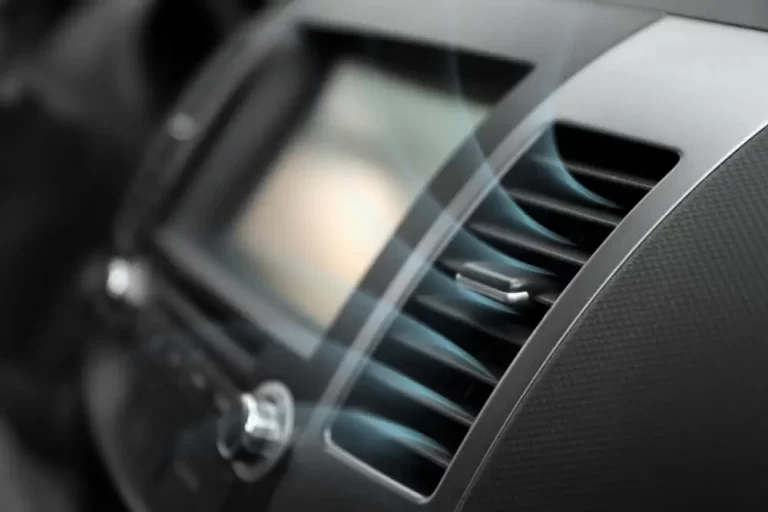
Summer’s here, and you’re sweating the moment you open your car door. You flip on the AC — but now you’re wondering if your gas mileage is tanking. Does using AC in car use gas? Short answer: yes. But how much depends on your speed, your car type, and a few tricks you probably haven’t tried. Read to the end — the windows vs. AC debate alone could save you real money.
How Car AC Actually Burns Your Fuel
Your car’s AC doesn’t just flip on magically. It runs a full refrigeration cycle that pulls power directly from your engine.
Here’s the quick version: A compressor — bolted to your engine and driven by the serpentine belt — squeezes refrigerant into a high-pressure vapor. That vapor travels to the condenser, dumps its heat into the outside air, then passes through an expansion valve that drops the pressure and temperature dramatically. The now-icy refrigerant flows through the evaporator inside your cabin, absorbs the hot air blowing across it, and sends cool air through your vents. Then it loops back to the compressor and starts again.
The problem? That compressor places a parasitic mechanical load of roughly 3 to 6 horsepower on your engine every time it runs. Your engine has to burn extra fuel just to keep up. According to Department of Energy data, AC use can cut fuel economy by more than 25% under extreme heat, high humidity, and short-trip conditions.
The Real Fuel Numbers Are Staggering
You might assume the AC penalty is minor. It isn’t.
Research from the National Renewable Energy Laboratory puts the numbers in sharp perspective:
- 62 gallons of gas per year — that’s what the average vehicle burns just to run the AC compressor
- 3.4 gallons per year — additional fuel burned just to haul the physical weight of the AC hardware
- 7 billion gallons of gasoline annually — what U.S. light-duty vehicles collectively burn for cabin cooling
Even a modest auxiliary load of 400 watts on a conventional engine knocks roughly 1 mile per gallon off your fuel economy. And when your car idles with the AC running — say, in a drive-through or parking lot — the AC accounts for 55% to 60% of all fuel consumed at that moment.
The emissions picture is equally grim. During the EPA’s SC03 test cycle, which simulates hot-weather driving with AC active, nitrogen oxide emissions jump ~80% and carbon monoxide climbs ~70% compared to AC-off driving.
| Impact Category | Value | Condition |
|---|---|---|
| Peak fuel economy loss | 25%+ | Extreme heat, humidity, short trips |
| Fuel penalty per 400W auxiliary load | ~1 mpg reduction | Conventional engine, steady speed |
| Fuel consumed at idle with AC | 55–60% of all fuel | Stationary vehicle, AC running |
| Annual fuel use per vehicle (AC only) | 62 gallons | Direct compressor power |
| U.S. annual fuel use for cooling | 7 billion gallons | All light-duty vehicles |
| NOx increase during AC operation | ~80% | EPA SC03 test cycle |
| CO increase during AC operation | ~70% | EPA SC03 test cycle |
Windows Down vs. AC On — Which Is Actually Cheaper?
This is the question everyone argues about. The answer depends entirely on your speed.
Rolling your windows down sounds like the free option. But open windows destroy your car’s aerodynamic profile. They create turbulence that pulls against your car — and that drag increases exponentially as you go faster.
Oak Ridge National Laboratory tested a 2009 Toyota Corolla and a 2009 Ford Explorer across a range of speeds. Here’s what they found:
- Below 40–45 mph: Wind drag is minimal. Windows down, AC off wins every time.
- Above 55–60 mph: Aerodynamic drag becomes the bigger fuel thief. Close the windows and use AC at a moderate setting.
- The Corolla at 75+ mph: Windows-down drag matched and then exceeded the AC penalty. Closing up was more efficient.
- The Ford Explorer: The blockier SUV shape meant the two methods were nearly equal above 60 mph — body style really matters here.
Research also shows that at 50 mph, open windows reduce a streamlined sedan’s fuel efficiency by 20%, while the same scenario only hurts an SUV by 8%.
| Vehicle Type | Speed | Windows Open Penalty | AC Penalty | Best Option |
|---|---|---|---|---|
| Streamlined sedan | 50 mph | 20% efficiency loss | ~10% loss | AC on, windows closed |
| SUV | 50 mph | 8% efficiency loss | ~10% loss | Windows down, AC off |
| Toyota Corolla | Under 75 mph | Low drag | Higher compressor load | Windows down |
| Toyota Corolla | Over 75 mph | High drag | Lower than drag | AC on, windows closed |
| Ford Explorer | Over 60 mph | Similar to AC load | Similar to drag | Negligible difference |
The takeaway: city driving = windows down. Highway driving = AC on.
How Hybrids and EVs Handle AC Differently
Hybrids and EVs ditch the serpentine belt entirely. Instead, they use high-voltage electric scroll compressors powered by the main battery pack. These compressors run independently of engine speed and can operate while the car sits still — no idling waste.
Electric scroll compressors also maintain 86% to 89% volumetric efficiency across a wide speed range, while conventional mechanical piston compressors drop off steeply. That’s a meaningful efficiency advantage.
But the energy has to come from somewhere, and it still costs you.
A May 2026 AAA study tested vehicles at 95°F with the cabin cooled to 72°F and found:
- Hybrids: 12% drop in fuel economy, adding $13.02 per 1,000 miles in operating costs
- EVs: 10.4% efficiency drop and 8.5% range loss, adding $6.78 per 1,000 miles on home charging — or $16.25 per 1,000 miles on public charging
Cold weather hits even harder. At 20°F, hybrids lose 22.8% of fuel economy. EVs lose 35.6% efficiency and 39% of driving range. At 5°F, some EVs are left with just 54% of their rated range.
The solution for cold-weather EV driving is a heat pump system. Instead of using resistive heating (which works like a space heater and can drain up to 30% of your battery), heat pumps reverse the cooling cycle to pull ambient heat from outside air. Advanced vapor-injected heat pump compressors achieve a coefficient of performance of 3.40 at 14°F — consuming over 50% less energy than resistive heaters.
| Powertrain | Temperature | AC/Heat Setting | Efficiency Impact | Cost per 1,000 Mi |
|---|---|---|---|---|
| Hybrid | 95°F | AC active (72°F cabin) | −12% fuel economy | +$13.02 |
| EV | 95°F | AC active (72°F cabin) | −10.4%; −8.5% range | +$6.78 (home) / +$16.25 (public) |
| Hybrid | 20°F | Heating active | −22.8% fuel economy | Significantly elevated |
| EV | 20°F | Heating active | −35.6%; −39% range | Heavily impacted |
| EV | 5°F | Resistive heat active | −46% range | Maximum impact |
How the EPA Tests AC Fuel Economy
The EPA’s official fuel economy testing runs vehicles through five drive cycles on a chassis dynamometer. The SC03 cycle specifically measures AC impact — it simulates driving at 95°F with a solar heat load of 850 watts per square meter and high humidity.
For EVs, the EPA applies a 0.7 adjustment factor to raw lab results to reflect real-world driving. A car that achieves 200 miles of highway range in the lab gets certified at 140 miles on its window sticker.
One finding worth knowing: running your AC in recirculation mode — where the system cools air already inside the cabin rather than pulling in hot outside air — uses 6.1% less accessory power than fresh-air mode. That translates to a 20% improvement in relative fuel economy under aggressive driving, and an 8% improvement during standard on-road driving. As a bonus, recirculation mode cuts in-cabin particulate concentrations by 92% compared to outside air. Worth using in heavy traffic.
Practical Ways to Cut Your AC Fuel Costs
You can’t skip AC entirely on a 100°F day — but you can run it smarter.
Before you drive:
- Park in shade whenever possible
- Use a reflective windshield sunshade to block solar heat buildup
- Crack windows while parked if it’s safe to do so
When you first get in:
- Roll windows down and drive for 2–3 minutes before switching to AC
- This flushes hot air out fast and cuts the initial cooling load significantly
While driving:
- Use recirculation mode — it’s more efficient and cleaner
- Set your temperature to 72–76°F rather than max cold; you’ll barely notice the difference in comfort
- Match your cooling method to your speed: windows down in traffic, AC on at highway speeds
For hybrid and EV owners:
- Pre-condition your cabin while plugged into a Level 2 charger — you’ll start with a cool cabin without touching your battery range
- In cold weather, use heated seats and a heated steering wheel first before cranking the cabin heater — it’s far more energy-efficient
Does using AC in car use gas? Absolutely. But with the right habits, you can keep that penalty as small as possible — whether you’re driving a gas-powered car, a hybrid, or a fully electric vehicle.