Ever wondered why a chainsaw sounds so aggressive or why a dirt bike can scream past anything twice its size? It’s all down to a brilliantly simple piece of engineering. This guide breaks down exactly how a 2 stroke engine works, what makes it tick, and why it’s still very much alive in 2024. Stick around — the physics behind this thing are genuinely fascinating.
What Makes a 2 Stroke Engine Different?
A 2 stroke engine completes a full power cycle in just two piston movements — one up, one down. That’s one single crankshaft revolution per power stroke.
Compare that to a 4 stroke engine, which needs four piston movements across two full crankshaft revolutions to do the same job.
The payoff? A 2 stroke fires a power stroke on every single revolution. That translates directly into a much higher power-to-weight ratio than a 4 stroke engine of the same displacement. It’s why a 125cc two-stroke motocross bike can absolutely embarrass a 125cc four-stroke on the track.
There’s a trade-off, though. Cramming intake, compression, combustion, and exhaust into just two movements creates some serious engineering challenges — especially around how gases move in and out of the cylinder.
The Core Parts of a 2 Stroke Engine
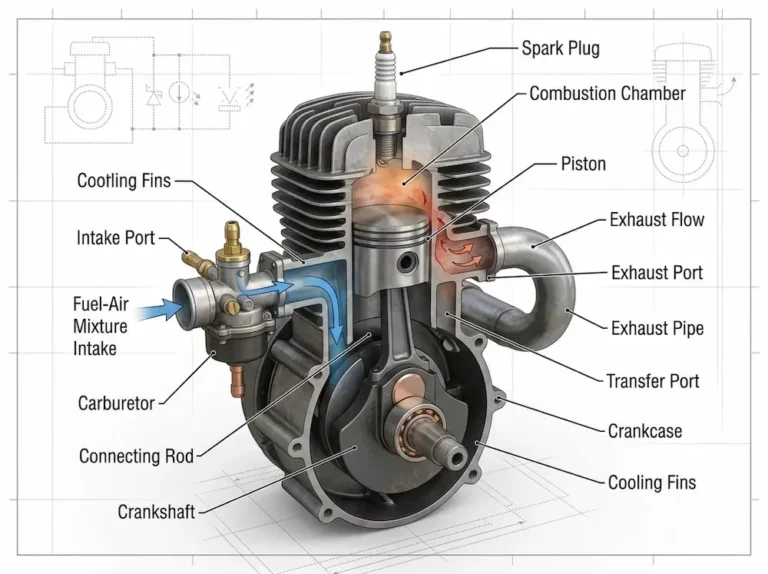
Before diving into the cycle itself, here’s what you’re working with:
The Cylinder and Its Ports
Instead of valves controlled by a camshaft, a 2 stroke engine uses ports — holes cut directly into the cylinder wall. The piston slides over them to open and close them. There are three key types:
- Intake port: Lets the fresh air/fuel mixture enter the crankcase
- Transfer ports: Channels that move the compressed charge from the crankcase up into the combustion chamber
- Exhaust port: Lets spent gases escape into the exhaust system
The Piston
The piston does double duty. Above its crown, it compresses the fuel mixture and captures combustion energy. Below its skirt, it acts as the valve mechanism — physically covering and uncovering the ports as it moves.
The Sealed Crankcase
This is where a 2 stroke gets clever. Unlike a 4 stroke, where the crankcase is just an unpressurized oil bath, the 2 stroke crankcase is hermetically sealed. It actively pumps the fresh charge up into the cylinder. Think of it as a built-in supercharger hiding below the piston.
The Crankshaft and Connecting Rod
The crankshaft converts the piston’s up-and-down motion into rotation. The connecting rod links the piston to the crankshaft. Counterweights on the crank balance the reciprocating mass and reduce vibration that would otherwise shake the engine apart.
How Does a 2 Stroke Engine Work? The Full Cycle
Here’s where it gets interesting. Two strokes, one complete power cycle. Let’s walk through each one.
The Upstroke: Compression Above, Intake Below
The piston starts at Bottom Dead Center (BDC) and moves upward toward Top Dead Center (TDC).
Above the piston: As the piston rises, it covers the transfer ports and exhaust port, sealing the combustion chamber. It then compresses the trapped air/fuel mixture into a dense, volatile pocket against the cylinder head — pressure spikes, temperature rises.
Below the piston: Simultaneously, the rising piston increases the volume inside the sealed crankcase. That expansion creates a partial vacuum. Atmospheric pressure pushes fresh air and fuel through the carburetor and into the crankcase through the intake port.
By the time the piston hits TDC, the combustion chamber is fully compressed and ready to fire, and the crankcase is fully loaded with fresh charge.
The Downstroke: Power, Exhaust, and Transfer — All at Once
When the piston reaches TDC, the spark plug fires. Combustion releases massive thermal energy. Expanding gases drive the piston forcefully downward — this is the power stroke.
Three things happen as the piston descends:
- Crankcase compression: The downstroke squeezes the crankcase, pressurizing the fresh charge below and snapping the intake valve shut
- Exhaust blowdown: The piston uncovers the exhaust port — residual high-pressure combustion gases blast out into the exhaust system
- Scavenging: Milliseconds later, the piston uncovers the transfer ports — the pressurized charge in the crankcase rushes up into the cylinder, physically pushing the remaining exhaust gases out the still-open exhaust port
That final phase — where intake and exhaust happen simultaneously — is called scavenging. It’s the defining moment of the entire 2 stroke cycle, and it’s also the engine’s biggest technical challenge.
Scavenging: The Most Complex Part of the Cycle
In a perfect world, the fresh charge would act like a solid piston — perfectly sweeping every last exhaust molecule out of the cylinder without mixing. Reality is messier. Gases mix. Some fresh fuel escapes out the exhaust port before the piston can seal it. Some exhaust lingers in the cylinder.
This phenomenon — called short-circuiting — is why traditional 2 strokes have historically been fuel-hungry and smoky. Engineers have spent a century developing different scavenging architectures to fight it.
| Scavenging Type | How It Works | Efficiency | Common Use |
|---|---|---|---|
| Crossflow | Ports on opposite sides; deflector piston redirects flow upward | Low — heavy pistons, poor gas separation | Mostly obsolete |
| Loop (Schnuerle) | Angled transfer ports flank the exhaust; charge loops up and over | Moderate to high | Modern small engines, chainsaws, dirt bikes |
| Uniflow | Intake ports at bottom; exhaust valve at top; gas flows in one direction | Highest | Large marine diesel engines |
Crossflow Scavenging: The Old Way
Early outboards and motorcycles used crossflow scavenging. The intake and exhaust ports sit directly across from each other. A massive deflector ramp on the piston crown blocks the direct path from intake to exhaust, forcing gases upward.
The problem? The deflector caused thermal hot spots that triggered pre-ignition. The combustion chamber shape was terrible for efficiency. And gases often shortcut over the deflector anyway. It’s largely obsolete now.
Loop Scavenging: The Modern Standard
The real breakthrough came from German engineer Adolf Schnürle, who patented loop scavenging in 1924. Instead of placing ports opposite each other, Schnuerle positioned angled transfer ports beside the exhaust port, aimed toward the rear cylinder wall.
The incoming charge jets across the cylinder, travels up the rear wall, loops backward over itself under the cylinder head, and sweeps down and out the exhaust port. The result? Far better gas separation, significantly less short-circuiting, and — critically — no deflector piston needed. Lighter, flat-topped pistons became possible, allowing higher compression ratios and much higher RPM limits.
After World War II, these patents were distributed globally and loop scavenging became the universal standard for small 2 stroke engines worldwide.
Uniflow Scavenging: The Marine Gold Standard
Uniflow scavenging eliminates directional changes entirely. Intake ports circle the bottom of the cylinder liner; a mechanically operated exhaust valve sits centrally in the cylinder head. Fresh air enters at the bottom and rises in a swirling column, pushing exhaust straight out the top. No looping. No mixing.
This is why massive low-speed marine diesel engines from manufacturers like MAN B&W achieve some of the highest thermal efficiencies of any internal combustion engine on the planet.
The Tuned Exhaust Pipe: Free Power From Sound Waves
High-performance 2 strokes use a tuned expansion chamber to recover fuel that would otherwise escape out the exhaust port.
Here’s the physics: when the exhaust port opens, a high-pressure pulse travels down the pipe at the speed of sound. When it hits the converging cone at the end of the pipe, it reflects back as a high-pressure wave toward the cylinder.
The pipe length is mathematically calculated so that wave returns at the exact moment after the transfer ports close, but just before the exhaust port seals. That returning wave shoves escaped unburned fuel back into the cylinder — acting as a form of acoustic supercharging that dramatically increases power output. It’s essentially free horsepower from tuned acoustics.
How 2 Stroke Engines Handle Lubrication
A 2 stroke can’t use a wet sump oil system. The crankcase is an active pump moving combustible fuel mixture — any oil pool would vaporize, foul the spark plug, and drain the engine dry. Handheld tools also run upside down and sideways constantly, which would instantly starve a gravity-dependent oil system.
Instead, 2 strokes use a total-loss lubrication system. Oil enters the engine mixed with the fuel, coats the bearings and cylinder walls as a fine mist, then gets burned in the combustion chamber and expelled out the exhaust.
Two delivery methods exist:
- Pre-mix: You blend oil into the fuel tank manually before filling. Most manufacturers specify ratios between 32:1 and 50:1. Too little oil causes seizure. Too much causes smoke and carbon buildup.
- Oil injection (Autolube): A separate oil reservoir feeds a crankshaft-driven pump that automatically meters oil based on throttle position. No mixing required.
One critical rule: never use 4 stroke oil in a 2 stroke engine. Four stroke oils contain metallic additives that leave abrasive ash deposits inside the combustion chamber when burned. Dedicated 2 stroke oils use low-ash or ashless formulations designed specifically to combust cleanly.
2 Stroke vs. 4 Stroke: The Real Comparison
| Metric | 2 Stroke | 4 Stroke |
|---|---|---|
| Power density | Very high — power stroke every revolution | Moderate — power stroke every two revolutions |
| Mechanical complexity | Very low — no valvetrain | High — camshafts, valves, timing chains |
| Fuel efficiency | Low — fuel escapes during scavenging overlap | High — dedicated intake/exhaust strokes prevent waste |
| Emissions | High — burns oil, emits unburned hydrocarbons | Low — oil stays sealed in crankcase |
| Multi-orientation use | Excellent — no wet sump to starve or spill | Poor — inverted operation kills oil pressure |
| Lifespan | Shorter — ports interrupt cylinder surface, thin lubrication film | Longer — pressurized oil film continuously protects components |
Emissions Regulations and Why They Forced a Reinvention
By the early 1990s, the EPA found that small spark-ignition engines — primarily 2 strokes under 25 horsepower — contributed roughly 20 percent of total mobile-source hydrocarbon emissions nationwide. Staggering, given their tiny fuel consumption compared to cars.
The EPA’s phased regulatory crackdown targeted these engines hard:
- Phase I (1997): 33% reduction in hydrocarbon emissions
- Phase II (2001-2007): 59% cumulative reduction in HC and NOx
- Marine Standards (2006): 75% reduction in hydrocarbon and NOx emissions for outboard motors
- Phase III (2011-2012): Tighter exhaust limits plus new evaporative emission standards
Non-compliant manufacturers faced $25,000 per engine in federal penalties. For lawnmowers and generators, manufacturers simply switched to 4 strokes. But for applications where weight is non-negotiable — racing motorcycles, professional chainsaws, marine outboards — engineers found a smarter solution.
Direct Injection and Transfer Port Injection: The Modern 2 Stroke
Direct Injection: Saving the Marine 2 Stroke
Systems like the Evinrude E-TEC solved the short-circuiting problem at its root. Instead of mixing fuel with the incoming air before it enters the crankcase, the engine breathes only pure air through the crankcase and transfer ports. Pure air does the scavenging. If any gas escapes out the exhaust port during overlap, it’s just air — zero fuel wasted, zero hydrocarbon emissions from that event.
Once the piston rises and seals the cylinder, a voice-coil injector fires precisely atomized fuel directly into the combustion chamber under high pressure. A separate electronic pump delivers microscopic droplets of oil directly to the bearings and cylinder walls — no smoke, no manual mixing, no oil consumption beyond what the engine actually needs. E-TEC technology earned Evinrude the EPA’s Clean Air Excellence Award, demonstrating lower carbon monoxide and particulate output than comparable ultra-low emission 4 stroke engines.
Transfer Port Injection: KTM’s Off-Road Solution
Austrian manufacturer KTM developed Transfer Port Injection (TPI) for off-road motorcycles where the weight of direct injection hardware is prohibitive.
Two downward-firing injectors tap directly into the rear transfer ports. The engine pulls pure air through the crankcase, and as it rushes up through the transfer ports during scavenging, the injectors spray atomized fuel directly into the moving airstream at the very last millisecond. A Synerject Engine Management System constantly adjusts fuel mapping based on throttle position, RPM, and barometric pressure — automatically compensating for altitude changes that used to require manual carburetor jetting.
The result? Up to 50% less smoke, dramatically better fuel economy, an ultra-lean 80:1 oil-to-fuel ratio delivered automatically, full Euro 4 compliance, and every bit of the aggressive power delivery that makes a 2 stroke so addictive to ride.
The 2 Stroke Isn’t Going Anywhere
The 2 stroke engine started as a Victorian-era attempt to squeeze more power out of a simple reciprocating mechanism — and over 130 years later, it’s still doing exactly that. The core principle hasn’t changed: one revolution, one power stroke, unbeatable power density.
What has changed is everything around it. Loop scavenging eliminated the deflector piston. Tuned exhaust pipes turned acoustics into free horsepower. Carbon fiber reed valves transformed throttle response. And now, direct injection has effectively decoupled the 2 stroke’s legendary power-to-weight advantage from the smoky, fuel-wasting reputation that nearly got it regulated out of existence.
Whether it’s the chainsaw in a logger’s hands, the outboard pushing a fishing boat, or a fuel-injected KTM clearing a rocky hillside, the 2 stroke engine keeps proving that brilliant simplicity, properly engineered, never really goes out of style.