
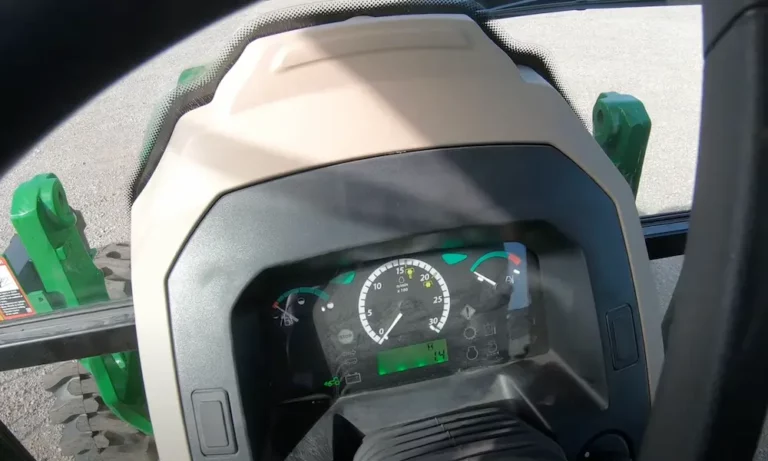
That little exhaust icon just lit up on your John Deere dash. Now what? If you’ve never dealt with a diesel particulate filter before, these warning lights can feel like a foreign language. Ignore the wrong one, and you could be looking at an engine derate—or a filter replacement bill north of $4,000. This guide breaks down every John Deere regen symbol, what triggers it, and exactly what you should do when you see it.
What “Regen” Actually Means
Regen is short for regeneration. It’s how your machine cleans soot out of its diesel particulate filter (DPF) by burning it off with heat. Think of it like a self-cleaning oven, but for your exhaust system.
John Deere built this into every Tier 4 machine to meet strict EPA emissions rules. Since the filter traps soot instead of letting it out the tailpipe, that soot has to go somewhere. Regen burns it into a tiny bit of ash instead.
The System Behind the Symbols
Before you can read the dashboard, it helps to know what’s actually happening under the hood.
Exhaust leaves the engine and hits the Diesel Oxidation Catalyst first. This part breaks down carbon monoxide and unburned fuel using a chemical reaction. Next, exhaust flows through the Diesel Particulate Filter, which physically traps soot particles before they leave the exhaust pipe.
On Final Tier 4 machines, there’s a third piece: Selective Catalytic Reduction (SCR). This system sprays Diesel Exhaust Fluid (DEF) into the exhaust stream to convert nitrogen oxides into harmless nitrogen and water vapor.
All three parts need monitoring. That’s where the dashboard symbols come in.
John Deere Regen Symbols You’ll See on the Dash
Every John Deere machine—from compact tractors to big loaders—uses a standard set of icons on the corner post display or Generation 4 CommandCenter screen. Here’s what they look like and what they mean.
| Symbol | What It Looks Like | What It Means | What You Should Do |
|---|---|---|---|
| Exhaust Filter Indicator | Filter icon with wavy lines through it | Soot level is high, or auto-cleaning got turned off | Turn on auto cleaning, or run a parked regen if it’s safe |
| High Exhaust Temp Indicator | Exhaust pipe with heat waves or a thermometer | Active cleaning is happening now, or temps are high enough to start | Keep working. Don’t park near dry grass or anything flammable |
| Auto Cleaning Disabled | Filter icon with a slash through it | You (or someone) manually disabled auto regen | Turn it back on once you’re in a safe spot |
| Diesel Exhaust Fluid Indicator | Exhaust pipe with a droplet, or a fuel gauge icon | DEF tank is running low | Refill with quality DEF fluid ASAP |
Not sure your exact machine? The icons stay consistent across most Deere equipment, but your owner’s manual will have the exact layout for your model.
When Symbols Combine: Warning Light Escalation
Sometimes the exhaust filter symbol pairs up with a general warning light. That combo tells you the situation is getting serious.
| Combo | What’s Going On | What Happens to Your Engine |
|---|---|---|
| Yellow/Amber warning + Exhaust Filter icon | Soot is critically high or there’s a system fault | Engine power drops (primary derate) |
| Red Stop Engine + Exhaust Filter icon | Extreme soot load or major aftertreatment failure | Severe power loss, possible PTO shutdown |
If you see the red combo, don’t keep pushing the machine. Shut it down and get it to a dealer. At this stage, parked regen gets locked out completely, and only a technician with special software can fix it.
The 5 Types of Regen John Deere Uses
Not all regens are the same. Deere built five different levels into the system, depending on how hard the soot buildup is fighting back.
Passive Regen This happens automatically while you’re working the machine hard. Exhaust temps naturally climb high enough (usually 842–1022°F) to burn soot without any help from the computer. No lights, no fuss. This is why running your equipment under decent load is actually good for it.
Enhanced Passive Regen If loads are lighter or it’s cold out, the engine control unit nudges things along. It partially closes the air intake and tweaks fuel timing to boost exhaust heat slightly. Still invisible to you—no dashboard lights, no extra fuel used.
Active Regen This is the one you’ll actually notice. When soot builds up too much for passive methods, the system injects extra fuel into the exhaust stream to spike temps up to 1022–1202°F. The High Exhaust Temperature light comes on during this. You might hear a slight whistle or notice higher idle. Just keep working—the machine handles this on its own.
Parked Regen When active regen can’t keep up (usually from too much idling or disabling auto-clean too often), the system asks you to stop the machine entirely and let it run a stationary cleaning cycle. This takes 30–45 minutes.
Recovery Regen This is the emergency-level cleanup. It only happens at a dealer, using diagnostic software to slowly and carefully burn off an extreme soot load without cracking the filter.
How to Run a Parked Regen (Step by Step)
When your machine asks for a parked exhaust filter cleaning, you can’t just idle it and walk away. There are safety checks the machine needs before it’ll start.
Before you start, make sure:
| Requirement | Why It Matters |
|---|---|
| Transmission in neutral/park | Machine can’t be moving during the RPM surge |
| Parking brake engaged | Stops rolling or creeping during the process |
| PTO disengaged | Keeps attached implements from suddenly spinning |
| Engine at low idle | Computer needs a stable starting point |
| Coolant above 140°F | Cold engines can’t handle the heat spike safely |
| Fuel above 1/8 tank | Prevents air pockets in the fuel system |
If any of these aren’t met, your display will tell you exactly what to fix (“Shift to Neutral,” “Apply Park Brake,” etc.).
To start the cleaning:
- Park on a hard, non-combustible surface (no dry grass, no fuel storage nearby)
- Lower any hydraulic attachments to the ground
- Press and hold the parked cleaning switch for 5 seconds until the LED blinks
- Release, then press again for 3 seconds until the LED goes solid
The engine will rev up on its own to around 2,200 RPM. A progress bar on the display tracks the cleaning from 1% to 100%. Don’t shut off the key or shift gears mid-cycle unless it’s a genuine emergency—stopping early means the soot’s still in there, and you’ll be right back where you started.
What Happens If You Keep Ignoring the Symbols
Here’s the part nobody likes to hear. If you keep disabling auto-clean, avoid parked regens, or run the machine mostly at idle, the soot keeps piling up. Eventually you hit a wall.
The dashboard shows the red Stop Engine light. The engine control unit cuts power hard—limp mode, basically. At this point, you can’t even trigger a parked regen from the cab anymore. The system won’t let you, because burning off that much soot at once risks melting the filter’s ceramic core or starting a fire.
Getting out of this requires a dealer visit. A technician runs a Recovery Regen using Service Advisor software to slowly clear the buildup. If the filter’s clogged with ash instead of soot (ash doesn’t burn off, ever), it has to be physically removed and cleaned—or replaced. That’s a bill that can run $4,000 to $10,000 depending on the machine.
Bottom line: a 30-45 minute parked regen is way cheaper than a dealer tow and a new filter.
Diagnostic Trouble Codes Worth Knowing
Beyond the basic symbols, John Deere machines throw specific fault codes when something’s off. Here are the ones you’ll run into most:
| Code | What It Means |
|---|---|
| DTC 3695.14 | Filter needs cleaning, but auto-regen is disabled |
| DTC 3719.16 | Parked cleaning required, engine already derated |
| DTC 3719.00 | Filter critically restricted—dealer intervention required |
| DTC 3720.16 | Ash cleaning needed (backpressure stays high after regen) |
If you’re comfortable digging into diagnostics yourself, tools exist to read and clear certain codes without a dealer visit, though anything involving ash cleaning or terminal restriction really does need the dealer’s specialized equipment.
DEF Symbols and Cold Weather Headaches
DEF has its own set of warnings, separate from the soot-related ones. When the tank drops below 10%, you’ll get a flashing indicator and an audible alarm. Ignore it, and the fluid level hits zero—the engine control unit derates power to force compliance. No fluid, no full power. That’s just how the regulations work.
Cold weather adds another wrinkle. DEF freezes solid at 12°F. Deere builds in heaters for the tank and lines, plus a grace period (usually 40-70 minutes) for everything to thaw before the engine derates.
One code that trips people up in winter is SPN 4354. This points to a failed DEF line heater—usually an electrical short or corroded connector. Even if your main tank thaws fine, frozen fluid stuck in the supply lines still throws this code and eventually forces a derate. Fixing it typically means replacing the heated hose assembly.
Keep Your Regen System Healthy
A few habits go a long way toward avoiding all these warning lights in the first place:
- Use low-ash oil. Regular oil leaves behind heavy metal deposits that clog the filter permanently. Stick with API CJ-4 or newer specs.
- Stick to ultra-low sulfur diesel. Higher biodiesel blends (above B20) create heavier soot loads and can cost you 2-3% in power and fuel economy.
- Avoid excessive idling. Light loads and idle time are the #1 cause of frequent parked regen requests.
- Don’t overuse the disable switch. It’s there for genuine safety situations (like parking near dry brush), not convenience.
- Respond to parked regen requests right away. Waiting just makes the eventual cleaning take longer—or pushes you into derate territory.
Fleet managers running multiple machines can also lean on JDLink telematics to catch problems early. The system tracks regen history, idle time, and exhaust temps across your whole fleet, then flags patterns—like frequent aborted regens—before they turn into a $10,000 filter replacement. Dealers even offer Expert Alerts that ping you directly when something looks off.
Final Thoughts
John Deere regen symbols aren’t just dashboard clutter—they’re your machine talking to you before things get expensive. The exhaust filter icon, the high temp light, the disabled cleaning slash—each one tells you something specific about what’s happening inside your emissions system.
Learn the basic sequence: passive regen handles itself, active regen needs no action but should run uninterrupted, and parked regen needs you to stop and let the machine do its thing for 30-45 minutes. Respect that sequence, and you’ll rarely see a red warning light. Ignore it repeatedly, and you’re looking at derates, dealer visits, and filter bills that hurt way more than a half-hour delay ever would.