Your engine mounts are the unsung heroes holding your powertrain in place. When they fail, your whole car feels it. Here’s exactly how long engine mounts last, what kills them early, and how to spot trouble before it costs you thousands.
What Does an Engine Mount Actually Do?
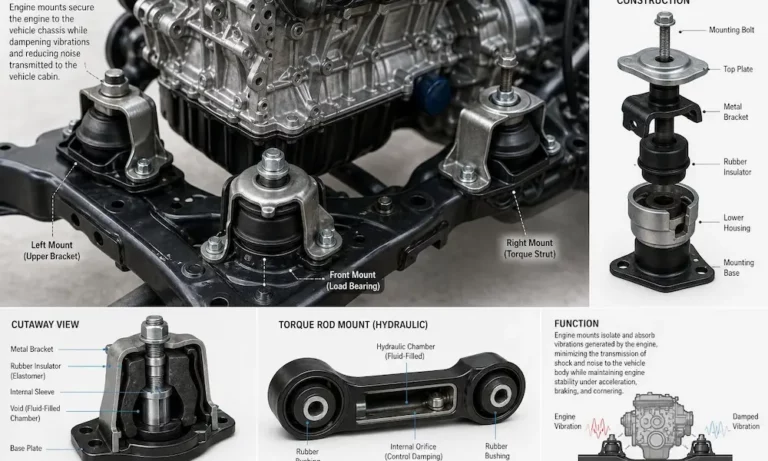
An engine mount sits between your engine and the car’s frame. It does two jobs at once: it holds the engine in place, and it absorbs the vibrations your engine produces at thousands of RPMs.
Most passenger cars use three or four mounts to support the engine and transmission assembly. Think of them as shock absorbers for your powertrain. Without them, every idle, gear change, and hard acceleration would rattle straight into the cabin.
They’re built to wear out — that’s by design. Mounts act as structural fuses, absorbing stress so your engine block and frame don’t have to.
How Long Do Engine Mounts Last?
The honest answer? It depends on the type of mount in your car.
Here’s a quick breakdown of how long do engine mounts last by material:
| Mount Type | Typical Lifespan | Mileage Range | Maintenance Needed |
|---|---|---|---|
| Solid Rubber | 5–7 years | 60,000–100,000 miles | Visual inspection only |
| Hydraulic | 5–8 years | 50,000–90,000 miles | Watch for fluid leaks |
| Polyurethane | 10+ years | 100,000+ miles | Grease every 6–12 months |
| Electronic (Active) | 5–7 years | 60,000–80,000 miles | Software/electrical check |
The sweet spot for most American drivers is around 75,000 miles before mounts start showing their age. But that number shifts fast depending on how and where you drive.
Rubber Mounts
Rubber mounts are the most common type found in sedans and light trucks. They bond high-density rubber to metal plates to absorb energy. Quality rubber mounts can last five to seven years, and premium OEM versions can push to 100,000 miles. Once the rubber hardens and cracks, it stops absorbing vibration — and that’s when you feel it.
Hydraulic Mounts
Hydraulic mounts use fluid-filled chambers to dampen vibration. They’re common in luxury vehicles and modern sedans. They last about as long as rubber mounts in years, but their failure mode is different. When the internal seals give out, the fluid leaks, and the mount collapses almost immediately. Failures in the 50,000-mile range aren’t rare, especially in stop-and-go city traffic.
Polyurethane Mounts
Polyurethane mounts are primarily an aftermarket upgrade for performance vehicles. They’re three to eight times stiffer than rubber, which improves throttle response. The trade-off? About 15 extra decibels of cabin noise. On the plus side, polyurethane resists oil and chemical damage far better than rubber. They can technically last the life of the vehicle — but they need silicone grease every six to twelve months or they’ll squeak and wear out prematurely.
Electronic (Active) Mounts
If you drive a Honda Pilot, Odyssey, or any vehicle with cylinder deactivation, you likely have active electronic mounts. When the engine drops cylinders to save fuel, it creates a noticeable vibration. These mounts contain a solenoid that vibrates at a cancelling frequency to mask it. The problem? They’re always working, even at highway cruise. That constant activity wears them out faster — often by 60,000 to 80,000 miles — and they cost roughly triple a standard mount to replace.
What Kills Engine Mounts Early
Knowing how long engine mounts last is only half the story. Here’s what shortens that lifespan dramatically.
Heat
Heat is the primary enemy of rubber mounts. Engine bays near exhaust manifolds frequently reach temperatures above 194°F, which causes rubber to harden and crack within three to five years in hot climates like the American Southwest. Drivers in cooler regions can often squeeze two extra years out of their mounts simply because the rubber spends less time at extreme temperatures.
Fluid Contamination
Engine oil, coolant, and power steering fluid are all destructive to rubber. If a leak drips onto a mount, the chemicals penetrate the rubber and cause it to swell and separate from the metal plates. Service data suggests oil saturation can cut a mount’s lifespan in half — regardless of mileage. Fix your leaks before they eat your mounts.
Road Conditions
Potholes, rough roads, and the broken pavement common in the American Rust Belt deliver high-amplitude shock loads to your mounts. These sudden jolts can tear the rubber webs or burst a hydraulic mount’s internal diaphragm. Urban stop-and-go traffic stresses mounts far more than steady highway driving because of the constant torque-loading during acceleration.
Aggressive Driving
Hard standing starts, rapid throttle changes, and aggressive braking all place the engine under heavy torsional stress. In high-torque vehicles — think big V8 trucks or turbocharged sedans — this can physically lift the engine on its mounts. Drivers with manual transmissions who slip the clutch or make rough gear changes add extra shock loads with every shift.
Signs Your Engine Mounts Are Failing
There’s no scheduled replacement interval for engine mounts, so you need to watch for the symptoms.
You Feel More Vibration
The earliest sign is increased vibration through the chassis. You’ll notice it most while idling at a stoplight, especially when the AC kicks on or the transmission is in Drive. The vibration shows up in the steering wheel, the seat, or the floor. As the mount wears, the cabin essentially becomes a sounding board for the engine.
You Hear Clunking or Banging
As a mount progresses from worn to broken, the noises get louder. Metal-on-metal contact between the engine bracket and the frame creates clunking or thumping sounds. Watch for these specific triggers:
- At startup or shutdown: A violent lurch or thud when the engine fires or stops
- Shifting gears: A distinct thump when going from Park to Drive or Reverse
- Hard acceleration: A bang during a quick throttle push or when you lift off the gas
Visual Signs During Inspection
A technician can confirm a bad mount by engaging the parking brake, pressing the foot brake, shifting into gear, and applying light throttle while someone watches the engine. Normal movement is a small, controlled rock. If the engine lifts several inches or tilts sharply, the mount is gone.
Visual checks can also reveal:
- Cracked, flaking, or dried-out rubber surfaces
- Fluid staining on hydraulic mounts
- The engine sitting lower on one side
- Shiny contact marks on the frame where the engine has been hitting
| Symptom | Mount Type Affected | Severity |
|---|---|---|
| Idle vibration | Rubber / Hydraulic | Low to moderate |
| Bang on startup | Any type | High |
| Thump when shifting | Torque strut | Moderate |
| Fluid visible on mount | Hydraulic | High — replace now |
| Engine visibly sagging | Any type | High |
What Happens If You Ignore a Bad Mount
Driving on a failed mount isn’t just uncomfortable — it’s expensive. A bad mount sets off a chain reaction of damage.
Cooling system damage: Your radiator is fixed to the frame. The engine moves. Those two components connect through flexible hoses. A shifting engine stretches those hoses beyond their limits, causing cracks, coolant leaks, and potential overheating. In extreme cases, the engine can push the cooling fan directly into the radiator core.
Exhaust damage: The exhaust manifold bolts to the engine. The rest of the pipe hangs from the chassis. An engine rocking on bad mounts uses the exhaust as a lever, cracking manifolds and breaking flex joints. That means loud exhaust leaks and potentially dangerous fumes entering the cabin.
Drivetrain misalignment: In front-wheel-drive vehicles, a sagging mount changes the angle of your CV joints and driveshafts. This causes premature CV joint wear, highway shimmies, and accelerated tire wear. It can also damage the transmission’s internal bearings over time.
Mount failure cascade: One broken mount puts its entire load on the remaining three. They weren’t designed for that. The other mounts often fail within weeks of the first.
| Collateral Damage | Estimated Repair Cost |
|---|---|
| Radiator hoses | $150–$350 |
| Exhaust flex pipe | $200–$600 |
| CV joint / axle | $300–$800 |
| Cooling fan | $400–$900 |
| Wiring harness | $500–$2,000+ |
How Much Does Engine Mount Replacement Cost?
Cost varies a lot based on your vehicle and where you take it.
Labor is the biggest factor. A simple torque strut on top of the engine might take 30 minutes. But many lower mounts require removing the subframe, disconnecting steering components, or supporting the engine with a hoist. Independent shops charge $75–$150 per hour. Dealerships run $150–$250 per hour. A four-hour job can exceed $800 in labor alone.
Parts vary too. OEM mounts are the most expensive but offer the most predictable lifespan. Quality aftermarket brands often meet or beat factory specs at 20–40% less cost. Budget aftermarket mounts use harder, lower-quality rubber and may fail within a year.
| Vehicle Type | Part Cost (1 Mount) | Labor Hours | Total Estimate |
|---|---|---|---|
| Compact sedan (e.g., Civic) | $50–$120 | 1–2.5 hrs | $450–$650 |
| Mid-size sedan (e.g., Camry) | $80–$200 | 1.5–3 hrs | $600–$850 |
| Full-size truck (e.g., F-150) | $100–$250 | 2–4 hrs | $550–$950 |
| Luxury SUV (e.g., BMW X5) | $250–$600 | 3–6 hrs | $1,200–$2,500+ |
Should you replace all mounts at once? Most mechanics say yes. Replacing mounts in pairs or as a full set makes sense because all your mounts are the same age and lived in the same conditions. One new stiff mount next to three soft old ones can actually make vibration worse, not better.
How to Make Your Engine Mounts Last Longer
You can’t stop time, but you can slow the clock down.
- Fix fluid leaks fast. Oil dripping on a mount can cut its life in half. Don’t let small leaks linger.
- Drive smoothly. Hard launches and rough gear changes put serious stress on mounts. Smooth inputs add miles to their life.
- Get regular inspections. ASE-certified technicians check mounts during routine service. After 75,000 miles, ask for a physical torque test to confirm the mounts haven’t gone soft.
- Choose quality parts. A cheap mount that fails in 12 months costs you more than an OEM mount that lasts seven years.
- Grease polyurethane mounts. If you’ve got performance mounts, don’t skip the silicone grease schedule. It’s cheap insurance.
The bottom line on how long engine mounts last: plan for five to seven years and 60,000 to 100,000 miles under normal conditions. Push harder, live somewhere hotter, or let fluid leaks go unchecked — and you’ll be replacing them sooner. Treat your car well, and a quality mount in a temperate climate can genuinely last 150,000 miles.