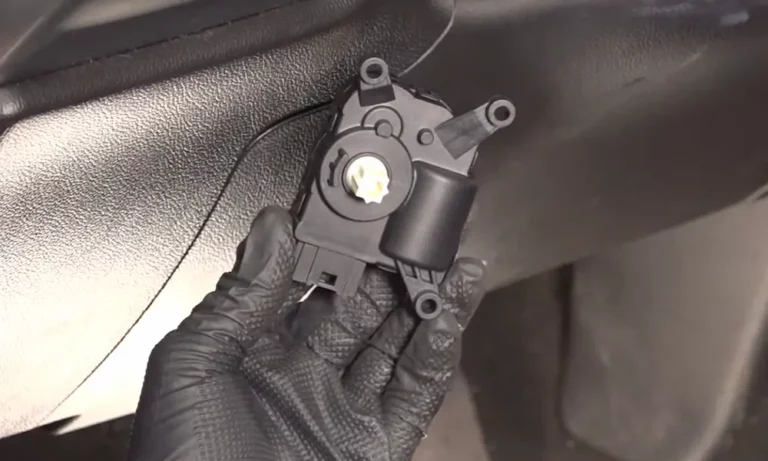
Your car’s blowing hot air when you want cold, or cold air when you want heat. A shop mentioned a “blend door actuator.” Now you’re staring at an estimate wondering how a part that fits in your palm costs this much. This post breaks down exactly how much a blend door actuator costs — and why the final bill can swing from $150 to $2,500.
What Is a Blend Door Actuator, Anyway?
It’s a small electric motor inside your dashboard. It moves a plastic flap — called a blend door — that mixes hot and cold air to hit the temperature you set. When it fails, your climate control stops responding. You get stuck blowing only hot or only cold air, no matter what you do.
There are actually three types:
- Temperature blend door actuator — controls hot/cold air mixing
- Mode door actuator — controls which vents the air flows through
- Recirculation door actuator — controls whether the system pulls in fresh air or recirculates cabin air
Each actuator does a different job, so misidentifying which one failed wastes your money before the repair even starts.
How Much Does a Blend Door Actuator Cost Just for the Part?
The part itself is genuinely cheap. Here’s what you’ll find across major retailers:
| Retailer | Price Range | Brands |
|---|---|---|
| RockAuto | $2 – $30 | Dorman, Generic |
| CarParts.com | $15 – $250 | AISIN, GPD, A-Premium |
| AutoZone | $32 – $67 | Duralast |
| Advance Auto Parts | $40 – $61 | Dorman, Motorcraft |
| NAPA Auto Parts | $19 – $132 | NAPA, ACDelco |
| O’Reilly Auto Parts | $54 – $60+ | ACDelco, Murray |
| Walmart (Online) | $30 – $65 | Global HVAC, Generic |
Budget options on RockAuto start as low as $2.19 for older vehicles. Duralast units at AutoZone run $31–$67 and come with a limited lifetime warranty. NAPA’s range is wide — from $19 up to $132 for heavy-duty units.
OEM parts from a dealership cost more — typically $80–$200 — but they carry manufacturer backing and guaranteed fitment.
OEM vs. Aftermarket: Which Should You Buy?
OEM is the safe bet if you want zero fitment guesswork. Aftermarket from trusted names like Dorman or ACDelco works fine for most vehicles and saves real money. Skip completely unbranded generic units on older high-mileage cars — the internal plastic gears can fail fast.
Why Does the Total Repair Cost So Much More Than the Part?
Here’s the honest answer: you’re not paying for the part. You’re paying for labor.
A blend door actuator might cost $40 at a parts store. But reaching it can require a mechanic to tear apart your entire dashboard — removing airbags, the steering column, the infotainment system, and every interior trim panel. That process can take six to eight hours.
At a national average labor rate of $140/hour at an independent shop, six hours of labor alone hits $840. Before parts. Before diagnostic fees. Before taxes.
How Labor Rates Vary by Shop and Location
| Shop Type | Typical Hourly Rate |
|---|---|
| Rural independent shop | $85 – $135 |
| National average independent | $120 – $159 |
| High-cost metro independent | $170 – $200 |
| Standard franchised dealership | $120 – $250 |
| Metro Ford dealership (Chicago) | $210 – $249 |
| Mercedes dealership (Chicago area) | Up to $450 |
Dealerships consistently charge $20–$40 more per hour than independent shops in the same market. That premium adds up fast on a six-hour job.
Also worth knowing: mechanics work on a flat-rate system. If the labor guide says your car takes five hours, you pay for five hours — regardless of how long it actually takes. The shop sets the door rate; the mechanic earns a fraction of it.
The Three Cost Tiers: What Will You Actually Pay?
Tier 1: Accessible Actuator (Budget Repairs)
Some vehicles — mostly older domestic models and trucks — have actuators you can reach by removing a glove box or kick panel. No dashboard teardown. Total labor: one to two hours.
Expected total: $130 – $450
Real-world examples:
- GMC Terrain: $133 – $156 total
- Honda Civic: $193 – $225 total
- Honda CR-V: $219 – $252 total
Tier 2: Moderate Dashboard Disassembly (Mid-Range)
Most modern cars fall here. Center console removal, partial dashboard disassembly, three to four hours of labor. Independent shop, national average rates.
Expected total: $360 – $700
Real-world examples:
- Nissan Altima: $376 – $422
- GMC Sierra 1500: $499 – $696
- 2016 Jeep Wrangler: ~$500 at an independent shop (including OEM part at $190 and two hours of labor)
Tier 3: Full Dashboard and Airbag Removal (Premium)
This is where costs get serious. The actuator sits deep against the firewall. The mechanic pulls the entire dash, drops the steering column, removes airbags, and sometimes drains coolant to extract the HVAC housing.
A 2020 Ford F-150 blend door actuator replacement requires a full instrument panel removal — that’s a six-hour flat-rate job right there. At $150/hour, that’s $900 in labor alone before parts.
Expected total: $700 – $2,500+
Real-world examples:
- Toyota Camry: $774 – $1,035 — surprisingly expensive due to HVAC placement
- GMC Yukon: $992 – $1,359
- 2011 Nissan Frontier: ~$1,000 total — $50 part, full dash removal required
- 2016 Ford Expedition (dealership quote): $2,500 for one driver-side actuator
Don’t Forget the Diagnostic Fee
Before any repair starts, the shop has to confirm which actuator failed. This isn’t a quick code scan. The technician manually tests each vent setting, checks voltage at the actuator wires, and often uses a bidirectional scan tool to command the motor directly.
This diagnostic process takes 30 minutes to 1.5 hours and typically costs $50 – $200. Many independent shops waive this fee if you authorize the repair with them. Dealerships usually don’t.
Hidden Costs That Can Raise Your Bill
Broken Linkage Arms
The actuator connects to the blend door through small plastic arms. These crack and strip just as often as the motor itself. If the arm is broken, add $50 – $150 in parts and another 30–60 minutes of labor.
A Jammed Blend Door
If debris falls into your defroster vents and jams the door, the actuator will burn itself out trying to force movement. Simply replacing the motor doesn’t fix a jammed door. The door itself may need to come out — and in some cases, the entire HVAC housing needs replacement.
The Calibration Reset
After installation, the computer must “learn” the new actuator’s position limits. Skip this step and the new motor will hyperextend, strip its own gears, and fail immediately.
Some vehicles need a manual fuse-pull reset — remove the HVAC fuse for 15 seconds, reinstall, then let the system sweep through its full range without touching the controls for 40 seconds. Others need bidirectional scan tool reprogramming. Either way, calibration is non-negotiable — and it’s already baked into the labor time.
Can You DIY a Blend Door Actuator Replacement?
Sometimes — depends entirely on your vehicle.
DIY is reasonable if:
- The actuator is accessible from under the dash without major disassembly
- You’re comfortable with basic electrical work and removing trim panels
- Your vehicle doesn’t require airbag deactivation to access the unit
Don’t DIY if:
- The repair requires airbag removal — mishandling an airbag during a dashboard teardown is a legitimate safety risk
- The steering column has to come out — improper reassembly compromises steering and safety systems
- You’re not confident performing the post-installation calibration correctly
A complete DIY guide is available here if you want to assess whether your specific vehicle is a reasonable candidate.
How to Get the Best Price on This Repair
Get three quotes. Labor rates vary dramatically between shops — even within the same city. A shop charging $120/hour versus one charging $170/hour saves you $300 on a six-hour job.
Supply your own part. Buy an aftermarket actuator from RockAuto or CarParts.com and ask if the shop will install a customer-supplied part. Some won’t. Many independents will, especially if you’re paying cash.
Skip the dealership for older vehicles. Once your car is out of warranty, there’s no functional reason to pay dealership labor rates for a non-warranty repair. An independent shop with good reviews does the same job for significantly less.
Ask the shop to waive the diagnostic fee. If you’re authorizing the repair on the spot, most independent shops will credit the diagnostic cost toward your total bill.
Check if only one zone is failing. Modern dual-zone systems have at least four actuators. If only the passenger side is stuck, you may only need one replaced — not all four.
The Bottom Line on Blend Door Actuator Costs
The part costs $20 – $200. The labor costs everything else.
A quick, accessible repair on a simple vehicle at an independent shop runs $130 – $450. A full dashboard teardown on a modern truck or SUV at a dealership can hit $1,000 – $2,500 without breaking any rules.
Before you agree to any estimate, ask the shop one question: Does this repair require full dashboard removal? That single answer tells you which cost tier you’re in — and whether it’s time to shop around.