You’ve probably seen a VinFast SUV on the road and thought, “Wait, where did that come from?” The answer is way more complicated than you’d expect. Understanding who actually makes these cars involves three continents, one Vietnamese billionaire, and a supply chain that reads like a global treasure hunt. Stick around — this gets interesting.
VinFast Is a Vietnamese Brand With Deep Roots
VinFast cars come from Vietnam. Specifically, they’re made by VinFast Auto Ltd., a company founded in June 2017 as part of the massive Vingroup conglomerate — Vietnam’s largest private corporation.
But here’s the twist: Vingroup started in Ukraine in 1993, selling instant noodles under the Mivina brand. The founder, Phạm Nhật Vượng, parlayed that food business into a real estate and hospitality empire back in Vietnam before deciding to build cars. Yes, really.
Today, Vingroup runs hospitals, schools, hotels, shopping malls, and now electric vehicles. At its peak in 2022, the conglomerate’s revenues accounted for over 1% of Vietnam’s entire GDP and employed more than 51,000 people.
The Billionaire Who Controls Everything
When you buy a VinFast, you’re buying a car made by a company that one man effectively controls entirely. Phạm Nhật Vượng owns roughly 99.7% of the outstanding voting stock through Vingroup and two private investment entities he controls personally.
The company listed on Nasdaq in August 2023 under the ticker VFS, but don’t let the public listing fool you. The public float sits at approximately 3%, which makes the stock wildly volatile and leaves almost zero room for outside shareholders to influence company direction.
This structure lets VinFast pivot fast — sometimes impressively fast. But it also concentrates enormous risk in a single person’s decisions.
Where VinFast Cars Are Actually Built
The primary factory sits in Haiphong, Vietnam, in the Đình Vũ – Cát Hải Economic Zone. This 335-hectare facility, partially built on reclaimed sea land, went from concept to operational in just 21 months. That’s genuinely remarkable for a greenfield auto plant.
Current capacity: 300,000 vehicles per year. Planned capacity by 2026: 950,000 units annually.
But Haiphong isn’t the only place VinFast cars get built anymore.
VinFast’s Growing Global Factory Network
| Factory Location | Status | Annual Capacity | Primary Market |
|---|---|---|---|
| Haiphong, Vietnam | Fully operational since 2017 | 300,000 units (target: 950,000) | Global export + domestic |
| Chatham County, North Carolina, USA | Halted — active state lawsuit | Originally 150,000 units | North America |
| Thoothukudi, Tamil Nadu, India | Operational since 2025 | 50,000 (target: 150,000) | South Asia + export |
| Subang, West Java, Indonesia | Operational since December 2025 | 50,000 units | Southeast Asia (RHD models) |
The India plant is notable because it’s the first VinFast facility outside Vietnam. It crossed 10,000 units produced shortly after opening and can eventually scale to 150,000 vehicles per year, creating over 3,000 local jobs.
The Indonesia plant in Subang was built in just 17 months and targets a localization rate of 40% in year one, rising to 80% by 2030 — a smart move to dodge import tariffs and align with the Indonesian government’s EV push.
Who Actually Designs and Engineers VinFast Cars?
This is where the answer to who makes VinFast cars gets genuinely fascinating. VinFast doesn’t operate like a traditional automaker. It acts more like a systems integrator — it buys the best expertise globally and assembles it into a finished product at high speed.
Here’s how that breaks down:
Italian Hands Shaped the Look
VinFast hired Pininfarina and ItalDesign — two of Italy’s most storied automotive styling houses — to design its vehicles. In a quirky move during the brand’s early days, Vietnamese consumers actually voted on their favorite design concepts submitted by these firms.
The winning designs were purchased outright for around $5 million each, giving VinFast European-caliber styling right out of the gate.
Austrian Engineers Built the Bones
The underlying platforms — the chassis, suspension geometry, and vehicle architecture — were engineered by Magna Steyr and AVL, two premier Austrian automotive engineering firms. Magna Steyr alone deployed over 400 dedicated engineers to develop VinFast’s foundational platforms from scratch.
Before VinFast pivoted fully to EVs, it also licensed platform technology directly from BMW for its early internal combustion models.
German Tech Runs the Software and Factory
Bosch supplied critical electronic control units, software solutions, and factory management systems. Siemens and SAP handle industrial automation and data infrastructure. VinFast even partnered with Bosch to give European drivers access to 700,000 charging points across 30 countries.
Paint shop equipment comes from German supplier Dürr. The factory robots came from Guangzhou MINO Equipment in China.
Chinese Suppliers Power the Core
The single most expensive and important component in any EV — the battery pack — comes from China. VinFast sources battery cells from CATL (Contemporary Amperex Technology Company Limited) and Gotion High-Tech, two of the world’s dominant EV battery makers.
That’s just the beginning. A deep dive into the supply chain reveals:
| Component | Supplier | Country |
|---|---|---|
| Battery cells | CATL, Gotion High-Tech | China |
| Electric motors | Haosen | China |
| Thermal management (water pumps, valves) | Feilong Auto Components | China |
| Millimeter-wave radar (ADAS sensors) | Intron Technology | China |
| Head-up display units | Foryou Corporation | China |
| Battery pack assembly | Weitang Industrial | China |
| Semiconductor chips | Renesas Electronics | Japan |
| Platform engineering | Magna Steyr, AVL | Austria |
| Exterior design | Pininfarina, ItalDesign | Italy |
| Software and ECUs | Bosch | Germany |
The bottom line: the majority of core internal components come from China, wrapped in Italian styling on an Austrian-engineered chassis, all assembled in Vietnam.
VinFast in the United States: Ambition Meets Reality
VinFast set up its North American headquarters in Los Angeles, California — specifically in Playa Vista, the tech-dense neighborhood known as “Silicon Beach.” Smart positioning. The execution, however, has been messier.
The VF8’s Rocky American Debut
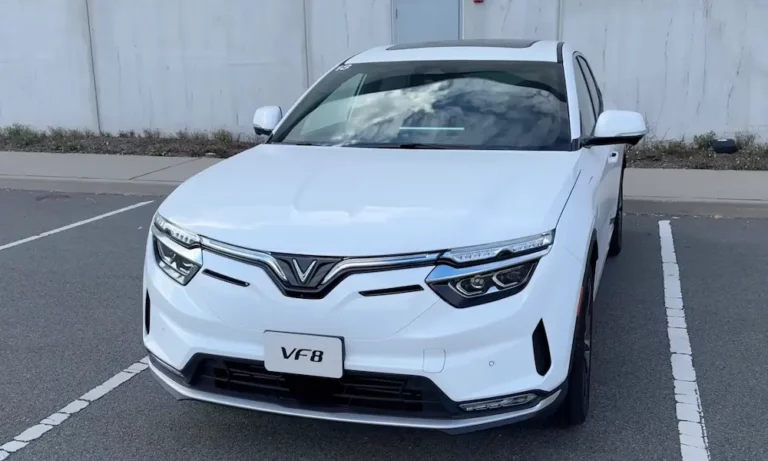
The VF8 SUV led VinFast’s US launch, and early reviews were brutal. Critics cataloged harsh suspension that caused motion sickness, glitchy software requiring mid-drive reboots, and unreliable proximity sensors. The electric range came in at a disappointing 235 miles from an 87 kWh battery. At a ~$46,000 base price, the value case fell flat.
VinFast improved the car rapidly — the subsequent “Plus” edition eliminated squeaks, reduced cabin noise, and stabilized the ride. But issues persisted: push-button gear selectors that missed inputs, persistent false alarm warnings, and screens that needed manual reboots.
NHTSA Stepped In
Federal regulators opened a formal investigation — NHTSA PE24025 — into the VF8’s Lane Keep Assist system, covering over 3,000 vehicles. Drivers reported the automated steering fighting their inputs and dragging the car toward lane boundaries, significantly raising collision risk.
NHTSA’s own test center replicated the problem. VinFast responded with a voluntary recall — Recall No. 25V-559 — deploying an over-the-air software update to reduce steering vibration and smooth the transition between active and inactive assistance modes. The investigation closed with no fatalities linked to the defect.
A separate hardware recall followed for a more serious issue: the center airbag’s cushion shape and deployment angle could cause it to inflate between a driver’s arm and torso during side impacts — potentially injuring rather than protecting occupants. VinFast issued Recall 24V-933 to physically replace the entire center airbag assembly.
The North Carolina Factory Fiasco
In 2022, VinFast signed an agreement with North Carolina to build a $4 billion factory in Chatham County — touted as the largest economic development project in state history. The promises were enormous:
- 7,500 jobs
- 150,000 vehicles annually
- Production start: summer 2024
None of it happened on schedule. VinFast pushed production start to 2028, quietly submitted plans for a much smaller facility, and slashed its job commitment to roughly 1,400 positions — an 80% reduction. The building permit expired in December 2024.
By January 2026, North Carolina issued a formal notice of default. In May 2026, the state’s Attorney General filed a lawsuit to reclaim the land and recover over $80 million in state funds already spent — with potentially another $125 million on the line in site preparation costs. VinFast recorded a $235 million impairment charge tied to the stalled project within its 2025 net loss of $3.9 billion.
The company refuses to sell the land and insists it still plans to build there eventually.
The Taxi Company That Inflates the Sales Numbers
Here’s a detail that every potential buyer should know. A large portion of VinFast vehicles don’t go to retail customers — they go to Green and Smart Mobility (Xanh SM), an all-electric taxi fleet founded by the exact same person who owns VinFast: Phạm Nhật Vượng.
In 2023, a staggering 72% of all VinFast deliveries went to this affiliated company. Capital moved from one of the founder’s pockets to another, and VinFast got to report impressive delivery growth to Nasdaq investors.
By Q3 2025, that figure dropped to 26% as organic retail sales grew. Green and Smart Mobility has since expanded into the Philippines and is now planning a Hong Kong IPO targeting a $2–3 billion valuation as early as late 2026.
The taxi fleet also served an unintended but useful purpose: it gave VinFast engineers real-world durability data from thousands of vehicles in continuous commercial use, feeding improvements directly back into vehicle development.
The Retail Strategy Keeps Shifting
VinFast started with a direct-to-consumer model — company-owned showrooms in California and managed delivery. That proved too expensive to scale across a country the size of the US. So it switched to a traditional dealer network, setting an ambitious target of 100+ dealer partners by end of 2025.
By early 2026, fewer than 20 active dealerships operated nationwide.
To move cars, VinFast leaned hard on subsidized leasing — some models available for under $200/month with zero down. The company also signed agreements with dozens of aftersales partners to build a global service network approaching 800 facilities, with a goal of delivering common spare parts within 24 hours in key markets.
An affordable subcompact — the VF3 — is planned for the US market, mirroring its wildly successful domestic launch in Vietnam where it generated tens of thousands of pre-orders in hours.
So, Who Makes VinFast Cars? Here’s the Short Answer
VinFast cars are designed in Italy, engineered in Austria and Germany, powered by Chinese components, and assembled primarily in Vietnam — all funded by a Vietnamese conglomerate controlled by one billionaire.
It’s not a traditional automaker. It’s an aggressively capitalized, extraordinarily fast-moving systems integrator that compresses decade-long development timelines into a few years by buying world-class expertise outright.
That model explains both its remarkable speed and its very public stumbles. The vehicles improved fast. The recalls got addressed. The North Carolina factory became a cautionary tale about overpromising. And the path forward — through India, Indonesia, and eventually North America — depends entirely on whether VinFast can stop assembling other people’s parts and start building something that feels unmistakably its own.